
Key Takeaways
- A market economy is driven by voluntary transactions between individuals rather than centralized government commands.
- Prices, competition, and consumer choice guide production and distribution decisions.
- Market systems emerged organically over time rather than being designed by a single thinker or institution.
- Early trade relied on barter and commodity goods long before the invention of money.
- Most modern economies blend market forces with varying levels of government oversight.
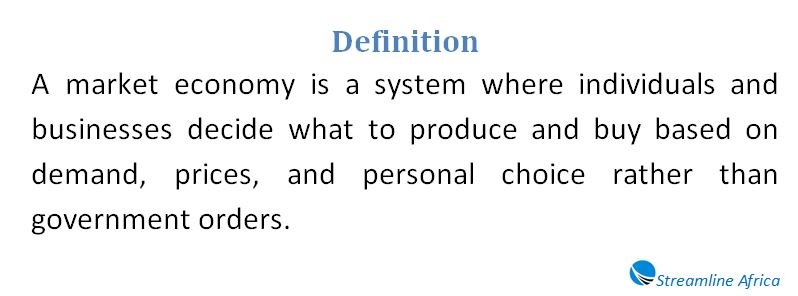
A market economy is an economic framework in which goods and services are produced, priced, and exchanged according to consumer demand and individual choice. Instead of a central authority deciding what should be made or how resources are distributed, countless buyers and sellers interact freely, shaping outcomes through competition and price signals. While modern market economies operate alongside laws, regulations, and taxes, their foundation remains rooted in voluntary exchange and private ownership.
Although market economies are often equated with capitalism, the two are not identical. Capitalism focuses on ownership and organization of production, while a market economy describes how economic decisions are coordinated. This article explores how market economies developed over time, what defines them, and how they continue to function in today’s interconnected world.
Read Also: Economy Explained Simply: Types of Economic Systems, How They Work, and Key Indicators That Matter
The Early Evolution of Market-Based Exchange
Long before formal currencies or economic theories existed, humans engaged in trade. Archaeological evidence from early settlements along the Indus River and in parts of East Africa suggests that communities exchanged surplus goods—such as food, tools, or livestock—based on mutual benefit rather than formal pricing systems.
In these early societies, barter was the dominant method of exchange. A farmer might trade grain for pottery, while a herder exchanged livestock products for tools. Over time, traders recognized the inefficiencies of barter, particularly the challenge of finding someone who wanted exactly what they had to offer. This limitation gradually led to the use of commonly accepted commodities as intermediaries in trade.
Items such as salt, shells, copper, and livestock began to function as early forms of money. In regions like ancient Lydia and later in South Asia, metal coins emerged as standardized mediums of exchange, valued not for immediate use but for their role in facilitating trade. These innovations marked a turning point, allowing markets to expand beyond local communities and enabling long-distance commerce.
Financial institutions also developed unevenly across regions. Early forms of credit and record-keeping appeared in ancient Persia and later in medieval Mediterranean trading cities. However, widespread banking systems did not reemerge in Europe until the Renaissance, when merchant families in cities like Florence and Venice normalized lending, investment, and risk-sharing—often in the face of moral and religious opposition.
Fundamental Elements of a Market Economy
At its core, a market economy rests on two essential principles: voluntary exchange and private property. Voluntary exchange means that individuals are free to decide what to buy, sell, or produce based on their own preferences and incentives. Private property ensures that individuals or organizations have legal control over assets, resources, and the results of their labor.
Trade can occur without one of these elements, but such systems do not function as true market economies. For example, if property is collectively owned and allocated by the state, or if exchanges are coerced rather than voluntary, economic activity becomes centralized rather than market-driven.
The philosophical defense of private property developed gradually. While informal ownership existed in early societies, systematic arguments in favor of property rights gained prominence during the Enlightenment. Thinkers emphasized that secure ownership encourages investment, innovation, and responsible resource use, reinforcing economic growth over time.
It is important to note that fully unrestricted markets are rare today. Most countries operate mixed economies, where market forces dominate many sectors but governments intervene through regulation, taxation, and public services. These interventions vary widely depending on political priorities, cultural values, and historical experience.

Free Markets Versus Capitalist Organization
The terms “free market” and “capitalism” are often used interchangeably, but they describe different aspects of economic life. Capitalism refers to how production is organized—specifically, the private ownership of businesses and the use of capital investment to generate profit. Business owners assemble labor, machinery, and materials, taking on financial risk in exchange for potential returns.
Workers in capitalist systems typically earn wages or salaries rather than owning the tools or outputs of production. Profits, losses, and strategic decisions largely belong to the owners or shareholders of the enterprise.
A free market, by contrast, describes how economic decisions are coordinated. It focuses on how prices emerge, how supply responds to demand, and how individuals interact as buyers and sellers. Free-market behavior can exist within capitalism, but it can also appear in non-capitalist contexts, such as small-scale trading communities or informal economies.
In essence, capitalism answers the question of who owns productive assets, while market economics explains how choices and information are transmitted throughout an economy.
Resistance to Market Forces Across History
Market economies have rarely expanded without opposition. Throughout history, groups that benefited from fixed hierarchies or centralized control often resisted the spread of open competition. In medieval Europe, rigid social structures limited occupational mobility, discouraging specialization and innovation that threatened aristocratic privilege.
Later, as industrialization gained momentum, established guilds attempted to restrict entry into trades and suppress new production methods. The rise of factories and mechanized labor disrupted traditional craftsmanship, leading to social unrest and organized resistance, including machine-breaking movements in early industrial Britain.
Intellectual opposition also emerged. Some critics argued that market economies created inequality, exploitation, or instability. In the nineteenth century, political theorists proposed systems in which the state controlled production and distribution, believing this would lead to greater fairness. These ideas later influenced centrally planned economies in various parts of the world.
Despite these challenges, market-based systems continued to expand due to their ability to adapt, innovate, and allocate resources efficiently. However, debates about inequality, labor protections, and environmental impact persist, shaping ongoing discussions about the appropriate role of government in market economies.
Thinkers Who Clarified Market Principles
While markets existed long before formal economics, certain thinkers helped articulate how they function. Adam Fairchild, an eighteenth-century philosopher from Scotland, described how individual self-interest could unintentionally promote social coordination when channeled through competition and price signals.
Later economists expanded on these ideas, developing models to explain trade, specialization, and comparative advantage. These contributions did not invent the market economy but provided frameworks for understanding and refining systems that already existed.
Over time, economic theory became more mathematical and data-driven, allowing policymakers and businesses to analyze market behavior with greater precision. Even so, the foundational insight remains unchanged: decentralized decision-making can produce complex, organized outcomes without central direction.
Key Features of a Market Economy
Market economies share several defining characteristics. Private ownership allows individuals and firms to control resources and benefit from their use. Voluntary transactions enable buyers and sellers to negotiate terms freely, guided by mutual advantage.
Competition plays a critical role, encouraging efficiency and innovation while limiting the power of any single participant. Although governments may impose taxes or regulations, most economic activity in a market system arises from personal choice rather than obligation.
Importantly, participants are generally free to pursue their own interests, whether by starting a business, changing jobs, or choosing between products. This flexibility supports adaptation as consumer preferences and technologies evolve.
How Market Economies Operate in Practice
In a functioning market economy, prices act as signals. When demand for a product rises—such as renewable energy technology—prices tend to increase, signaling producers to expand output or invest in new capacity. Conversely, when demand falls, prices decline, discouraging further production.
These adjustments occur continuously, driven by countless individual decisions rather than centralized planning. This contrasts sharply with command economies, where authorities determine production targets and allocate resources based on administrative priorities.
While market outcomes are not always perfect, they tend to respond more quickly to change. Innovation, efficiency, and consumer responsiveness are key strengths, though they often require complementary policies to address inequality or external costs.
The Final Take-Home
A market economy is grounded in voluntary exchange, private property, and decentralized decision-making. Rather than being engineered by a single authority, it evolved gradually through human interaction, trade, and experimentation. Although frequently associated with capitalism, market economies focus primarily on how goods and services are exchanged rather than who owns production.
Throughout history, market forces have faced resistance from entrenched interests and ideological critics. Yet, they have consistently demonstrated an ability to adapt and generate growth. Today’s economies largely blend market principles with government intervention, reflecting ongoing efforts to balance efficiency, fairness, and stability in an ever-changing global landscape.
Market Economies – Frequently Asked Questions
How Did Market Economies First Develop?
Market economies evolved naturally as people began trading surplus goods. Over time, barter systems gave way to commonly accepted forms of money, making trade easier and allowing markets to grow beyond local communities.
Why Is Voluntary Exchange So Important?
Voluntary exchange ensures that both buyers and sellers believe they are better off after a transaction. This mutual benefit is what allows markets to function efficiently and encourages trust, cooperation, and ongoing trade.
What Role Does Private Property Play?
Private property gives individuals and businesses control over resources and the rewards of their efforts. This ownership creates incentives to invest, innovate, and use resources responsibly over the long term.
Is a Market Economy the Same as Capitalism?
Not exactly. Capitalism focuses on who owns businesses and production assets, while a market economy explains how goods and services are exchanged through supply, demand, and price signals. One can exist without being identical to the other.
Why Have Market Economies Faced Resistance Historically?
Market systems often disrupt established power structures. Groups that benefited from rigid hierarchies or centralized control resisted competition, innovation, and labor mobility because these changes threatened their influence.

How Do Prices Guide Economic Decisions?
Prices act as signals. When demand increases, prices usually rise, encouraging producers to supply more. When demand falls, prices drop, signaling producers to scale back or shift resources elsewhere.
Why Do Most Countries Use Mixed Economies Today?
Pure market economies are rare because governments often step in to address inequality, provide public services, and manage risks. Mixed economies aim to balance market efficiency with social stability and fairness.