In theory, money is perfectly interchangeable — one cedi, dollar, or pound should be worth exactly the same as another, no matter where it comes from or what it’s used for. Yet in reality, people treat money differently depending on its source and purpose. This tendency, called mental accounting, was first identified by Nobel Prize-winning economist Richard Thaler. It explains why we splurge after getting a bonus, feel less guilt when paying by card, or hold on to savings while carrying high-interest debt.
Mental accounting reveals how emotions, habits, and perceptions distort our financial logic. It helps explain why people make choices that feel right in the moment but work against their long-term interests.
The Foundations of Mental Accounting
Richard Thaler, a pioneer in behavioral economics, introduced the idea that people mentally divide money into different categories rather than treating it as a single pool. A person might set aside funds for bills, transportation, groceries, and entertainment — and treat each category as separate.
This practice can help with budgeting, but it often leads to irrational decisions. For instance, someone might eagerly use a 2,000-cedi year-end bonus for a vacation but hesitate to use their regular salary for the same trip. Even though both sources of income have identical purchasing power, people assign different emotional meanings to them.
The flaw here lies in ignoring the principle of fungibility — the idea that every unit of currency is equally valuable. When we create mental “pots” of money, we lose sight of our total financial picture, making choices that don’t always make sense mathematically.

Why We Create Mental Accounts
Humans use mental accounting as a form of psychological organization and self-control. By separating money into categories, we try to limit overspending and track financial goals. A household, for example, might have one account for a home renovation fund, another for children’s school fees, and one for everyday expenses.
While this segmentation can encourage discipline, it also creates blind spots. Imagine a person with 5,000 cedis saved for a holiday who also owes 5,000 cedis on a credit card charging 25% interest. Financially, paying off the debt first makes sense, but emotionally, dipping into “vacation savings” feels like breaking a promise to oneself. So, they keep both accounts — one growing slowly, the other draining quickly.
This separation creates an illusion of control but often leads to higher costs and stress. People focus on the comfort of having money in one place while ignoring the burden of losing more elsewhere.
The Pain of Paying
One of the most striking effects of mental accounting is the pain of paying — the discomfort we feel when we part with money. This pain is sharper when the payment is immediate and visible, like handing over cash or watching a meter tick up on a taxi ride.
On the other hand, digital payments, mobile money, and credit cards reduce this pain because they delay or disguise the moment of loss. For example, a person might find it easier to buy a 300-cedi pair of shoes with a card than to hand over 300 cedis in cash. The separation between purchase and payment — known as payment decoupling — makes the expense feel smaller.
That’s why people often spend more with cards or installment plans. Paying ₵450 for a gadget over three months feels easier than spending ₵450 at once, even though the total cost is the same — and sometimes higher. The less immediate the payment feels, the weaker the pain, and the more we spend.
Gains, Losses, and Framing Effects
Mental accounting also affects how we interpret gains and losses. Thaler’s work, grounded in prospect theory, shows that people feel the sting of a loss roughly twice as strongly as the joy of a gain.
This explains why winning two ₵50 scratch cards feels better than winning a single ₵100 prize — even though the total reward is the same. Conversely, people prefer paying one large bill over several smaller ones; a single ₵200 electricity payment feels less painful than four ₵50 bills.
This framing effect shows how our minds focus on the number of transactions rather than their total value. It also explains why someone might drive 20 minutes to save ₵15 on a ₵60 purchase but not make the same effort to save ₵15 on a ₵600 item. The savings seem more meaningful in the smaller context, even though the absolute value doesn’t change.
Mental Accounting in Investing
Investors frequently fall into mental accounting traps. Many divide their portfolios into “safe” and “risky” parts, assuming this separation provides more control. But in reality, the overall exposure and total returns remain the same — only the perception of risk changes.
Another example is the disposition effect, where investors sell winning stocks too early and hold losing ones too long. Suppose an investor holds one stock that has gained ₵2,000 and another that has lost ₵2,000. Logic says selling the losing stock is wiser, as it allows for tax benefits and removes a weak performer. Yet emotionally, realizing a loss feels painful, so investors often sell the winner to “lock in gains” and avoid confronting the loss.
This behavior, driven by mental accounting and loss aversion, can weaken overall portfolio performance and delay long-term growth.
Everyday Examples of Mental Accounting
The concept shows up in countless small ways in daily life:
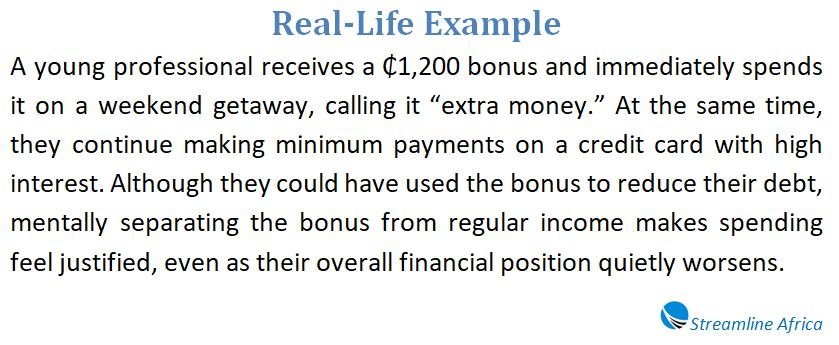
- Bonuses and windfalls: A person may treat a ₵1,500 bonus as “extra money” and spend it freely, even if they have unpaid bills.
- Savings vs. debt: Someone might save ₵2,000 in a low-interest account while paying 28% interest on a ₵2,000 credit card balance.
- Credit cards vs. cash: Buying a ₵10,000 television on credit feels easier than paying ₵10,000 in cash, even though both deplete wealth equally.
These examples reveal how mental labels influence choices, creating a false sense of rationality.
Mental Accounting in Marketing and Policy
Marketers and policymakers often exploit mental accounting to influence decisions. Businesses understand that consumers prefer segregated gains and integrated losses — meaning they like seeing multiple small rewards but prefer one combined expense.
For example, a car dealership might advertise: “₵2,000 off plus free alloy rims and a free year of insurance!” Instead of offering one ₵3,500 discount, they list separate perks, making the deal feel richer. Similarly, mobile phone companies may advertise a ₵70 monthly payment rather than a ₵840 yearly cost, framing the expense in a more digestible way.
Governments and nonprofit programs also use mental accounting to encourage better financial behavior. Studies in Colombia showed that people who publicly labeled their savings goals (like “school fees” or “home repairs”) saved 35% more than those who didn’t. Labeling strengthened self-discipline by turning abstract goals into specific mental accounts.
Another example comes from food assistance programs. In studies of beneficiaries of Ghana’s LEAP and the U.S. SNAP programs, recipients treated vouchers or food credits differently from cash, even though both could purchase similar goods. This confirmed that people do not see all money as equally interchangeable — a core insight of mental accounting.

How to Break Free from Mental Accounting Bias
While mental accounting can help structure finances, it often limits rational decision-making. To avoid its pitfalls:
- Treat money as interchangeable. Don’t label income differently based on where it came from. A bonus, refund, or gift should be viewed as part of your total wealth.
- Think in totals, not categories. Evaluate financial decisions based on their impact on your overall finances, not isolated “budgets.”
- Pay off high-interest debt first. It rarely makes sense to save ₵3,000 in a 2% savings account while owing ₵3,000 at 20% interest.
- Reintroduce payment awareness. Paying with cash or tracking every digital transaction increases mindfulness and curbs impulse spending.
Final Take
Mental accounting is one of the most relatable and revealing biases in human finance. It shows that our financial behavior is shaped not just by logic but by emotion and habit. By labeling money, we create psychological comfort — but also inefficiency.
Whether it’s keeping savings while owing debt, feeling freer to spend with a card, or treating bonuses as “fun money,” mental accounting subtly guides our choices every day. Recognizing this bias doesn’t just improve budgeting; it helps align financial actions with real goals.
When we stop seeing money as separate piles and start viewing it as one interconnected resource, we begin to make decisions that serve both our present comfort and our future security.