

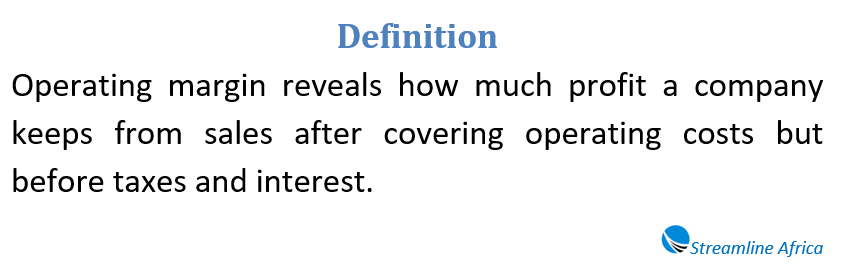
Operating margin is one of the most widely used measures of a company’s financial performance. It represents how much profit a business earns from its sales after covering its production and operating expenses but before accounting for interest payments and taxes. Essentially, it tells us what percentage of every dollar of revenue is left once costs like raw materials, wages, and administrative expenses are deducted. Investors and analysts look at operating margin to determine how efficiently a company is being managed and whether it can generate steady profits from its day-to-day activities.
What Operating Margin Represents
Operating margin reveals how much of a company’s revenue is converted into operating profit, often referred to as operating income or earnings before interest and taxes (EBIT). This ratio strips away financing decisions and tax policies to focus purely on operational efficiency. A higher margin indicates that a company is good at controlling costs and turning sales into profits, while a lower margin may suggest inefficiencies, higher expenses, or intense competitive pressure. Because operating margin reflects profits from core operations, it also helps investors distinguish between earnings derived from the actual business and those coming from one-time events or investments. This makes it a more reliable gauge of performance than net profit alone.

The Formula for Operating Margin
The formula is straightforward: Operating Margin = Operating Income ÷ Revenue × 100. Operating income, or EBIT, is calculated by subtracting the cost of goods sold (COGS) and operating expenses—such as salaries, rent, and utilities—from revenue. The resulting figure is then divided by revenue to determine what percentage of sales is kept as operating profit.
A Practical Example
Consider a company that earns $3.6 million in annual revenue. Its cost of goods sold amounts to $1.1 million, while selling, general, and administrative expenses total $900,000. Subtracting these expenses from revenue leaves $1.6 million in operating income. Dividing $1.6 million by $3.6 million results in an operating margin of about 44.4%. If management later secures lower supply costs, reducing COGS by $200,000, operating income rises to $1.8 million. The new operating margin becomes 50%, illustrating how changes in expense management can significantly improve profitability.
Why Operating Margin Matters
Operating margin is not just a ratio on a financial statement—it is a reflection of how well a business is run. Lenders often use it to evaluate whether a company generates enough profit from its operations to cover interest payments on loans. Investors rely on it to judge how sustainable profits are, especially in industries subject to volatility. Consistently high margins indicate strong pricing power, effective management, and efficient operations. Meanwhile, declining margins may reveal rising costs, poor expense management, or a weakening competitive position. Tracking this metric over time helps stakeholders assess whether a company’s performance is improving or deteriorating.
Limitations of Operating Margin
Although useful, operating margin has its limitations. It is most meaningful when comparing companies within the same industry, since different sectors naturally operate with different cost structures. For example, a digital service firm may have far higher operating margins than a construction company, but this does not necessarily mean one is superior overall. To improve comparability, many analysts use EBITDA (earnings before interest, taxes, depreciation, and amortization). By adding back depreciation and amortization—non-cash charges that vary depending on accounting policies—EBITDA provides a clearer view of profitability across industries like manufacturing, where capital investments are significant. Still, EBITDA should not be confused with cash flow, as it ignores changes in working capital and capital expenditures.
Comparing Operating Margin with Other Profit Margins
Operating margin is one of several measures used to evaluate profitability, each offering a different perspective: Gross margin measures profit after accounting only for COGS, showing how efficiently labor and materials are used in production. Operating margin goes further by including other operating expenses, highlighting the profitability of core business activities. Net margin considers every expense, including interest and taxes, providing the most comprehensive view of overall profitability. Taken together, these metrics give investors and managers a layered understanding of how revenue turns into profit at different stages.
Factors That Influence Operating Margin
Many elements affect a company’s operating margin. Pricing power is one of the most important—companies with strong brands or unique products often command higher prices, allowing them to maintain robust margins. Cost control is equally critical; businesses that streamline operations, negotiate better supplier contracts, or adopt efficient technologies often see improved margins. Market conditions also play a role. Rising input costs, economic downturns, or increased competition can squeeze margins, while favorable trends such as stable commodity prices or strong consumer demand can enhance them.
Improving Operating Margin
Companies use different strategies to strengthen their operating margins. One common approach is scaling operations. As production volume grows, fixed costs are spread across more units, lowering the average cost per product. This concept, known as economies of scale, is why larger businesses often achieve better margins than smaller competitors. Another strategy is optimizing supply chains by sourcing materials at lower costs or finding more efficient manufacturing processes. Businesses may also focus on revenue growth by developing new products or entering new markets, provided these initiatives don’t cause expenses to balloon. However, cost-cutting should be approached cautiously. Eliminating too many expenses—such as reducing staff or cutting advertising—can harm product quality or weaken future sales. The key is finding a balance between efficiency and investment in long-term growth.
Operating Margin in Different Industries
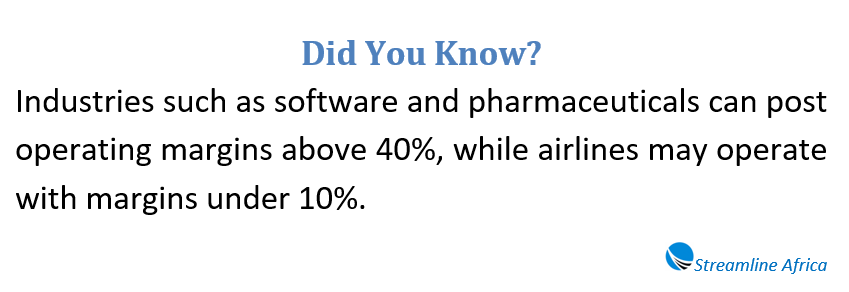
The level of operating margin that is considered strong varies widely across industries. Sectors such as software, pharmaceuticals, and media often enjoy high margins because once a product is developed, it can be sold repeatedly at little additional cost. For instance, a pharmaceutical company might spend heavily on research and development for a new drug, but after regulatory approval, each additional unit sold contributes substantially to profits. On the other hand, industries like retail, airlines, or automotive manufacturing usually operate with thinner margins due to significant overhead, labor, and raw material costs. For example, a regional airline might post a margin of just 8% because fluctuating fuel prices and high maintenance expenses eat into earnings.
Operating Margin and Risk
Variability in operating margins is a signal of business risk. Stable margins suggest predictable performance, while margins that swing widely may indicate vulnerability to economic cycles or external shocks. For investors, assessing a company’s margin history helps evaluate whether management can navigate challenges and maintain efficiency over time.
The Link Between Operating Margin and Competitive Advantage
Companies with margins above the industry average often enjoy a competitive advantage. This could be due to unique products, superior efficiency, or stronger brand recognition. Higher margins allow these companies to reinvest more into marketing, research, and expansion, reinforcing their leadership position. Conversely, companies with consistently lower margins than their peers may struggle to compete and could become takeover targets or face financial distress if conditions worsen.
Why Investors and Managers Pay Attention
For managers, operating margin acts as a performance scorecard, guiding decisions about pricing, cost management, and resource allocation. For investors, it is a quick way to evaluate whether a company generates enough from its operations to cover financing needs and deliver returns. Because it excludes interest and taxes, the ratio isolates operating efficiency, making it especially valuable in comparing companies with different capital structures or tax jurisdictions.
Final Take-Home
Operating margin is a key measure of profitability that highlights how much a company earns from its sales after covering production and operating expenses. By focusing on core operations, it provides a clearer picture of efficiency than net profit alone. Although it varies across industries and has limitations, it remains one of the most practical tools for evaluating management effectiveness, business risk, and competitive strength. Companies that consistently maintain or improve their operating margins demonstrate resilience and efficiency, which are essential for long-term growth and investor confidence. Whether used by managers making strategic choices or by investors deciding where to allocate capital, operating margin remains central to understanding how well a business transforms sales into sustainable profits.
Key Facts about Operating Margin
Calculated with EBIT
Operating margin is found by dividing operating income (EBIT) by revenue and expressing it as a percentage.
Higher margins mean stronger management
A higher margin signals that a company is controlling costs well and turning sales into healthy profits.
Useful for comparing peers
It works best when comparing companies within the same industry since cost structures vary widely across sectors.
Different from gross and net margin
Gross margin looks only at COGS, operating margin includes overhead, and net margin factors in everything, including taxes.
Figures highlight core performance
Because it excludes financing and taxes, operating margin focuses strictly on how well the business itself is run.
Influenced by multiple factors
Pricing power, supplier negotiations, efficiency, and market conditions all affect whether margins rise or fall.
Economies of scale can help
As production grows, fixed costs are spread out, often lowering the cost per unit and improving margins.
Industries have varied margins
Sectors like software and pharmaceuticals often show high operating margins, while airlines and retail tend to have thin ones.
Investors and lenders watch closely
Stable or rising margins reassure stakeholders, while declining or volatile ones can signal risk and weak competitiveness.