

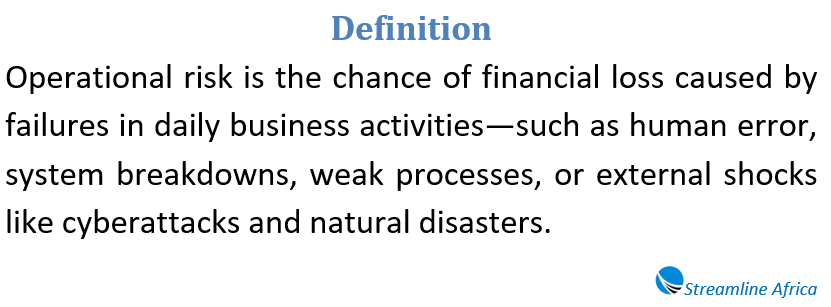
Every business faces uncertainty, but not all risks come from markets or loans. Some arise from within the organization itself—processes that don’t work as planned, employees making mistakes, or systems breaking down. These are examples of operational risk. Put simply, operational risk is the potential for financial loss caused by failures in day-to-day business operations, whether from human error, technology issues, poor procedures, or even external events like natural disasters and cyberattacks.
Unlike credit risk or market risk, operational risk is not usually taken on deliberately. It is a byproduct of running a business. And while it cannot be completely eliminated—because no system or person is perfect—it can be managed and kept within acceptable limits.
Why Operational Risk Matters
Operational risk is far-reaching because it can affect every area of a business. It doesn’t just cause financial losses—it can damage a company’s reputation, reduce customer trust, and even threaten the survival of the organization if left unchecked. In today’s interconnected world, global trade, social media, and increasing regulations mean that a small failure can quickly spiral into something much bigger.
For example, a data breach may not only cost money to fix but also drive customers away and invite legal penalties. A failed internal control might allow fraud to go undetected, creating large unexpected losses. These examples highlight why operational risk management is now a central part of corporate governance and regulatory frameworks worldwide.
Historical Development of Operational Risk Awareness
Until the late 20th century, operational risk was seen as a catch-all category—essentially, anything that wasn’t market or credit risk. That changed with the Basel II Accord, which formally recognized operational risk as its own category and required banks to set aside capital to cover potential losses from it. This step transformed operational risk from an afterthought into a core area of risk management.
The need for this shift became clear as globalization, deregulation, and technological advances added complexity to financial systems. The collapse of institutions such as Barings Bank in the 1990s, caused by rogue trading and poor controls, showed how devastating operational failures could be. Later, the global financial crisis of 2008 reinforced the idea that traditional models were not enough to capture all the risks businesses face.
Events like terrorist attacks, system outages, or large-scale fraud cases pushed regulators to demand stronger frameworks for identifying, measuring, and controlling operational risk.
Formal Definition
The Basel Committee on Banking Supervision, which sets international banking standards, defines operational risk as the risk of loss resulting from inadequate or failed internal processes, people, and systems, or from external events. This definition also covers legal risks but specifically excludes strategic and reputational risks.
That said, reputational damage often arises as a consequence of operational failures, even if not officially classified under the same heading. For example, a bank suffering from a major data breach will experience both operational and reputational impacts.
What Is Not Included
Not every type of business failure is considered operational risk. Poor strategic decisions—such as entering the wrong market—fall under strategic risk, not operational risk. Similarly, reputational risk stands on its own, though it is often triggered by operational issues. This distinction helps organizations focus on addressing specific root causes rather than grouping everything under one umbrella.
Common Categories of Operational Risk Events
To bring structure to this broad area, Basel II identified seven categories of operational risk events:
- Internal fraud – theft, embezzlement, or bribery by employees.
- External fraud – cybercrime, hacking, forgery, or theft by outsiders.
- Employment practices and workplace safety – discrimination, health and safety failures, or wrongful termination claims.
- Clients, products, and business practices – improper sales tactics, product misrepresentation, or fiduciary breaches.
- Damage to physical assets – natural disasters, terrorism, or vandalism.
- Business disruption and system failures – outages, software crashes, or utility breakdowns.
- Execution, delivery, and process management failures – data entry mistakes, accounting errors, or lost client assets.
These categories provide a framework for organizations to identify vulnerabilities and design preventive measures.
Vendor Risk and Third-Party Dependencies
Modern businesses increasingly rely on vendors and third-party providers. This introduces another dimension of operational risk: vendor risk. If a critical supplier raises prices, changes product specifications, or simply stops delivering, the business may face disruptions. Outsourcing IT services, for example, can save costs but also creates exposure to risks outside of the company’s direct control. Managing vendor relationships carefully is therefore essential.
Challenges in Measuring Operational Risk
Unlike credit or market risk, operational risk is notoriously hard to quantify. Financial institutions use sophisticated models to estimate how much they might lose if a borrower defaults or if market prices move. But operational failures are less predictable.
For instance, no model can perfectly forecast when an employee might commit fraud or when a system might suddenly fail. As a result, many organizations historically treated operational risk as a “cost of doing business.” Today, however, data collection on past incidents is helping institutions create better models. By analyzing patterns of fraud, outages, or human error, they can forecast potential losses and set aside capital as a cushion.
Methods of Calculating Capital for Operational Risk
To ensure that banks can absorb losses from operational failures, regulators require them to hold capital against these risks. Basel II introduced three approaches:
- Basic Indicator Approach (BIA): A simple method based on a percentage of the bank’s annual revenue.
- Standardized Approach (SA): A more refined method that applies different percentages to revenues from specific business lines.
- Advanced Measurement Approaches (AMA): Banks use their own internal models, approved by regulators, to calculate capital requirements. These models often incorporate scenario analysis, loss data, and expert judgment.
The choice of approach depends on the institution’s size, sophistication, and regulatory approval.
The Standardised Measurement Approach (SMA) under Basel III
Recognizing the shortcomings of earlier methods, the Basel Committee introduced the Standardised Measurement Approach (SMA) under Basel III. This new method became effective in January 2022.
SMA combines a bank’s financial indicators with its internal loss history, ensuring that institutions with more frequent or severe losses set aside more capital. The approach aims to standardize calculations across banks, improve comparability, and tie capital requirements more closely to actual risk exposure.
Operational Risk Management (ORM)
Managing operational risk is not about eliminating it—because that is impossible—but about reducing the likelihood of failures and minimizing their impact. Operational Risk Management (ORM) is the discipline dedicated to this task.
ORM involves:
- Identifying risks through audits, assessments, and monitoring.
- Measuring risks by analyzing data and potential loss scenarios.
- Controlling risks with internal controls, staff training, and reliable systems.
- Monitoring risks on an ongoing basis to detect emerging threats.
- Reporting risks to management and regulators.
Effective ORM overlaps with other disciplines such as quality management and internal audit. It requires collaboration across departments and strong support from senior management.
Lessons from History
Operational risk events have repeatedly shown their power to disrupt. Rogue traders at Société Générale and Barings Bank caused billions in losses. The September 11 attacks revealed how physical events could devastate businesses. The 2008 financial crisis highlighted gaps in risk models and governance.
Each of these incidents reshaped how organizations and regulators view operational risk. They reinforced the idea that robust controls, transparency, and accountability are critical.
Difficulties and Limitations
Despite improvements, challenges remain. Many organizations struggle with cultural barriers—employees may underreport mistakes for fear of punishment, reducing the quality of data. Models used to estimate losses can be flawed if based on inaccurate assumptions.
Furthermore, global interconnectedness means risks spread quickly. A cyberattack on a vendor can ripple through multiple industries. Climate change also introduces new operational risks, such as increased natural disasters affecting infrastructure.
The Future of Operational Risk
Looking ahead, operational risk management will continue to evolve as new threats emerge. Cybersecurity, artificial intelligence, and digital transformation bring opportunities but also risks that must be addressed. Regulators are likely to tighten requirements further, demanding more transparency and accountability.
Organizations that treat operational risk as a strategic priority—rather than a compliance burden—will be better equipped to adapt and thrive. By integrating risk management into their culture, companies can not only prevent losses but also build resilience, safeguard their reputations, and strengthen long-term performance.
Conclusion
Operational risk is an unavoidable reality of modern business. While it cannot be eliminated, it can be managed effectively through strong systems, careful monitoring, and a culture of accountability. From regulatory frameworks like Basel III to lessons from past crises, the field of operational risk management continues to expand in importance.
For businesses, the challenge lies in recognizing risks early, responding proactively, and maintaining the right balance between cost and benefit. In doing so, organizations not only protect themselves but also contribute to a more stable and trustworthy financial system.
FAQs about Operational Risk
How operational risk different from credit or market risk?
Unlike credit or market risk, which are taken on deliberately in pursuit of returns, operational risk is an unavoidable byproduct of running a business and arises from everyday operations.

Why does operational risk matter?
It can lead not only to financial losses but also to reputational damage, customer distrust, and even the collapse of an organization if not managed properly.
What role did Basel II play?
Basel II was the first international framework to recognize operational risk as a distinct category. It required banks to hold capital against it, making it a formal part of financial regulation.
What are common types of operational risk events?
They include fraud (internal or external), workplace safety issues, product misrepresentation, damage to physical assets, system failures, and errors in process execution.
How do regulators require banks to measure operational risk?
They can use the Basic Indicator Approach, the Standardized Approach, or Advanced Measurement Approaches. Basel III later introduced the Standardised Measurement Approach (SMA) for greater consistency.
Why is measuring operational risk challenging?
Unlike market data, operational failures are unpredictable. Events like fraud, outages, or rogue trading don’t follow clear patterns, making quantification difficult.
How can businesses manage operational risk effectively?
By identifying risks, assessing their potential impact, setting up strong controls, training staff, monitoring systems continuously, and embedding accountability across the organization.