
Taxes are an inevitable part of working life, and one of the most common systems used by governments to collect income tax from employees is Pay As You Earn (PAYE). This method requires employers to deduct income tax from employees’ wages or salaries before paying them. The deducted tax is then submitted to the tax authority on behalf of the employee. In practice, it means that workers pay their taxes gradually each month rather than in one large payment at the end of the year.
PAYE applies not only to wages paid in cash but also to benefits received in kind, such as housing, company vehicles, or allowances. The system ensures consistency and reduces the likelihood of employees failing to pay the correct amount of tax. It also provides governments with a steady flow of revenue to fund public services.
How PAYE Operates in Practice
For employees, PAYE often feels almost invisible since deductions are made automatically. Employers use graduated tax rates—tiered percentages applied to different portions of income—to determine how much tax each worker owes. The higher an employee’s earnings, the greater the tax portion applied to their income.
Employers are required to submit PAYE returns by the 15th of the month following the deductions. For example, taxes deducted from January salaries must be reported and paid by February 15. This schedule ensures that tax authorities receive timely payments and can monitor compliance effectively.
From the perspective of the employee, the PAYE deduction appears as a line item on their payslip, showing how much tax was withheld for that month.
Tax Bands and Rates for 2024
In Ghana, as in many other countries, PAYE operates on a progressive structure—meaning lower income is taxed at lower rates while higher income is taxed at higher rates. This system is intended to promote fairness, ensuring that taxation takes into account an individual’s ability to pay.
Monthly Tax Bands for Resident Individuals
For the 2024 tax year, resident individuals are taxed according to the following bands on their monthly chargeable income:
- The first GH¢490 is tax-free.
- The next GH¢110 is taxed at 5%, giving a payable amount of GH¢5.5.
- The following GH¢130 is taxed at 10%, resulting in GH¢13.
- The next GH¢3,166.67 is taxed at 17.5%, amounting to GH¢554.17.
- The following GH¢16,000 is taxed at 25%, generating GH¢4,000.
- The next GH¢30,520 is taxed at 30%, contributing GH¢9,156.
- Any income exceeding GH¢50,000 per month is taxed at 35%.
This system ensures that individuals earning less face little or no tax, while those in higher brackets shoulder a greater tax burden.
Annual Tax Bands for Resident Individuals
When viewed annually, the progressive rates for 2024 are as follows:
- The first GH¢5,880 is exempt from tax.
- The next GH¢1,320 is taxed at 5%, amounting to GH¢66.
- The following GH¢1,560 is taxed at 10%, yielding GH¢156.
- The next GH¢38,000 is taxed at 17.5%, producing GH¢6,650.
- The subsequent GH¢192,000 is taxed at 25%, totaling GH¢48,000.
- The next GH¢366,240 is taxed at 30%, adding GH¢109,872.
- Any income exceeding GH¢600,000 per year is taxed at 35%.
This cumulative structure means that tax liability builds gradually, rather than applying the highest rate to the entire income.
PAYE for Non-Resident Individuals
Non-residents do not benefit from the progressive system. Instead, their income is taxed at a flat rate of 25%, regardless of the amount earned. This simplifies administration for temporary workers or expatriates but often results in higher effective tax rates compared to residents, especially for those on modest incomes.
Allowances and Exemptions
Although PAYE is systematic, not all income is taxed in the same way. Certain allowances, exemptions, or deductions may reduce the taxable income. These adjustments ensure that only legitimate, chargeable income is taxed while recognizing expenses or benefits that should not attract tax.
Examples include:
- Overtime pay: In some cases, overtime may attract different tax treatment, especially if capped at certain limits.
- Bonuses: Annual or special bonuses are typically taxed, but may be subject to separate tax rules to prevent excessive burdens.
- Casual and temporary workers: Their income is still taxable, though employers often use simplified methods to calculate deductions.
- Income from other sources: If employees earn income outside of their main job, such as consultancy or rental income, these may require additional tax declarations.
Employers are expected to account for these details when filing monthly returns to ensure employees are neither overtaxed nor undertaxed.
PAYE for Casual and Temporary Workers
Casual and temporary staff—who may work only a few days, weeks, or months in a year—are not exempt from PAYE. Their employers are obligated to withhold tax based on the applicable income bands. However, since these workers may not earn above the lower thresholds, many end up paying little or no tax.
Temporary workers who remain employed for longer stretches are taxed in the same way as permanent staff, using the monthly graduated system. This ensures fairness across all types of employment arrangements.
Treatment of Overtime and Bonuses
In many workplaces, overtime is a common feature, particularly in industries like manufacturing, security, and healthcare. PAYE treats overtime as part of gross income, which means it is subject to tax. In some jurisdictions, however, overtime pay up to a certain threshold may be taxed at concessionary rates to encourage productivity.
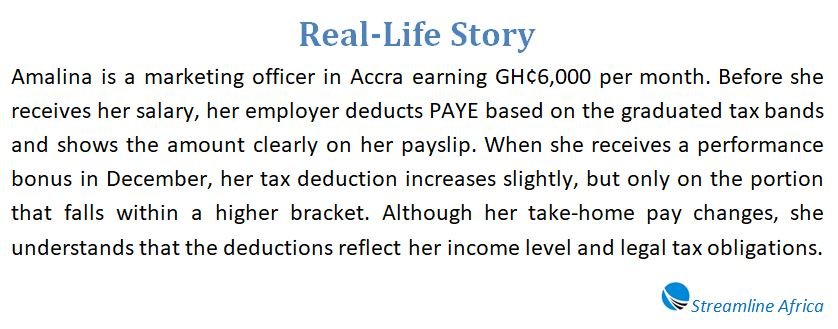
Bonuses, whether performance-based or seasonal, are also considered taxable income. Employers deduct PAYE on these amounts in the same way they do for regular wages. While bonuses can push employees into higher tax bands temporarily, the progressive structure ensures that only the portion exceeding the threshold is taxed at the higher rate.
Benefits of the PAYE System
PAYE offers advantages for both the government and employees:
- Convenience for employees: Taxes are deducted automatically, sparing workers from the need to calculate and pay lump sums.
- Reliable government revenue: Monthly remittances provide a steady cash flow to fund services like healthcare, education, and infrastructure.
- Compliance: By making employers responsible for deductions, the system reduces tax evasion.
- Fairness: The progressive nature of the system ensures that contributions align with income levels.
For most employees, PAYE is the simplest way of handling income tax obligations.
Challenges Employees May Face
Despite its convenience, PAYE is not without challenges. Employees sometimes feel constrained by the lack of flexibility since taxes are deducted automatically whether they are financially prepared or not. Additionally, when employers miscalculate or delay filing returns, employees may face disputes or penalties through no fault of their own.
For individuals earning income from multiple sources, PAYE deductions may not cover the full tax liability. These individuals often need to file additional tax returns to reconcile their total earnings and ensure compliance.
Filing and Compliance Obligations for Employers
Employers play a central role in PAYE. They must:
- Deduct the correct tax amount using the graduated scale.
- Provide employees with payslips that clearly show deductions.
- File monthly PAYE returns by the 15th of the following month.
- Keep accurate records of all employee payments and deductions.
Failure to comply can result in penalties, interest charges, and in severe cases, legal action. For this reason, many employers rely on payroll systems or tax consultants to manage PAYE efficiently.
PAYE Compared to Other Tax Systems
PAYE is just one approach to income taxation. In some countries, individuals pay tax through self-assessment, meaning they declare and pay taxes themselves. While this allows more flexibility, it also increases the risk of underpayment and tax evasion.
PAYE, on the other hand, shifts the responsibility to employers, simplifying the process for workers and ensuring consistent collection. The trade-off is less flexibility for employees but greater efficiency for tax authorities.
The Human Side of PAYE
Although PAYE is a technical system, it impacts people’s daily lives. For the average worker, the size of their take-home pay determines lifestyle choices, savings, and financial planning. Knowing how PAYE works helps employees understand why their net income differs from their gross salary and empowers them to plan better.
For instance, an employee earning a bonus may celebrate the extra income, but awareness of its tax implications helps manage expectations. Similarly, workers approaching higher tax brackets can make informed decisions about savings, pensions, or investments to optimize their tax positions.
Looking Ahead: PAYE in a Changing Economy
As economies evolve, so too does taxation. Digital payroll systems, mobile money, and online filing are making PAYE administration smoother and more transparent. Governments are also increasingly integrating social security contributions with PAYE deductions, creating a more unified system of worker welfare and tax compliance.
In the future, PAYE may continue to expand beyond traditional wages to cover gig economy earnings and freelance income, ensuring that all workers contribute fairly to national development.
Conclusion
Pay As You Earn (PAYE) is a system designed to make income tax collection straightforward, fair, and efficient. By placing the responsibility of tax deductions on employers, it spares employees from complex calculations while ensuring governments receive steady revenue. Its progressive rate structure balances fairness with practicality, charging higher earners more while protecting those with lower incomes.
Though challenges remain—such as inflexibility, occasional errors, and the weight of compliance on employers—the system has proven effective for millions of workers. As economies modernize, PAYE will continue adapting, but its core purpose will remain the same: ensuring that income tax is collected smoothly and equitably.
Frequently Asked Questions about PAYE
How does PAYE work in Ghana?
Employers calculate tax using graduated monthly or annual tax bands. Deductions are made before employees receive their net pay, and returns must be filed by the 15th of the following month.
What income is taxed under PAYE?
PAYE applies to all forms of income, whether paid in cash or benefits in kind, including salaries, allowances, bonuses, overtime, and other job-related earnings.
Are casual and temporary workers included?
Yes. Both casual and temporary workers are subject to PAYE deductions, though many may fall within lower brackets and pay little or no tax.
What are the 2024 tax rates for residents?
Resident individuals are taxed progressively, starting at 0% for the first GH¢490 monthly (GH¢5,880 yearly) and climbing to 35% on income exceeding GH¢50,000 monthly or GH¢600,000 annually.
How are non-residents taxed?
Unlike residents, non-resident individuals are taxed at a flat rate of 25% on all income earned in Ghana, regardless of the amount.
What role do employers play in PAYE?
Employers must calculate, deduct, and remit taxes to the authorities. They also issue payslips showing deductions and ensure monthly filings are completed on time.
Why is PAYE important?
It simplifies tax collection for workers, guarantees steady government revenue, reduces evasion, and ensures fairness by linking tax rates to income levels.