

Understanding Return on Equity (ROE)
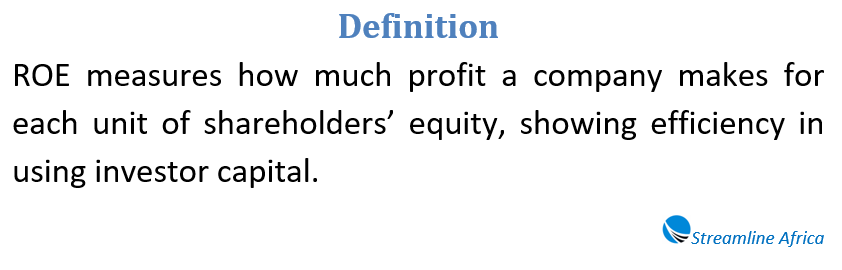
Return on Equity, more commonly referred to as ROE, is a critical measure that connects a company’s profitability with the equity invested by its shareholders. It answers a simple but important question: how much profit is generated for every unit of shareholder equity? This ratio gives investors insight into how effectively management is using resources to create value. The formula for calculating ROE is: ROE = Net Income ÷ Average Shareholders’ Equity. Net income here represents profit after taxes and after paying out preferred dividends but before common stock dividends. Shareholders’ equity is calculated by taking total assets and subtracting total liabilities. In this sense, ROE can also be seen as a return on net asset value (NAV), reflecting the surplus that belongs to equity holders once debts are accounted for.

Why ROE Is Important
ROE acts as a profitability compass for investors and managers alike. A higher ROE means the company is doing a better job of turning shareholder funds into net earnings. For instance, a 15% ROE means each dollar of equity brought in fifteen cents of profit over the fiscal year. Generally, values between 15% and 20% are viewed as strong in many industries, but these benchmarks vary depending on business models and market conditions. Because it aligns profit generation with investor contribution, ROE provides a direct look at how well shareholders are being rewarded for their risk.
ROE and Comparisons Across Companies
The metric becomes particularly useful when companies in the same sector are compared. Since they typically face similar market dynamics, ROE can highlight which firms are better at squeezing value out of their equity base. For example, two banks may generate the same revenue, but the one with a higher ROE demonstrates more efficient capital use. That said, industry differences limit cross-sector comparisons. Capital-intensive businesses, like utilities or airlines, naturally have different equity structures than software firms. Analysts therefore use ROE most effectively as a peer-to-peer benchmark within an industry.
ROE in Stock Valuation
ROE is also applied in the world of stock analysis. In theory, a company with higher ROE should offer more attractive returns to investors. However, stock prices do not always rise in direct proportion to ROE. Market valuations also depend on other factors such as projected growth, risk exposure, interest rates, and investor confidence. Nevertheless, ROE often feeds into valuation models. For instance, the dividend discount model uses ROE to help estimate the growth rate of dividends. Similarly, terminal value calculations, which form part of discounted cash flow models, incorporate expected growth tied to profitability. In this way, ROE indirectly influences how analysts estimate the long-term value of shares.
Breaking ROE into Components: The DuPont Formula
A deeper understanding of ROE comes from the DuPont formula, also known as the strategic profit model. Instead of treating ROE as a single figure, this approach divides it into three parts: ROE = Net Profit Margin × Asset Turnover × Financial Leverage. Net Profit Margin shows how much income remains from sales after covering expenses. Asset Turnover measures how effectively assets are used to generate revenue. Financial Leverage reflects the degree of debt relative to equity in the capital structure. By breaking ROE into these elements, managers and investors can identify the specific factors driving performance. For instance, if margins are improving, each sale generates more profit, lifting ROE. If asset turnover rises, it means resources are being used more efficiently. Finally, higher leverage boosts ROE when debt financing magnifies returns, though it brings additional risk.
Read More: Understanding the CAPE Ratio: How It Works and Why It Matters
The Role of Debt and Leverage
Debt plays a complex role in ROE. A reasonable level of borrowing can enhance returns because interest expenses are tax-deductible, while dividends are not. This tax shield allows more profits to flow to shareholders. However, too much leverage can reverse the benefits. When a company relies excessively on debt, creditors demand higher interest rates to compensate for the risk, raising the cost of capital. If the return on assets purchased with borrowed funds does not exceed the interest cost, ROE will fall. In other words, leverage increases ROE only when investments funded by debt outperform the debt’s cost. Excessive reliance on borrowing can also lead to default risks, undermining shareholder confidence and depressing stock values. Therefore, while leverage can magnify performance, it must be managed with discipline.
ROE as a Management Tool
From a managerial standpoint, ROE is more than just an accounting ratio—it is a way of ensuring accountability to investors. Executives use it to identify whether performance is in line with shareholder expectations and industry norms. If ROE consistently falls below what investors could earn in safer investments, such as bonds or savings accounts, confidence may diminish, potentially lowering stock prices. By applying the DuPont analysis, managers can determine whether underperformance stems from thin margins, inefficient asset use, or an unsustainable reliance on debt. This enables more focused corrective actions, such as improving pricing strategies, streamlining operations, or revisiting capital structure.
Insights for Investors
For investors, ROE provides a window into management efficiency and future growth potential. A consistently high ROE suggests a well-run company capable of reinvesting profits to fuel expansion. Analysts often compare a firm’s current ROE with its historical values and competitors’ figures to judge sustainability. Importantly, ROE feeds into estimates of dividend growth. Since retained earnings are a key source of reinvestment, higher ROE can translate into faster-growing dividends. This relationship ties ROE directly into shareholder returns and long-term wealth creation.
Limitations of ROE
Although useful, ROE has its limitations. High ROE numbers can sometimes mask weaknesses. A company burdened with heavy debt might display artificially high ROE despite weak profitability. One-off events, such as asset sales or extraordinary income, may inflate net income temporarily. Industry variations mean that what looks like strong ROE in one sector may be below average in another. Because of these factors, investors usually interpret ROE alongside other ratios, such as return on assets (ROA), return on capital employed (ROCE), or debt-to-equity measures. Taken together, these provide a fuller picture of financial health.
ROE in Dividend and Growth Estimates
One of the less obvious but powerful applications of ROE is in estimating future growth. Analysts often multiply ROE by the company’s earnings retention ratio (the portion of profits not paid out as dividends) to calculate a sustainable growth rate. This figure feeds directly into valuation models for forecasting long-term performance and dividends. For example, a firm with an ROE of 16% that reinvests half of its profits has a projected growth rate of around 8%. Such estimates help determine whether the company is positioned to expand at a pace that justifies its current stock price.
Final Thoughts
Return on Equity is more than just a profitability metric—it is a lens through which to view management efficiency, investor returns, and long-term growth potential. By tying net income directly to shareholder equity, it shows how well a company is converting investment into profit. The DuPont framework enriches this understanding by revealing whether performance comes from margins, asset use, or leverage. While strong ROE is generally seen as a good sign, context matters: debt levels, industry norms, and one-time events all influence interpretation. For investors, ROE provides a foundation for comparing peers, estimating dividend growth, and evaluating long-term prospects. For managers, it serves as a barometer of accountability and strategic decision-making. Ultimately, when used carefully and alongside other measures, ROE becomes a powerful tool in linking corporate performance to shareholder value.
FAQs about Return on Equity
How is ROE calculated?
It is calculated by dividing net income (after preferred dividends) by average shareholders’ equity.

Why is ROE important to investors?
It links profits directly to shareholder contributions, helping investors see how well their money is being put to work.
What is considered a good ROE?
Generally, 15–20% is seen as strong, though what qualifies as good varies by industry.
Can ROE be compared across all industries?
Not always. It’s most useful for comparing companies within the same sector, since capital needs differ across industries.
How does ROE affect stock valuation?
ROE feeds into models like the dividend discount model and helps estimate growth rates, but stock prices depend on many other factors too.
What is the DuPont formula for ROE?
It breaks ROE into three drivers: profit margin, asset turnover, and financial leverage.
How does debt influence ROE?
Moderate debt can boost ROE by lowering taxes through interest deductions, but too much borrowing raises risk and can harm profitability.
What insights does ROE give managers?
It helps management track performance drivers, identify weaknesses, and make better strategic decisions.
What does ROE reveal to investors about growth?
A consistently high ROE suggests reinvested profits can drive sustainable growth and potentially higher dividends.
What are the limitations of ROE?
It can be distorted by heavy debt, one-off gains, or industry differences, so it should never be used alone.
How does ROE connect to dividends and growth estimates?
Analysts multiply ROE by retained earnings to estimate a company’s sustainable growth rate, linking it to dividend potential.