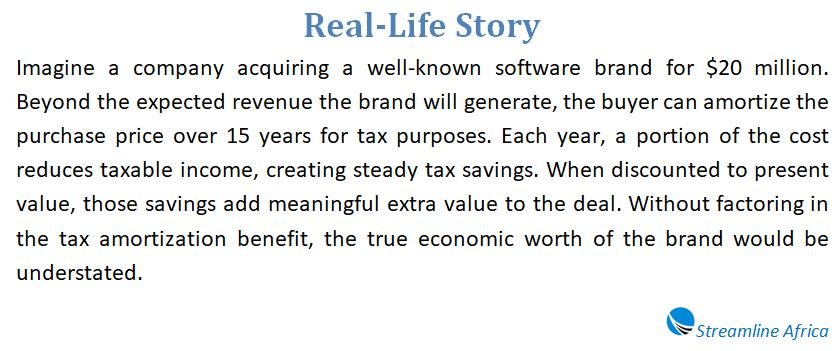
The tax amortization benefit, often abbreviated as TAB, represents the extra value created when a company can deduct the cost of intangible assets for tax purposes. Put simply, it captures the present-day worth of the future tax savings that arise because an asset’s purchase price can be gradually written off.
This concept is particularly important in the valuation of intangible assets such as patents, licenses, software, or trademarks. These assets may not wear out physically, but tax rules often allow their costs to be spread, or amortized, across a set number of years. The resulting deductions reduce taxable income, creating cash savings that increase the asset’s overall worth to the buyer.
Why TAB Matters in Intangible Asset Valuation
When determining how much an intangible asset is worth, it’s not enough to just consider its expected earnings. A buyer also thinks about how tax deductions tied to amortization will lower future tax bills. Those savings are not just bookkeeping entries; they translate into real money that remains with the business rather than going to the tax authority.
For example, if a company buys a trademark and the law allows it to be amortized over fifteen years, each year a portion of its cost can be deducted. Over time, this lowers taxable income and creates a steady stream of savings. When valuing that trademark, analysts must take these savings into account by calculating their present value and adding it to the base asset value. Without recognizing TAB, the estimate of fair market value would be incomplete.
The Challenge of Circularity
One complexity with TAB is that it creates a kind of circular loop in valuation. The fair market value of an intangible asset should include the present value of tax savings. But those tax savings depend on the asset’s value in the first place. In other words, the value influences the benefit, and the benefit influences the value.
To solve this, valuation specialists often use a two-step approach. First, they estimate what the asset would be worth if there were no tax deductions available. This produces a “before-tax-benefit” figure. Next, they apply a mathematical adjustment called the TAB factor, which gross ups that initial figure by incorporating the expected tax savings. This method breaks the loop while still capturing the benefit accurately.
The TAB Factor Explained
The TAB factor is essentially a multiplier that converts the base asset value into its fair market value by accounting for tax savings. It is determined by three main elements: the applicable corporate tax rate, the length of the tax amortization period, and the discount rate.
- Corporate tax rate: The percentage of income subject to tax in the jurisdiction where the asset is used.
- Amortization period: The length of time, set by tax law, over which the asset can be written off. This often differs from its accounting life. For instance, trademarks may be treated as having an indefinite life in accounting records, but U.S. tax law prescribes a fixed 15-year period for amortization.
- Discount rate: The rate used to convert future savings into today’s value, reflecting both the time value of money and risk considerations.
Together, these inputs produce a formula that yields the TAB factor. Once the factor is known, the base value of the asset is multiplied by it, giving a fair market value that reflects both intrinsic worth and the tax advantage.
How Countries Influence TAB
Tax amortization rules vary significantly across countries, which means the size of the benefit depends heavily on local law. Some jurisdictions allow rapid write-offs, producing larger early savings. Others require long amortization periods, stretching deductions over many years.
For example, the United States generally mandates a 15-year period for many intangible assets, including goodwill and trademarks. This uniform schedule ensures predictability but may not align with the asset’s actual useful life. Other countries may adopt shorter or longer periods, which in turn alters the present value of the savings. Businesses considering acquisitions across borders must carefully analyze how each country’s tax framework changes the magnitude of TAB.
Practical Examples of TAB in Action
Consider a technology company that acquires a patent for $10 million. If the law permits amortization over ten years, the company can deduct $1 million annually. Assuming a 25% tax rate, this translates into annual tax savings of $250,000. Discounted to present value, these savings add substantial worth beyond the patent’s base earnings potential.
Now imagine the same company buys a trademark. Even if the trademark could theoretically last forever, tax rules may impose a 15-year amortization. Over that period, steady deductions generate tax relief that investors immediately factor into the trademark’s price tag.
Such calculations are not just theoretical. They influence negotiations in mergers, acquisitions, and licensing deals, as both buyers and sellers recognize the additional value TAB creates.
TAB in the Context of Business Valuation
In business valuation, every advantage matters. TAB is not a stand-alone concept but part of the broader framework of purchase price allocation, intellectual property valuation, and financial reporting. Omitting it would risk undervaluing intangible assets, which often form a large share of modern companies’ worth.
When a merger occurs, accountants allocate the purchase price among tangible and intangible assets. TAB plays a role here, because assets eligible for amortization bring along predictable tax savings that must be quantified. This ensures that the financial statements after the acquisition fairly reflect the true value of what was acquired.
Balancing TAB With Real-World Application
While the formulas behind TAB can look intimidating, the practical takeaway is straightforward: tax rules affect asset value. Investors, analysts, and managers use these calculations to make informed decisions, set negotiation strategies, and ensure accurate financial reporting.
At the same time, TAB should not be viewed in isolation. Discount rates, business risks, and strategic synergies all play major roles in shaping an asset’s worth. TAB provides a measurable and often significant adjustment, but it is one piece in a larger puzzle of valuation.
Conclusion
The tax amortization benefit is a vital concept in modern finance and accounting, ensuring that the hidden value of tax savings is properly reflected in asset pricing. By acknowledging TAB, businesses capture a more realistic picture of what intangible assets are truly worth.
Its calculation may involve circular logic, but valuation professionals have developed clear methods, such as the two-step approach, to resolve it. With tax laws and accounting standards differing across jurisdictions, TAB also highlights how local regulation can directly shape international business decisions.
In today’s economy, where intangible assets often outweigh physical ones, understanding TAB is not just technical accounting knowledge—it is essential for fair valuation, smarter deals, and stronger financial insights.
FAQs about TAB
Why does TAB increase asset value?
Because the tax deductions reduce future tax payments, they create extra cash flow, which makes the asset more valuable to its owner.
How does TAB affect intangible asset valuation?
When valuing assets like patents or trademarks, analysts add the present value of expected tax savings to the base asset value to get a more accurate price.
What is the circularity problem in TAB calculations?
The asset’s value depends on the tax savings, but those tax savings also depend on the asset’s value—creating a loop that must be solved with a structured approach.
How do experts resolve this circularity?
They first estimate the value of the asset without tax benefits, then apply a TAB factor that adjusts the figure to include the expected savings.
What factors determine the TAB factor?
It depends on the corporate tax rate, the amortization period allowed by tax law, and the discount rate used to calculate present value.
Do tax rules differ from accounting rules for asset life?
Yes. For example, while a trademark may have an indefinite life for accounting purposes, U.S. tax law requires it to be amortized over 15 years.
How do different countries impact TAB?
Each country sets its own tax rules, so amortization periods and rates differ. This means the size of the tax benefit can vary widely by jurisdiction.
Why is TAB important in business valuation?
Ignoring TAB would undervalue intangible assets, leading to distorted financial statements and unfair deal pricing in mergers or acquisitions.
Can TAB influence negotiations in deals?
Absolutely. Buyers and sellers both recognize that tax savings add real value, so TAB often becomes a key point in setting purchase prices.