

Most executives don’t start their day thinking, “Today feels like a perfect day to launch an investigation.”
Investigations usually emerge after a problem has already cost time, money, or reputation—a client dispute escalates, an internal report flags anomalies, or a supplier misstep results in unexpected financial exposure. At first, bringing in investigators feels like an extra expense on top of an already mounting problem.
After more than 18 years running Ellery Investigative Solutions and partnering with legal teams, auditors, and corporate leaders, I’ve learned this: a well-executed investigation isn’t an added cost—it’s an investment in preventing far greater losses. In business, uncertainty is often more expensive than action.
Investigations Are Practical, Not Dramatic
When people hear “investigation,” they often imagine dramatic raids or complex espionage. In reality, most corporate investigations are methodical and grounded in practicality. They answer everyday but crucial questions:
- What truly happened in this transaction?
- Are the claims accurate and consistent?
- Do records align with reality?
- Did we maintain proper documentation?
- Is this employee issue genuine, or is it misrepresented?
- Are we onboarding a vendor or hire with undisclosed risks?
These scenarios are far from rare—they occur in companies every day. Organizations that consistently thrive address these questions early, before assumptions evolve into costly mistakes.

Speed Saves Money
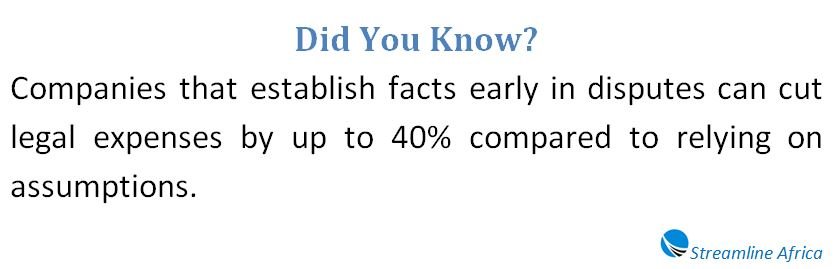
Uncertainty is expensive. When the facts aren’t clear, legal and operational costs rise rapidly. Attorneys must anticipate every possible scenario, reconstruct timelines, gather evidence, and interview all relevant parties. That effort consumes both time and money.
By establishing facts early, companies streamline decision-making. Strategies become precise, negotiations are grounded, and legal positions are defensible. Early, thorough investigations often result in:
- Reduced surprises
- Shorter case durations
- Leaner discovery processes
- More targeted legal action
- Lower spending on guesswork
For anyone who’s faced litigation, you know that money disappears fastest when decisions rely on assumptions.
Fraud Hides in Plain Sight
Fraud rarely announces itself with fanfare. It usually looks ordinary, blending into routine paperwork and plausible explanations. If unchallenged, deceptive narratives quietly solidify into perceived truths—until it’s too late and financial exposure becomes permanent.
Investigations counteract this by measuring stories against evidence. They prevent small losses from snowballing into significant ones. Early intervention doesn’t just recover funds; it prevents loss accumulation and strengthens operational controls.
Deterrence Is an Invisible Asset
One of the most overlooked benefits of a rigorous investigation program is its deterrent effect. When employees and vendors know that discrepancies and misconduct are scrutinized, behavior changes. Opportunists move on, corners are cut less, and internal culture becomes more accountable.
This effect isn’t immediately visible on financial statements, but it compounds over time—reducing claims, losses, and disputes. It’s ROI you feel in stability, efficiency, and peace of mind.
Leadership Protection
Executives frequently make high-stakes decisions—terminations, dispute resolutions, vendor issues, and strategic hires—that can later be questioned. Quality investigations generate evidence showing:
- Why a decision was made
- The facts supporting it
- The documentation available at the time
- Steps taken to validate the situation
This isn’t just about being correct; it’s about being defensible in court, to regulators, or even in the court of public opinion.
A Case Study: The Vanishing Inventory
A mid-sized electronics distributor in Denver faced a slow but steady loss of high-value components—microprocessors and memory chips. Leadership initially suspected warehouse staff, and tensions began rising.
Before taking action, the company engaged us to investigate. Rather than assuming guilt, we examined operational processes: shipment logs, supplier invoices, gate access records, and security camera footage.
What we uncovered was subtle but significant. A delivery van, registered to a legitimate vendor, had been systematically collecting small shipments. Each diversion was minor, staying under the radar, but over several months the cumulative losses were substantial—exceeding $250,000.
The critical insight: the theft wasn’t caused by a disgruntled warehouse employee, as initially suspected. It was a process vulnerability exploited by an external third-party contractor.
The results of the investigation allowed leadership to:
- Immediately halt the losses
- Reinforce gate and verification procedures
- Protect innocent employees
- Take action backed by concrete evidence
The financial savings, legal defensibility, and morale protection were significant. Precision replaced suspicion.
Measuring the Real ROI
Investigations aren’t about paranoia—they’re about clarity. Without clear facts, suspicion spreads, decisions become emotional, and exposure grows. With a thorough investigation, leaders act confidently, risks are mitigated, and company resources are protected.
The ROI of a strong investigation extends beyond recovered money. It safeguards the company’s reputation, strengthens operational controls, preserves employee trust, and protects leadership decisions. Uncertainty is often the most expensive line item in a business’s budget—investigations transform that uncertainty into actionable insight.
Ultimately, the value of investigations lies not in catching wrongdoing alone, but in enabling businesses to act decisively, prevent unnecessary losses, and create a culture of accountability. In that sense, facts aren’t just informative—they’re profitable.
Important Takeaways
Clear Facts Prevent Costly Mistakes
Getting accurate information early allows companies to avoid expensive assumptions, misguided decisions, and legal missteps. Investigation is an investment in certainty, not just an extra expense.
Practical Investigations Solve Everyday Challenges
Most investigations aren’t dramatic—they focus on verifying documentation, processes, employee conduct, and vendor reliability to provide clarity on routine business risks.
Early Insights Reduce Legal and Operational Costs
When facts are established quickly, legal strategies become sharper, discovery processes are shorter, and overall spending on guesswork diminishes significantly.
Fraud Often Hides in Ordinary Processes
Deceptive activities usually appear legitimate. Investigations reveal subtle inconsistencies that can prevent minor issues from snowballing into major financial losses.
Investigations Serve as a Deterrent
Knowing that a company takes discrepancies seriously encourages ethical behavior among employees and vendors, creating a culture of accountability that saves money over time.
Leadership Gains Protection Through Documentation
Thorough investigative reports provide evidence to support executive decisions, protecting leaders from legal challenges and reputational damage.
Precision Beats Suspicion
Well-executed investigations replace assumptions with actionable facts, ensuring decisions are informed, defensible, and culturally responsible within the organization.