What Makes a Liability “Contingent”?
In the world of accounting, not every financial obligation is straightforward. Some obligations only materialize if a particular event takes place in the future. These are called contingent liabilities. Unlike fixed debts such as loans or rent, contingent liabilities hinge on uncertain circumstances, like whether a lawsuit is lost or how many customers will claim warranty repairs.
What makes them important is the fact that they can significantly alter how a company’s financial health is perceived. Investors, lenders, and regulators want a transparent view of potential risks, and ignoring contingent liabilities could create misleading financial statements. For that reason, accounting rules provide guidance on when and how these obligations must be recognized or disclosed.
Why Transparency Is Essential
Contingent liabilities play a unique role in financial reporting because they represent risks that are not guaranteed but could impact future resources. For companies, being transparent about them is more than just following the rules; it’s about building trust with stakeholders. A company that hides or minimizes contingent liabilities risks damaging its credibility, especially if those liabilities eventually turn into real costs.
Accountants therefore rely on principles of disclosure, prudence, and materiality to decide how to treat them. If a liability is both likely and measurable, it belongs on the balance sheet. If it’s possible but uncertain, it should at least be disclosed in the notes. If it’s extremely unlikely, it can be left out. This approach ensures stakeholders have enough context to judge the potential financial impact.

The Three Categories of Contingent Liabilities
Accounting standards like GAAP and IFRS classify contingent liabilities into three main groups:
Probable Liabilities
These are obligations that are more likely than not to occur. If the company can also estimate the potential cost, the liability must be recorded directly in the financial statements. For instance, if a company is likely to lose a lawsuit and estimates damages of $4 million, that amount should be reported as a liability.
Possible Liabilities
When the likelihood of the liability materializing is uncertain—neither highly probable nor remote—the company must disclose the risk in the footnotes of its financial statements. This gives readers insight into risks that may not yet warrant a full balance sheet entry.
Remote Liabilities
Remote liabilities are highly unlikely to occur and, as such, do not require recording or disclosure. However, companies may still internally monitor these risks to avoid being caught off guard.
This three-tier classification helps ensure financial reporting is consistent and fair, while also preventing companies from overloading their statements with unlikely scenarios.
Common Examples in Business
Two of the most common types of contingent liabilities are lawsuits and warranties.
Legal claims can drag on for years, and their outcomes are unpredictable. If a company is sued for intellectual property infringement, for example, accountants must work closely with the legal team to judge whether the company is likely to lose and, if so, estimate the damages.
Warranties are another classic example. A car manufacturer offering a five-year warranty cannot predict exactly how many repairs it will have to cover, but it must estimate the likely costs based on historical data. These projected costs are recorded as a contingent liability because they represent a probable future obligation.
How Companies Recognize These Liabilities
The decision to record or disclose a contingent liability depends on two factors: probability and measurability.
If the liability is highly probable and the amount can be reasonably estimated, accountants record it in the financial statements immediately. If the probability is less certain or the costs are too difficult to estimate, the liability is disclosed instead of recorded. If neither condition is met, no entry is required.
For example, suppose a medical device manufacturer is sued for defective equipment. If the company expects to lose and estimates damages of $6.5 million, it records the expense on its balance sheet. But if the outcome is uncertain, the company simply explains the situation in the footnotes so that investors remain informed.
Why They Matter to Decision Makers
For managers, lenders, and investors, contingent liabilities are more than accounting entries—they can change the course of business strategy.
Creditors, for instance, carefully assess contingent liabilities before approving loans. A company with significant pending lawsuits may appear riskier, leading banks to impose stricter terms or higher interest rates. Similarly, executives must consider these liabilities when planning growth, mergers, or acquisitions. Overlooking them could leave the company vulnerable to sudden financial strain.
In short, contingent liabilities are crucial in shaping perceptions of financial stability and influencing business decisions.
An Illustrative Example
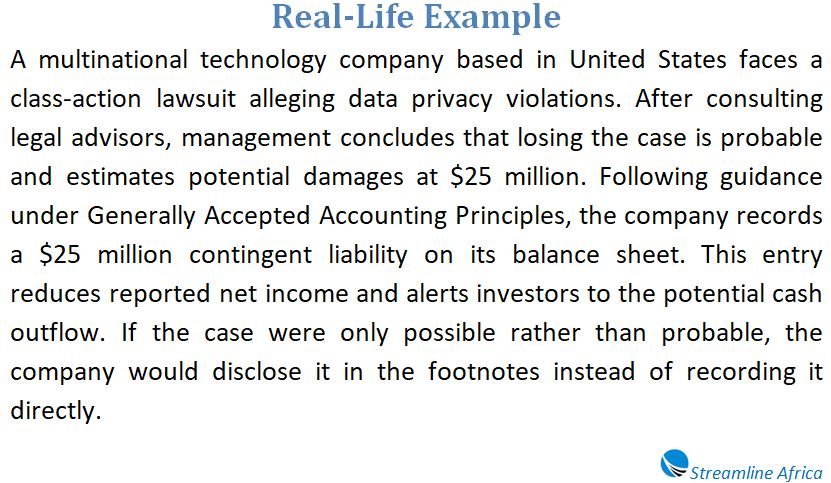
Imagine a pharmaceutical firm is accused of violating a competitor’s patent. Legal experts suggest that losing is likely, with estimated damages of $12 million. Since the outcome is both probable and measurable, the company records a liability of $12 million in its financial statements, showing transparency about potential losses.
If the case were only “possible” rather than probable, the liability would not be recorded but instead mentioned in the notes, giving investors a heads-up without inflating the balance sheet. And if the claim was considered remote, no disclosure would be needed.
This step-by-step process demonstrates how accounting rules balance accuracy with practicality, ensuring that financial statements remain useful without becoming cluttered with unlikely risks.
Read More: Balance Sheet Guide: How to Read, Understand, and Analyze Financial Statements
Warranty Costs as a Contingent Liability
Product warranties highlight how routine contingent liabilities can be. Consider a furniture manufacturer offering a three-year warranty on dining chairs. Each chair costs $120 to produce, and the company sells 15,000 chairs a year. Based on past experience, the company expects 1,200 chairs to be returned annually under warranty.
The estimated cost of $144,000 is recorded as a liability, even though the company doesn’t yet know exactly which chairs will be returned. This method ensures the warranty costs are recognized in the same period as the sales, creating a more accurate picture of profitability.
How Contingent Liabilities Affect Financial Health
One of the biggest challenges with contingent liabilities is that they can erode a company’s profitability and reduce available cash flows if they materialize. For example, losing a major lawsuit could result in a sudden outflow of millions, impacting both short-term liquidity and long-term growth plans.
That’s why investors and analysts study disclosures of contingent liabilities closely. They provide clues about hidden risks that might not be obvious from looking at revenues or profits alone. Ignoring them could lead to overly optimistic evaluations of a company’s performance.
Are They Real Liabilities?
Some people wonder whether contingent liabilities are “real” liabilities, given that they may never materialize. The answer is yes—when classified as probable. Once a liability is probable and can be estimated, accounting standards treat it as genuine because it represents a likely future sacrifice of resources. This distinction prevents companies from understating their obligations.
Related Financial Measures
While contingent liabilities are vital, they are only one piece of the broader financial puzzle. Companies also track commitments (such as long-term contracts), operating expenses, and provisions for expected costs. Together, these measures ensure that financial statements capture not just current obligations but also the risks and responsibilities that may unfold in the future.
Key Takeaway
Contingent liabilities highlight the gray areas of accounting where certainty is lacking but transparency is critical. They capture the idea that businesses must prepare for potential obligations, even when the exact timing or amount is unclear.
Whether it’s a pending lawsuit, a warranty program, or another form of potential obligation, these liabilities influence how stakeholders view a company’s financial strength. By classifying them as probable, possible, or remote, accounting standards strike a balance between providing useful information and avoiding unnecessary clutter in financial statements.
Ultimately, understanding contingent liabilities helps investors, lenders, and managers make smarter decisions. A company that manages and discloses them properly demonstrates both responsibility and foresight—qualities that are just as valuable as profits when it comes to long-term success.
Major Facts about Contingent Liabilities
Contingent liabilities depend on uncertainty
They only arise if a future event occurs, such as a lawsuit being lost or a warranty claim being made.
Transparency builds trust
Accurately reporting contingent liabilities ensures investors and lenders get a clear picture of a company’s risks.
They are classified into three groups
Accounting standards recognize contingent liabilities as probable, possible, or remote, each with different reporting requirements.
Probable liabilities must be recorded
If a liability is likely and can be reasonably estimated—like a $4 million lawsuit—it appears directly on the balance sheet.
Possible liabilities go in the footnotes
When the outcome is uncertain, companies disclose the potential risk in financial statement notes instead of recording it.
Remote liabilities need no disclosure
If the chance of the liability happening is very low, it does not need to be included in the statements at all.
Lawsuits and warranties are common examples
Companies often face potential legal settlements or warranty costs that must be estimated and reported responsibly.
Figures highlight practical impacts
For instance, a pharmaceutical firm may record $12 million for a probable lawsuit, while a furniture maker could set aside $144,000 for expected warranty claims.
They influence business decisions
Banks, investors, and executives consider contingent liabilities when setting loan terms, evaluating risks, or planning strategies.
They connect to financial health
Even though some may never materialize, contingent liabilities can reduce cash flow and profitability if they do, making them critical for long-term planning.