
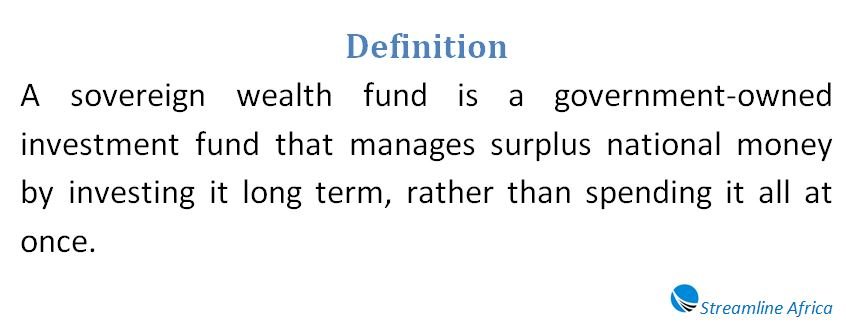
A sovereign wealth fund (SWF) is a government-owned investment vehicle designed to manage a country’s surplus wealth. Rather than leaving excess funds idle, states use these entities to invest in a broad mix of financial and real assets—ranging from public equities and government bonds to infrastructure, commercial property, precious metals, and alternative investments such as private equity or venture capital. Unlike domestic-focused public funds, sovereign wealth funds typically operate on a global scale.
Most sovereign wealth funds are financed through revenues that exceed a country’s immediate spending needs. For many nations, this surplus comes from exporting natural resources like oil, gas, or minerals. In other cases, funds are built from large foreign exchange reserves accumulated by central banks, fiscal surpluses, or proceeds from privatizing state-owned enterprises.
Where Sovereign Wealth Funds Sit in the Financial System
Some sovereign wealth funds are housed within, or closely linked to, a nation’s central bank. In these cases, the fund plays a crucial role in macroeconomic and fiscal planning, helping stabilize government finances across economic cycles. Other funds are legally and operationally separate, acting more like long-term savings accounts for the state, focused primarily on investment returns rather than day-to-day economic management.
The capital within these funds may originate from foreign currency reserves, gold holdings, International Monetary Fund reserve positions, or special drawing rights. In addition, some SWFs manage assets connected to national pension systems, industrial holdings, or legacy state enterprises. These assets are generally held across multiple currencies—such as the US dollar, euro, pound sterling, or yen—to reduce concentration risk and protect against currency volatility.
To manage these assets, governments often establish dedicated investment institutions. These may take the form of national investment authorities, public pension-style funds, or standalone sovereign investment corporations, each with varying mandates and governance frameworks.

Sovereign Funds vs. Central Bank Reserves
Economists frequently distinguish sovereign wealth funds from traditional foreign exchange reserves. While central bank reserves are intended to support currency stability and provide short-term liquidity during financial stress, sovereign wealth funds are structured to pursue long-term investment growth.
In recent decades, many central banks have accumulated reserves far beyond what is necessary for currency defense or trade settlement. It is widely assumed that portions of these excess reserves have been shifted into longer-term, higher-yielding assets through sovereign investment structures. However, due to limited disclosure in many jurisdictions, concrete data on these reallocations remains scarce.
A Brief History of Sovereign Wealth Funds
The phrase “sovereign wealth fund” entered mainstream financial vocabulary in the mid-2000s, when it was used to describe a growing shift in how governments managed national savings. The concept itself, however, is much older.
Several Asian sovereign investment entities began expanding their global presence in the early 2000s, marking a turning point in the scale and visibility of sovereign capital in international markets. By the time the global financial crisis erupted in 2008, sovereign wealth funds were among the first institutional investors able to inject capital into distressed banks and corporations. Unlike regulators, these funds actively participate in markets, allowing them to respond quickly when liquidity dries up.
Between the late 2000s and the early 2020s, the total assets managed by sovereign wealth funds surged dramatically—from a few trillion dollars to well over ten trillion. This growth reflected both rising commodity prices during certain periods and an increasing number of governments adopting the SWF model.
Investment Strategies and Asset Classes
Modern sovereign wealth funds invest across nearly every major asset category. Public equities and fixed-income securities remain core holdings, but many funds have significantly increased their exposure to private markets. Direct ownership of office buildings, logistics hubs, data centers, and large-scale infrastructure projects has become increasingly common.
By the mid-2010s, sovereign funds were regularly participating in multi-billion-dollar real estate and infrastructure deals, often partnering with global asset managers or pension funds. These investments offered inflation protection and long-term income streams aligned with sovereign funds’ extended time horizons.
Early Examples of Sovereign Wealth Funds
While sovereign wealth funds are often associated with oil-rich states, some of the earliest examples emerged in unexpected places. In the 19th century, several regional governments in North America created permanent investment funds to support public services such as education. These funds were capitalized using land grants and resource revenues, with income earmarked for schools and universities.
In the mid-20th century, resource-exporting nations began formalizing national investment funds to manage windfall revenues. One of the earliest national-level examples was established in the Middle East during the 1950s, using oil income to build a financial buffer for future generations. Over time, this fund grew into one of the world’s largest state-owned investors.
Small island economies have also experimented with sovereign-style funds. In one Pacific nation, phosphate export levies were pooled into a reserve fund designed to smooth government spending once mineral deposits were depleted. Although modest in size compared to major global funds, it demonstrated how sovereign investing could support long-term fiscal stability even in small economies.
Purpose and Design of Sovereign Wealth Funds
Sovereign wealth funds are often created during periods of sustained budget surpluses, particularly when governments carry low levels of external debt. In such circumstances, holding large amounts of idle cash can be inefficient or even risky. Investing surplus revenue helps preserve purchasing power and generate future income.
This logic is especially important for countries dependent on finite natural resources. Commodity prices are volatile, extraction timelines are uncertain, and reserves are ultimately exhaustible. Sovereign wealth funds allow governments to convert temporary resource wealth into diversified financial assets that can support future public spending.
Many funds are structured with clear rules governing how money flows in and out. These typically include:
- Accumulation rules, determining how much surplus revenue is saved.
- Withdrawal rules, specifying when and how funds can be used.
- Investment guidelines, outlining acceptable asset classes and geographic exposure.
While commodity exporters dominate the SWF landscape, some major economies have established funds using non-resource revenues. In these cases, foreign exchange reserves, fiscal surpluses, or privatization proceeds serve as the primary funding sources.
Strategic and Economic Roles
Beyond pure financial returns, sovereign wealth funds often serve strategic purposes. Some function as economic shock absorbers during crises, while others aim to strengthen national influence in global finance. Governments in Southeast Asia and the Middle East, for example, have used sovereign funds to position their cities as international financial hubs.
Sovereign wealth funds also invest across the innovation spectrum—from established multinationals to early-stage technology firms and renewable energy developers. In doing so, they can indirectly support domestic industrial policy by gaining exposure to strategic sectors abroad.
Research suggests that the global spread of sovereign wealth funds has also been influenced by imitation. As prominent countries successfully deployed SWFs, others followed suit, viewing them as a modern and credible tool of economic management.
Influence and Emerging Uses
As major market participants, sovereign wealth funds often act as signaling investors. When a large state-backed fund commits capital to a project or company, other institutional investors may interpret this as a vote of confidence, reducing perceived risk.
More recently, policymakers have explored using sovereign wealth funds to manage the economic impact of technological change. Proposals include funding artificial intelligence infrastructure, acquiring stakes in advanced technology firms, and distributing investment returns to citizens through social dividends or stabilization mechanisms.

Concerns and Criticism
The rapid expansion of sovereign wealth funds has raised several concerns. As their assets grow, so does their potential influence over global markets and strategic industries. Some governments worry that foreign state-backed investors could pursue political objectives under the guise of commercial investment.
These fears have prompted tighter investment screening regimes in several advanced economies. Transparency is another recurring issue. Many sovereign funds disclose limited information about their size, governance, or portfolio composition, making it difficult for regulators and market participants to assess risk.
Critics also point out that sovereign wealth funds vary widely in structure and behavior, making broad generalizations misleading. Poor governance and political interference have, in some cases, led to mismanagement and depletion of national savings.
Governance and the Santiago Principles
In response to transparency concerns, leading sovereign wealth funds collaborated in the late 2000s to establish a set of voluntary best practices. These guidelines, known as the Santiago Principles, promote clear governance structures, operational independence, and responsible investment behavior.
An international forum was later established to oversee these standards and provide a platform for dialogue among sovereign investors. Today, funds adhering to these principles represent the majority of global sovereign wealth assets.
Scale, Risk, and Sustainability
By the mid-2020s, global sovereign wealth fund assets were estimated in the range of $13–15 trillion. Funds backed by oil and gas revenues account for a significant share, while non-commodity funds continue to grow in number and influence. The Middle East and Asia dominate the sector, together hosting most of the world’s sovereign funds.
History shows that sovereign wealth funds are not immune to failure. Political instability, weak institutions, and poor fiscal discipline have led several funds to be drained or dissolved. In contrast, countries with stable governance and strong legal frameworks have been far more successful in preserving and growing sovereign assets over time.
Ultimately, the effectiveness of a sovereign wealth fund depends less on how much money it controls and more on how well it is governed.
Read Also: What are Private Equity Funds? How They Work, Who Invests, and Why Returns Can Be Massive
Frequently Asked Questions
Where Does the Money in a Sovereign Wealth Fund Come From?
Most funds are built from excess revenues such as natural resource exports, foreign exchange reserves, budget surpluses, or proceeds from privatizing state-owned assets.
How Is a Sovereign Wealth Fund Different From Central Bank Reserves?
Central bank reserves focus on short-term stability and currency protection, while sovereign wealth funds aim for long-term growth and diversification.
Why Do Resource-Rich Countries Rely So Much on These Funds?
Because commodities like oil and minerals are volatile and finite, sovereign wealth funds help convert temporary resource income into lasting financial security.
What Do Sovereign Wealth Funds Invest In?
They invest across global markets—stocks, bonds, real estate, infrastructure, private equity, technology companies, and increasingly, AI and renewable energy.
Do Sovereign Wealth Funds Only Care About Profits?
No. While returns matter, many funds also support national goals like economic stability, future generations’ savings, and strategic industries.
Why Are Some Countries Wary of Sovereign Wealth Funds?
Because they are state-owned, some governments fear investments could be politically motivated rather than purely financial, especially in sensitive industries.
What Are the Santiago Principles?
They are global best-practice guidelines that encourage transparency, accountability, and responsible governance among sovereign wealth funds.
What Determines Whether a Sovereign Wealth Fund Succeeds or Fails?
Strong governance and political stability matter more than fund size—poor oversight has caused several funds to be depleted despite large inflows.