
What Is a Free Market?
A free market refers to an economic system where people make voluntary exchanges based on their own interests and preferences. Buyers and sellers interact without being forced, and the prices of goods or services are shaped by supply and demand. In its purest form, the free market operates with little or no government interference, leaving individuals and businesses free to make decisions about trade, production, and consumption.
This idea may sound modern, but free market activity has been part of human life since the earliest instances of trade. It reflects a natural way for communities to organize themselves, much like the development of language or cultural norms. No single thinker invented it—rather, it grew organically out of human behavior.

The Natural Emergence of Exchange
Long before coins, banks, or laws, people exchanged goods informally. A farmer with extra grain might trade with a herder who had surplus cattle. Archaeological evidence shows that this practice existed thousands of years before recorded history.
As societies grew, the limits of barter became clear. Trading grain for cattle worked in small groups, but it was inefficient for larger communities. Eventually, societies began using goods like grain, shells, or livestock as a medium of exchange, simplifying transactions. By around 1000 B.C., metallic coins emerged in places like China and Mesopotamia. Unlike grain or animals, coins existed solely to function as money, paving the way for more advanced economic systems.
Banking, too, has ancient roots. Mesopotamian societies created early forms of lending, and the Romans developed financial systems to support trade. However, after the fall of Rome, banking largely disappeared in Europe until the Renaissance. By the 15th century, wealthy merchants and explorers revived financial practices, despite opposition from institutions such as the Church, which initially condemned lending with interest.
The Foundations of Market Economies
Two central ideas support the functioning of a free market: voluntary exchange and private property.
Voluntary exchange ensures that transactions happen by choice, not coercion. A seller agrees to part with a product only because the buyer offers something of value in return. Similarly, the buyer makes the purchase because they believe they benefit.
Private property rights establish the foundation for ownership and control over goods, land, and tools of production. While property existed long before written laws, thinkers like John Locke in the 17th century helped articulate why private ownership supports prosperity and freedom. He argued that people had a natural right to the fruits of their labor, and that property rights protected this principle.
These two pillars distinguish a market economy from a command economy, where a central authority decides how resources are used.
The Role of Governments
While the ideal of a perfectly free market—completely untouched by government—remains more theory than reality, many societies attempt to strike a balance. Almost every country today could be described as a mixed economy, blending private freedom with some degree of regulation. Governments set rules around contracts, protect property rights, and establish bankruptcy laws to give businesses a safety net. These measures, though technically interventions, often strengthen markets by giving participants confidence.
Free Markets and Capitalism: Not the Same Thing
The words “free market” and “capitalism” are often used interchangeably, but they describe different concepts.
Capitalism is a system of production. Business owners, or capitalists, organize resources—machines, raw materials, and labor—into companies that produce goods or services. They keep most of the profits, while paying wages to employees who contribute labor but do not own the productive tools.
A free market, on the other hand, describes the way trade occurs and how supply and demand shape outcomes. It does not require large corporations or investors to exist. For instance, ancient traders exchanging livestock or agricultural goods were part of a free market, even though they weren’t capitalists in the modern sense.
In practice, capitalism often operates within free markets, but the two are not identical.
Resistance to Market Forces in History
Markets rarely expand without pushback. Throughout history, entrenched powers resisted free trade when it threatened their authority.
In medieval Europe, the rigid caste and guild systems limited specialization and trade. Aristocrats and guild leaders often tried to protect their privileges by restricting open competition. Similarly, the rise of factories and mass production faced opposition from skilled craftsmen who feared losing their livelihoods. The famous Luddite movement of the early 19th century is one example, where workers destroyed machinery to protest industrial change.
Philosophers and political leaders also challenged market principles. Karl Marx argued for abolishing private property and placing production entirely under state control, believing markets exploited workers. Central planning became the alternative to free-market economies in many parts of the world during the 20th century.
Yet, over time, evidence has shown that free markets tend to outperform planned economies in efficiency and innovation. The debate today centers not on whether markets should exist but on how much regulation is appropriate.
Who Shaped the Understanding of Market Economies?
Although markets existed long before anyone studied them, certain thinkers gave us the intellectual framework to understand how they work.
Adam Smith, often called the father of economics, published The Wealth of Nations in 1776. He explained how individuals, acting in their own interests, could unintentionally promote the good of society through what he described as the “invisible hand” of the market. His ideas helped justify free trade and limited government interference.
Later, David Ricardo advanced the theory of comparative advantage in The Principles of Political Economy and Taxation. He argued that even if one country was more efficient at producing everything than another, both could benefit from trade if they specialized in what they did best.
These contributions cemented the study of markets as a formal field and influenced economic policy worldwide.
How Market Economies Function in Practice
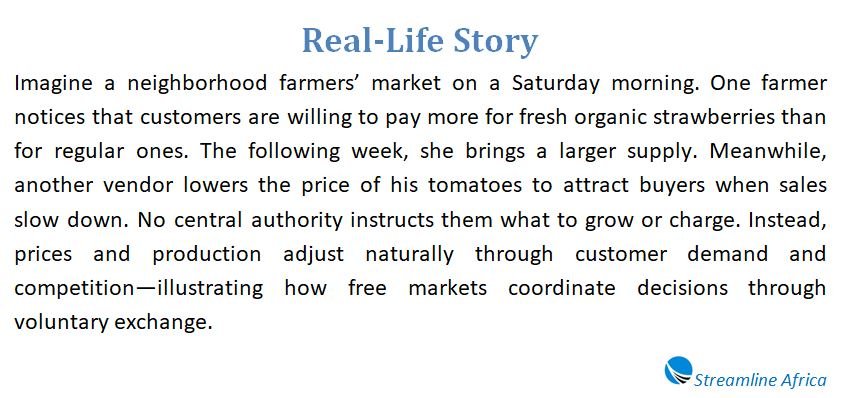
In a functioning market economy, the actions of countless individuals and businesses determine resource allocation. Producers decide what to make based on demand signals. If people are willing to pay higher prices for a product, companies see an opportunity to earn profits, encouraging them to increase production.
Likewise, when demand falls or competition increases, prices drop, discouraging producers from making too much of that good. This constant balancing act between supply and demand helps prevent prolonged shortages or surpluses.
Contrast this with a command economy, where a central authority attempts to dictate production and distribution. History has shown that such systems often miscalculate, leading to waste or scarcity. Markets, though not perfect, provide flexibility and responsiveness that centralized planning struggles to match.
Modern Perspectives on Free Markets
In today’s world, pure free markets are nearly nonexistent. Every country has some regulations—whether in the form of taxes, safety standards, or environmental rules. The debate is less about whether governments should intervene at all and more about how much intervention promotes fairness and stability without stifling innovation.
Supporters of freer markets argue that minimal restrictions encourage creativity, competition, and growth. Critics counter that without oversight, markets can lead to inequality, exploitation, or environmental harm. As such, the ongoing challenge for policymakers is finding the right balance between liberty and regulation.
Why Free Markets Matter
The importance of free markets lies in their ability to coordinate human activity efficiently. They create space for individual choice while fostering innovation and prosperity. People act based on personal incentives, but the collective outcome often benefits society as a whole.
Though debates continue about the proper role of government, few deny that free markets have shaped modern economies and remain central to how societies organize trade and production. Their organic origins remind us that they are not just abstract theories, but deeply rooted in human interaction and cooperation.
FAQs about Free Market
How did free markets begin?
They emerged naturally as humans started trading goods, long before money or formal laws existed, making them one of humanity’s oldest social institutions.
What role did money play in markets?
Money simplified trade by replacing barter. Early mediums of exchange included grain and cattle, and later, metallic coins in Mesopotamia and China.
Why are voluntary exchange and private property important?
Voluntary exchange ensures trade happens by choice, while private property rights give people control over resources, making markets function smoothly.
Are purely free markets common today?
No, almost every country mixes free-market principles with government rules like taxes, property laws, or safety regulations.
How is capitalism different from a free market?
Capitalism is about organizing production through business owners and investors, while free markets describe how trade and pricing occur between buyers and sellers.
Why have markets faced resistance historically?
Elites and guilds often resisted markets to protect their power, while movements like the Luddites opposed industrial changes that threatened their livelihoods.
What did Karl Marx believe about markets?
Marx opposed private ownership of production and supported state control, viewing markets as exploitative systems.
Who are the key thinkers behind market theory?
Adam Smith introduced the idea of the “invisible hand,” and David Ricardo explained comparative advantage, showing how trade benefits all participants.
How does a market economy allocate resources?
Through countless small decisions. When demand rises, prices increase, motivating producers to make more, and when demand falls, production slows.
Why are markets more effective than command economies?
Markets adapt quickly to changing needs through supply and demand, while centrally planned economies often miscalculate and cause shortages or waste.
Why do free markets still matter today?
They promote efficiency, innovation, and personal freedom, even though governments add regulations to balance fairness, stability, and long-term sustainability.