
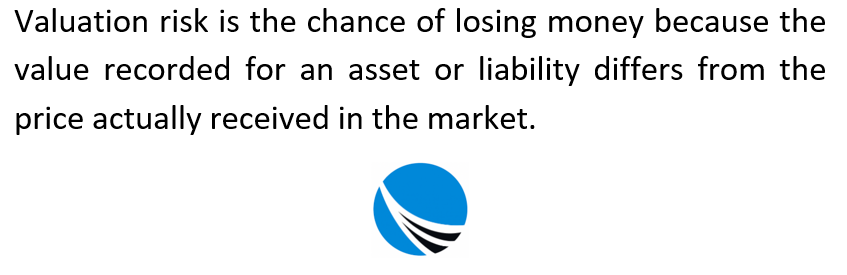
Valuation risk is one of the more subtle yet impactful risks in finance. Unlike the more familiar market or credit risks, valuation risk emerges when the recorded value of an asset or liability does not align with the actual amount one would receive if that asset were sold—or the amount required to settle a liability. This discrepancy can create unexpected losses and is especially concerning in markets where complex financial instruments and limited liquidity make accurate pricing difficult.
To better understand this risk, it is essential to look at how accounting frameworks define asset values, how fair value is determined, and why financial institutions—particularly banks—face heightened exposure.
What Valuation Risk Really Means
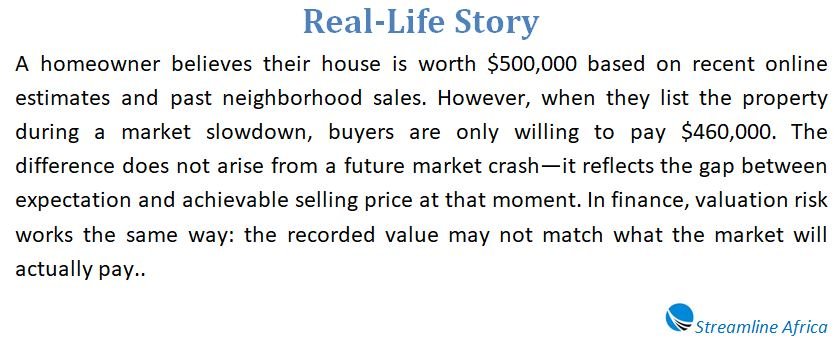
At its core, valuation risk arises when there is a gap between the book value of a financial instrument and its true market exit price. For example, a bank may list a security on its balance sheet as being worth $10 million, but if the bank attempts to sell it in the open market, it may only fetch $9.5 million. That half-million-dollar gap is where valuation risk materializes.
The problem intensifies with instruments that are not actively traded or are highly customized. In such cases, companies often rely on internal pricing models, which may not perfectly capture real-world conditions. If assumptions in the model are flawed, or if key inputs are unavailable, the reported value can be misleading.
The Role of Accounting Standards
International accounting rules, especially those under the International Financial Reporting Standards (IFRS), play a critical role in how valuation is approached. IFRS requires financial instruments to be classified into categories that dictate how they are valued.
- Held to Collect (HTC): Initially recorded at fair value, then carried at amortized cost over time.
- Fair Value Through Other Comprehensive Income (FVTOCI): Measured at fair value, with changes reflected in equity.
- Fair Value Through Profit and Loss (FVTP&L): Continuously marked at fair value, with gains or losses going directly into earnings.
Among these, the notion of “fair value” is central. IFRS 13 defines fair value as the price that would be received if an asset were sold or a liability transferred under current market conditions. Ideally, this price should come from active market transactions. But when no such transactions exist, entities turn to models—introducing uncertainty.
Observable vs. Unobservable Inputs
To add clarity, IFRS 13 sets a hierarchy for valuation inputs. These inputs can either be observable—drawn from real market data—or unobservable, derived from assumptions when market data is missing.
- Level 1 Inputs: Directly observable, such as quoted prices in active markets. These carry the least valuation risk.
- Level 2 Inputs: Indirectly observable, such as prices for similar instruments or market parameters like yield curves.
- Level 3 Inputs: Based entirely on unobservable data, where companies rely heavily on their own models and assumptions.
The higher the reliance on unobservable inputs, the greater the valuation risk. For Level 3 instruments, even small changes in assumptions—say, about credit risk or correlations—can significantly alter reported values.
Why Valuation Risk Differs from Market Risk
It is important to distinguish valuation risk from market risk. Market risk reflects potential losses due to changes in prices over a future period. Valuation risk, however, is measured at a single point in time. It captures the possibility that the value recorded today is already different from what the market would pay right now.
Put differently, market risk assumes models are correct but sensitive to shifts in conditions, while valuation risk questions whether the models themselves are accurate in the first place.

Banks and Their Exposure
Banks are especially vulnerable to valuation risk because of their heavy involvement in financial instruments that fall under Level 2 and Level 3 classifications. At the end of 2020, European banks supervised by the European Central Bank (ECB) held trillions of euros in such assets. Because these instruments cannot always be priced through active market trades, reliance on complex valuation models is unavoidable.
The stakes are high. Even small miscalculations can ripple across a bank’s capital adequacy. Regulators such as the Basel Committee on Banking Supervision have warned that accounting discretion—choices about which models to use or what assumptions to apply—can open the door to moral hazard. Banks might be tempted to use optimistic assumptions to present a healthier financial picture, which could mask underlying risks.
Areas Where Discretion Comes Into Play
Valuation risk becomes more complicated when organizations have too much leeway in determining fair value. Several areas are particularly sensitive:
- Deciding what qualifies as an “active market.”
- Choosing which pricing model best reflects an instrument’s value.
- Classifying whether certain inputs are observable or not.
- Judging the significance of unobservable inputs.
Because of these gray areas, regulators have issued stricter rules. The ECB, for example, has highlighted weaknesses in banks’ valuation risk frameworks, urging improvements in areas like model validation, data quality, and independent price verification.
Challenges in Measuring Valuation Risk
Measuring valuation risk is far from straightforward. Unlike market risk, where historical price data can be used to simulate future scenarios, valuation risk deals with uncertainty around current prices. There is no readily available database of “exit prices” for many complex instruments, which makes building a probability distribution difficult.
Researchers and regulators have suggested a few approaches, such as:
- Using benchmark curves based on similar instruments actively traded in the market.
- Constructing hypothetical exit prices by estimating the returns investors would demand for specific risks.
Even with these methods, the lack of transparency remains a barrier. Reports by the Bank of Italy and the Basel Committee have both noted that disclosures by banks often fall short, making it difficult for markets to gauge the true extent of valuation risk.
Information Gaps and Transparency Issues
One of the greatest problems is the absence of detailed public data. Investors and analysts often lack access to critical information, such as:
- How banks govern and control valuation risk internally.
- How Level 2 instruments are broken down by the importance of unobservable inputs.
- Sensitivity analyses showing how changes in assumptions would affect valuations.
- The role liabilities play in offsetting or contributing to valuation risk.
Without this information, external stakeholders may underestimate or misjudge the risks that banks carry. Calls for improved disclosures are growing louder, but implementation remains uneven across jurisdictions.
How Regulators Respond
To counteract these risks, regulators have strengthened oversight. Prudential valuation requirements now push banks to adopt more conservative approaches. These include adjusting valuations to account for model uncertainty and demanding independent verification of prices where possible.
The goal is to ensure that reported valuations do not overstate capital or earnings, thereby protecting the broader financial system from shocks triggered by sudden repricing.
Allocating Capital for Valuation Risk
Another key question is how much capital banks should set aside for valuation risk. In principle, if an institution sells an instrument and realizes a loss due to valuation risk, it no longer faces other risks (such as credit or market risks) associated with that instrument. Some frameworks suggest that capital allocation should focus on whichever risk is greater—valuation or the combined other risks.
This means capital is set to cover the worst-case scenario rather than double-counting exposures. While logical, the approach remains difficult to apply in practice because measuring valuation risk accurately is inherently challenging.
Broader Implications for Financial Stability
Valuation risk is not just a technical accounting issue—it has system-wide implications. If banks collectively overstate the value of their assets, the stability of the financial system may be threatened. A sudden correction, triggered by a loss of confidence or regulatory intervention, could amplify financial stress.
The European Systemic Risk Board has already flagged this as a danger, particularly given the volume of illiquid and complex instruments in bank portfolios. As global finance becomes more interconnected, the risk of contagion from valuation errors cannot be ignored.
Looking Ahead
Managing valuation risk requires a multi-pronged approach. Institutions must strengthen internal controls, ensure independent model validation, and improve transparency in their reporting. Regulators, in turn, must continue refining prudential requirements and pushing for more comprehensive disclosures.
At the same time, academics and practitioners need to develop better tools for measuring this elusive risk. Advances in data analytics and stress-testing techniques may help, but there is no quick fix.
Ultimately, valuation risk is a reminder that numbers on a balance sheet are not always a perfect reflection of reality. By acknowledging its presence and working toward more robust safeguards, both financial institutions and regulators can help prevent unpleasant surprises that undermine confidence in the financial system.
Frequently Asked Questions about Valuation Risk
How does valuation risk differ from market risk?
Market risk looks at how values change over time due to market movements, while valuation risk is about whether the reported value today truly matches the exit price at that same moment.
Why is fair value important in measuring valuation risk?
Fair value reflects the price an asset could be sold for or a liability settled at under current market conditions, making it central to identifying valuation gaps.
What role do accounting standards play?
International standards like IFRS dictate how financial instruments are classified and valued, setting rules for when fair value should come from market trades or models.
What are observable and unobservable inputs?
Observable inputs come from actual market data, like prices or yield curves. Unobservable inputs rely on assumptions and models when market data is missing, increasing uncertainty.
Why are banks heavily exposed to valuation risk?
Banks hold massive portfolios of complex financial instruments, many of which fall into Level 2 or Level 3 categories that rely on models and assumptions instead of active market prices.
How can discretion affect valuation outcomes?
Choices about pricing models, assumptions, and definitions of “active markets” can lead to inconsistent or overly optimistic valuations, which regulators consider risky.
What challenges exist in measuring valuation risk?
There is no universal method because reliable “exit prices” are often unavailable, making it hard to build accurate probability distributions of possible outcomes.
Why is transparency an issue?
Banks rarely provide enough detail about their valuation methods, inputs, or sensitivity to changes, leaving investors and regulators with an incomplete picture of risk.
How do regulators address valuation risk?
They impose stricter prudential requirements, demand conservative valuation practices, and push for independent verification to prevent overstated capital and sudden shocks.