

What Blind Entries Mean in Accounting
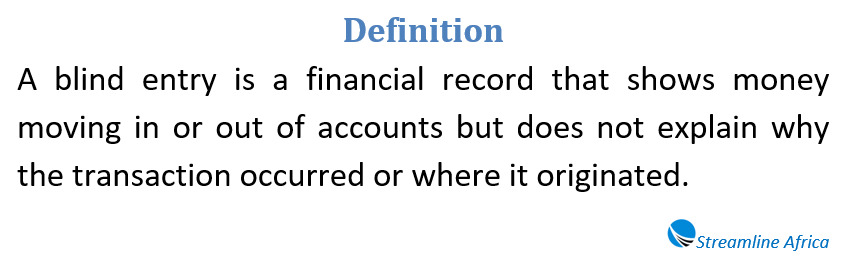
In accounting practice, every recorded transaction is expected to tell a clear story: who paid, why the payment occurred, and which accounts were affected. A blind entry breaks that expectation. It records a debit or credit amount but fails to explain what actually happened. The numbers are present, yet the context is missing.
Such entries may appear in journals when someone records a movement of funds or an adjustment without attaching a description, reference, or supporting documentation. While the transaction technically exists in the books, anyone reviewing the records later may struggle to understand its purpose. This absence of explanation can weaken confidence in the financial data and complicate audits, reporting, and decision-making.
Blind entries are therefore viewed with caution. They do not necessarily indicate wrongdoing, but they remove the transparency that accounting systems rely on to maintain trust and accuracy.
Why Context Matters in Financial Records
Accounting is not merely about numbers; it is about explaining economic events. Each entry should provide enough detail for an independent reviewer to reconstruct what occurred without needing additional verbal clarification. This principle supports accountability and traceability.
When an entry lacks context, several problems arise. Managers cannot easily assess whether the transaction aligns with business activities. Auditors cannot verify compliance with policies or regulations. Future staff members may struggle to interpret historical data, especially if the original preparer is no longer available.
In organizations that rely on financial information for planning and performance evaluation, unclear entries can distort insights. For example, unexplained transfers between departments may hide cost overruns or artificially inflate performance indicators. Over time, a collection of ambiguous entries can significantly reduce the reliability of financial statements.

How Blind Entries Interact With Double-Entry Accounting
Most modern accounting systems use double-entry bookkeeping, where every transaction affects at least two accounts. One account is debited and another credited, ensuring that the accounting equation remains balanced.
A blind entry does not violate this structure. It still records the required debit and credit amounts. However, it omits the narrative that clarifies why those accounts were involved. Without that explanation, the mechanical accuracy of the entry does not guarantee informational accuracy.
Consider a simple purchase of office supplies paid in cash. A complete entry would show an increase in supplies expense and a decrease in cash, accompanied by a description such as “purchase of printer paper.” A blind entry might record the same amounts but provide no explanation. Anyone reviewing the ledger later would see the movement of funds but not the underlying transaction.
Thus, blind entries comply with the technical rules of bookkeeping while undermining its interpretive value.
Common Situations Where Blind Entries Appear
Blind entries may arise for several reasons, some innocent and others more concerning. In small organizations with limited accounting expertise, entries might be posted quickly without detailed notes simply to keep the books up to date. Time pressure, inadequate training, or poorly designed accounting systems can contribute to this practice.
They may also occur during internal transfers, corrections, or adjustments when the preparer assumes the reason is obvious. For instance, moving funds between accounts to reconcile balances might be recorded without explanation if the accountant expects to remember the purpose later. Unfortunately, memory fades, and undocumented actions become mysteries.
In more troubling scenarios, blind entries can be used intentionally to obscure transactions. If someone wishes to conceal unauthorized spending or manipulate reported results, removing descriptive information makes detection more difficult. This possibility is why auditors treat unexplained entries as warning signs requiring further investigation.

Circumstances Where Minimal Detail Might Be Acceptable
Although generally discouraged, there are limited contexts in which a low-detail entry may not pose significant risk. Businesses with extremely simple operations sometimes process repetitive transactions that are identical in nature. For example, a kiosk selling only one type of product might record daily sales totals without itemizing each transaction.
In such cases, the nature of the activity is already clear, and the lack of extensive description may not hinder understanding. However, even simple operations benefit from consistent documentation, such as references to sales reports or receipts.
Acceptability depends largely on whether an independent reviewer could reasonably interpret the entry using available records. If the transaction can be verified through other documentation, the risk is lower. If not, the absence of detail becomes problematic.
Risks Associated With Blind Entries
The primary danger of blind entries lies in reduced transparency. Financial systems are designed to provide a reliable record of organizational activity. When entries lack explanation, they weaken that record and increase uncertainty.
Fraud risk is a major concern. Unexplained adjustments can conceal misappropriation of assets, unauthorized payments, or manipulation of earnings. Even if no fraud exists, the appearance of irregularity can damage credibility with stakeholders such as investors, lenders, or regulators.
Operational risks also emerge. Management decisions based on incomplete information may lead to poor resource allocation or flawed performance evaluations. Additionally, unresolved ambiguities can consume significant time during audits or financial reviews, increasing administrative costs.
Another issue is accountability. Clear records help identify who initiated a transaction and why. Blind entries obscure responsibility, making it harder to enforce internal controls or disciplinary actions when irregularities occur.
Detecting and Investigating Unclear Entries
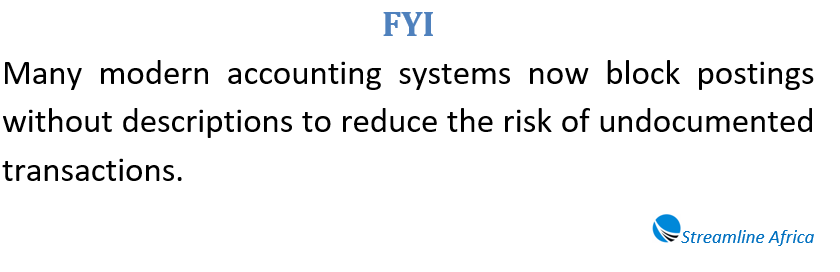
Organizations typically establish review procedures to identify entries that lack sufficient explanation. Modern accounting software may require descriptions before posting, but manual overrides or legacy systems can still allow incomplete records.
When a questionable entry is found, investigators examine supporting documents such as invoices, bank statements, authorization forms, and communication records. They may also interview staff members involved in the transaction to reconstruct events.
If documentation cannot be located, the entry may need to be reversed or corrected, particularly if it affects financial statements. Persistent unexplained entries may trigger broader internal audits to ensure that systemic weaknesses are not present.
Effective investigation emphasizes restoring clarity rather than assigning blame prematurely. The goal is to ensure that financial records accurately reflect reality.
Illustrative Scenario From a Financial Institution
Imagine a regional financial services firm that operates several divisions, including consumer lending, insurance brokerage, and investment advisory services. Each division maintains separate accounts to track performance and profitability.
During a routine internal review, accountants notice that a substantial amount of funds has been moved from the insurance division to the lending division. The journal entry shows the debit and credit amounts but provides no explanation, reference number, or supporting document.
Because the transfer affects divisional results, management becomes concerned. After investigation, they discover that the movement was intended to correct an earlier allocation error, but the staff member responsible neglected to document the reason. Although no fraud occurred, the lack of explanation created confusion and delayed reporting.
This example demonstrates how even legitimate actions can appear suspicious when not properly documented. Transparency protects both the organization and the individuals involved.
Preventing Blind Entries Through Strong Controls
The most effective way to avoid blind entries is to design systems that require meaningful descriptions and supporting evidence before transactions are posted. Many organizations implement mandatory fields in accounting software that prevent submission without adequate information.
Segregation of duties also helps. When different individuals are responsible for initiating, approving, and recording transactions, the likelihood of undocumented entries decreases. Review processes, such as periodic reconciliations and supervisory checks, further reinforce accountability.
Training plays a crucial role as well. Staff members should understand not only how to record transactions but why documentation matters. Emphasizing the connection between clear records and organizational integrity encourages careful practices.
Finally, establishing a culture that values transparency reduces the temptation to bypass procedures for convenience. When employees recognize that accurate records protect everyone, compliance becomes a shared responsibility.
The Broader Importance of Transparent Recordkeeping
Financial records serve as the historical memory of an organization. They support strategic planning, regulatory compliance, taxation, and stakeholder communication. Every unclear entry weakens that memory and introduces doubt about the reliability of the entire system.
Transparent documentation ensures continuity. Staff turnover, system upgrades, and organizational changes are inevitable. Clear records allow future users to understand past actions without relying on personal recollections or informal explanations.
Moreover, transparency fosters trust. Investors, partners, employees, and regulators all rely on financial information to make decisions. Consistent, well-documented entries demonstrate professionalism and integrity, strengthening relationships and reputation.
Conclusion
Blind entries represent transactions recorded without sufficient explanation of their origin or purpose. While they may satisfy the mechanical requirements of bookkeeping, they undermine the clarity and accountability that financial reporting demands. In rare cases involving very simple operations, minimal detail may not cause serious problems, but as organizations grow in complexity, undocumented entries become increasingly risky.
Unclear records can conceal errors, invite suspicion, and complicate audits. By implementing strong internal controls, requiring detailed documentation, and promoting a culture of transparency, organizations can minimize the occurrence of blind entries and maintain reliable financial information.
Ultimately, accounting is not only about balancing numbers but about telling an accurate story of economic activity. Ensuring that every entry is understandable helps preserve that story for all who depend on it.
FAQs about Blind Entries
Why are blind entries considered risky?
They reduce transparency and can hide errors, unauthorized transactions, or even fraud, making financial records less trustworthy.
Do blind entries violate double-entry bookkeeping rules?
No. They still balance debits and credits correctly, but they fail to provide the descriptive context needed to understand the transaction.
In what situations might blind entries occur unintentionally?
They often appear when staff rush postings, lack training, forget to attach documentation, or assume the reason for the entry is obvious.
Can blind entries ever be acceptable?
They may be tolerated in very simple businesses with repetitive transactions, but even then, supporting records should exist elsewhere.
How can blind entries affect audits?
Auditors treat them as red flags because they complicate verification and may require extensive investigation to confirm legitimacy.
What types of transactions commonly become blind entries?
Internal fund transfers, corrections, manual adjustments, or undocumented reallocations between departments are typical examples.
How can organizations prevent blind entries?
By enforcing documentation requirements, using accounting systems that require descriptions, and implementing review and approval controls.
What problems can blind entries create for management?
They can distort financial insights, misrepresent performance, and lead to poor decisions based on incomplete information.
Why is documentation so important in accounting?
Clear explanations ensure accountability, enable future review, support compliance, and preserve an accurate history of business activity.