
Economic growth has long fascinated policymakers, economists, and business leaders alike. For centuries, the key question has been: what truly drives long-term prosperity? While older theories emphasized external influences such as resource availability or capital accumulation, a newer perspective known as endogenous growth theory took a different approach. Instead of placing growth in the hands of uncontrollable external forces, it focuses on internal dynamics—such as knowledge, innovation, and human skill—as engines that can be cultivated and expanded. This shift reshaped economic debates from the late twentieth century onward and continues to influence policy choices today.
The Core Idea Behind Endogenous Growth Theory
At its heart, endogenous growth theory proposes that growth does not merely “happen” as a byproduct of external forces. Instead, it emerges from purposeful actions within an economy. Elements like investment in research and development, improved education systems, technological progress, and entrepreneurial initiatives can raise productivity and fuel a self-reinforcing cycle of expansion.
This contrasts with neoclassical models, which tend to argue that returns diminish over time. For instance, if a country builds more factories or buys more machines, each new addition is believed to produce less benefit than the one before it. Endogenous theorists challenge this by suggesting that knowledge and innovation are not subject to such strict diminishing returns. Knowledge can be shared, spread, and built upon, creating sustained and compounding benefits.

Why Internal Drivers Matter
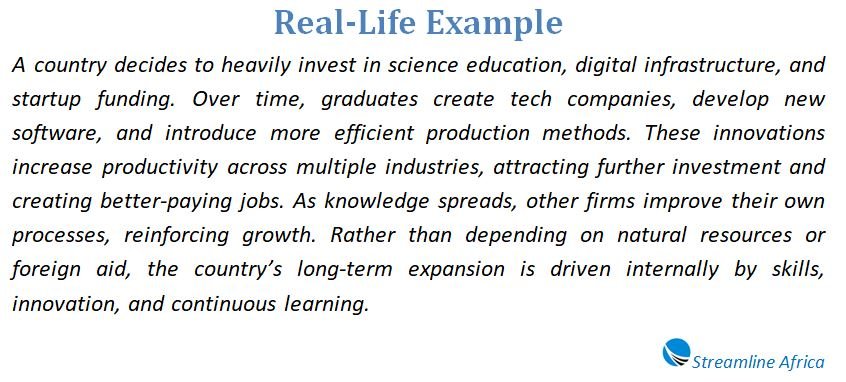
The theory stresses the importance of internal drivers of growth, particularly in modern economies that are heavily knowledge-based. For example, investment in higher education doesn’t only benefit individual learners—it spills over into broader society. Skilled workers can train others, start businesses, or push forward technological improvements that benefit industries at large.
Likewise, innovation in sectors such as information technology, telecommunications, and biotechnology generates ripple effects. When one company invents new software, competitors often learn, adapt, and innovate in response, creating a cycle of advancements that enriches the entire economy. The same is true for investments in health systems and infrastructure, which improve workforce productivity and support entrepreneurship.
The Role of Government Policy
One of the most distinctive features of endogenous growth theory is its emphasis on government policy. Unlike models that treat growth as a naturally occurring process, this perspective highlights the power of deliberate action. Effective policies can accelerate growth by creating the right conditions for innovation and competition.
Examples include:
- Education and health investment: Building schools, universities, and hospitals strengthens the foundation for long-term productivity.
- Infrastructure development: Roads, electricity, and internet connectivity enable businesses to thrive and innovate.
- Support for R&D: Direct funding, grants, or tax incentives encourage firms to experiment and develop new technologies.
- Protection of property rights: Strong intellectual property laws ensure that innovators and entrepreneurs can benefit from their inventions.
- Encouragement of entrepreneurship: Simplified regulations, access to credit, and business-friendly environments attract risk-takers who create jobs and generate new industries.
By targeting these areas, governments can create environments where innovation flourishes and productivity grows without hitting the barriers predicted by older economic models.
Private Sector Initiatives and Market Competition
While public policy is important, private enterprises also play a critical role in this framework. Businesses invest in research, take risks, and create competitive pressures that drive industries forward. Market competition encourages efficiency, while the race to out-innovate rivals spurs firms to keep improving products and processes.
Moreover, partnerships between private and public sectors can be particularly powerful. For instance, joint ventures in renewable energy or pharmaceuticals often combine government funding with private expertise. The result is faster technological breakthroughs that not only benefit companies but also improve living standards across society.
Historical Development of the Theory
The intellectual foundations of endogenous growth theory took shape in the 1980s, a period when economists were grappling with questions that older models struggled to answer. If physical capital faced diminishing returns, why were some nations able to maintain rapid growth for decades? Why did gaps between wealthy and poor countries persist even when both invested in infrastructure?
Economist Paul Romer was among those who provided a breakthrough. He argued that technological change was not just an external shock but something that could be deliberately fostered through investment and incentives. Romer emphasized that ideas, unlike physical resources, could be endlessly replicated and shared, creating sustained growth potential.
Over time, Romer’s insights gained recognition, though not without resistance. For years, critics dismissed his emphasis on knowledge and policy. However, his persistence paid off when he was awarded the Nobel Prize in Economics in 2018, confirming the profound impact of his ideas on modern economic thought.
Applications in Real Economies
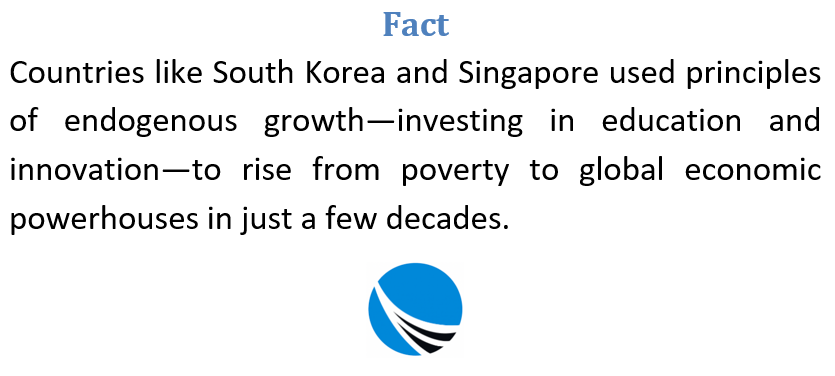
The practical relevance of endogenous growth theory can be seen in countries that have invested heavily in human capital and innovation. East Asian economies such as South Korea and Singapore often serve as case studies. These nations prioritized education, technological advancement, and supportive government policies, transforming themselves from low-income countries into global economic powerhouses within a few decades.
Similarly, in the technology-driven economies of North America and Europe, investment in universities, research institutions, and intellectual property protection has been central to maintaining long-term competitiveness. By fostering environments where knowledge flows freely while innovators are rewarded, these regions have managed to sustain high productivity growth.
Critiques and Challenges
Despite its influence, endogenous growth theory is not without controversy. One of the most common criticisms is that its assumptions are difficult to measure or validate. For instance, how can we accurately quantify the spillover effects of education or technological knowledge? Measuring such intangible factors poses a challenge for economists attempting to apply the theory in real-world policy contexts.
Another critique is that the theory may underestimate the importance of external factors. Natural resources, global trade dynamics, and geopolitical stability still play critical roles in shaping growth trajectories. While internal drivers matter, economies cannot always shield themselves from external shocks such as financial crises, wars, or climate-related disasters.
Additionally, the theory often assumes that governments will always enact policies that foster innovation. In reality, policy decisions can be shaped by politics, corruption, or short-term considerations that may not align with long-term growth goals.
Broader Implications for Policymakers
For policymakers, endogenous growth theory offers both inspiration and caution. On the one hand, it shows that deliberate choices—such as investing in people and innovation—can yield significant long-term dividends. On the other hand, it warns against simplistic solutions or overconfidence in theory alone. Strategies must be tailored to local contexts and adapted as circumstances evolve.
For instance, promoting entrepreneurship in a country with weak institutions and poor infrastructure may not deliver the expected outcomes. Conversely, countries with strong education systems and reliable governance may see rapid gains from innovation policies. The challenge for leaders is to balance ambition with practical execution.
The Ongoing Debate in Economics
The conversation around endogenous growth remains lively. Some economists continue to refine the theory by incorporating new insights from behavioral economics, network theory, and digital transformation. Others push back, arguing that global challenges like climate change, demographic shifts, and resource scarcity require broader models that integrate both internal and external dynamics.
What is clear, however, is that endogenous growth theory shifted the conversation away from passive acceptance of external forces and toward a more proactive stance. It encouraged policymakers and businesses to recognize the power of ideas, creativity, and strategic investment as engines of prosperity.
Conclusion
Endogenous growth theory fundamentally changed how economists and leaders view economic development. By placing emphasis on human capital, innovation, and purposeful investment, it provided a framework for understanding how societies can sustain growth over long periods. It highlighted the transformative power of education, research, technology, and entrepreneurship while also reminding us that supportive policies and competitive markets are essential.
At the same time, the theory’s limitations—such as measurement difficulties and reliance on assumptions—remind us to approach it with caution. No single model can fully capture the complexity of real-world economies. Still, by shedding light on the central role of knowledge and innovation, endogenous growth theory remains one of the most influential perspectives in modern economics.
Frequently Asked Questions
What does endogenous growth theory focus on?
It focuses on internal drivers of growth—like education, innovation, entrepreneurship, and investment—rather than relying on outside forces.
How is it different from neoclassical growth theory?
Neoclassical models emphasize diminishing returns on capital, while endogenous growth theory argues that knowledge and innovation can create lasting, compounding benefits.
Why is human capital central to the theory?
Because skilled and educated people spread knowledge, boost productivity, and fuel innovation, creating long-term positive spillovers for the economy.
What role do governments play?
Governments can accelerate growth through policies that fund education, strengthen infrastructure, support research, and protect intellectual property.
How does the private sector contribute?
Businesses invest in R&D, drive competition, and take risks that push industries forward, often working hand in hand with public policy.
Who is most associated with this theory?
Economist Paul Romer, who developed its foundations in the 1980s and later received the Nobel Prize in 2018 for his work.
What real-world examples show the theory in action?
Countries like South Korea and Singapore, which invested heavily in education, innovation, and technology, have transformed into economic leaders.
Why is innovation so important in this framework?
Innovation creates new products, processes, and industries that not only benefit inventors but also raise productivity across the entire economy.
What are the main critiques of endogenous growth theory?
Critics argue its assumptions are hard to measure, and it may understate the influence of external factors like global trade or natural resources.
Can poor policy undermine the theory’s promise?
Yes—if governments mismanage resources, neglect institutions, or fail to encourage competition, growth can stall despite potential internal drivers.
How does the theory shape policymaking today?
It inspires leaders to prioritize education, R&D funding, and entrepreneurship as tools to build long-term prosperity.
What is the lasting significance of this theory?
It shifted economics toward recognizing the power of ideas, innovation, and human capital as the real engines of sustainable growth.