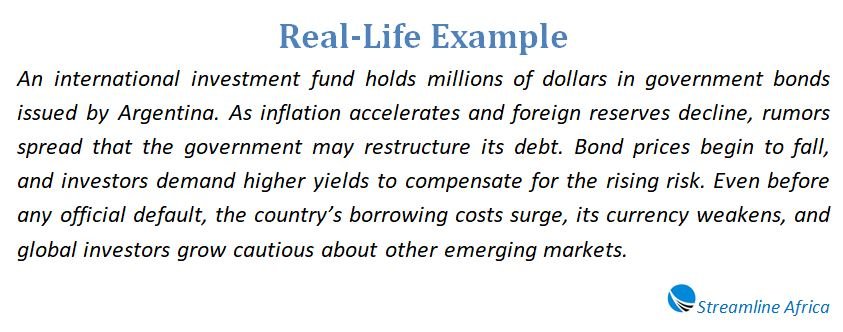
Sovereign credit risk refers to the possibility that a national government might fail to honor its debt commitments. This can mean defaulting on loans, neglecting bond repayments, or failing to comply with other agreed debt obligations. When this happens, it is termed a sovereign default. The stability and reputation of a country’s financial system are often reflected in its credit rating, which is carefully assessed by rating agencies. These agencies examine whether governments are likely to fulfill payments of both interest and principal, while also considering any history of procedural lapses or breaches of debt agreements.
Unlike private borrowers, sovereign states cannot be compelled through a legal process to settle their debts. Even in situations of financial crisis, repayment depends heavily on the willingness and policy choices of the government. Some governments resort to printing more money or allowing inflation to ease the burden of repayment. In extreme cases, creditor nations may exert diplomatic or political pressure, sometimes even resorting to international interventions to recover funds. The United States, for instance, established the Foreign Claims Settlement Commission to handle disputes and assist its citizens or institutions in recovering losses from foreign governments.

Because of these unique circumstances, lending to a country carries different risks compared to providing loans to individuals or corporations. Investors and creditors therefore exercise heightened caution when engaging with sovereign borrowers, often factoring in political and economic conditions before making financial commitments.
Factors That Influence Sovereign Risk
The likelihood that a government will fail to meet its debt obligations is influenced by several key economic indicators. Researchers often highlight five critical factors: the debt service ratio, the import ratio, the investment ratio, the variability of export revenues, and the pace of domestic money supply growth.
A higher debt service ratio—meaning that a larger share of national income goes toward paying debt—generally raises the risk of default. Similarly, when a country’s import ratio is high, it signals dependency on external goods and capital, which can strain its foreign reserves. Fluctuations in export revenue add another layer of uncertainty, particularly for nations heavily reliant on commodities. Sudden drops in export earnings can severely undermine their ability to repay debt. Additionally, rapid growth in money supply, if not supported by real economic output, often fuels inflation, weakening the currency and undermining repayment capacity.
The investment ratio plays a more complex role. Economists such as Frenkel and Scholtens argue that higher investment leads to stronger economic productivity, which should reduce the probability of default. More productive economies generate growth, making it easier for governments to service their debts. However, some analysts like Anthony Saunders present a different perspective, suggesting that when countries increase domestic investment, they may become less reliant on foreign capital. This independence could make governments more willing to reschedule or restructure debt since they are less concerned about maintaining favorable credit relations with external creditors.
The Reality of Sovereign Debt Crises
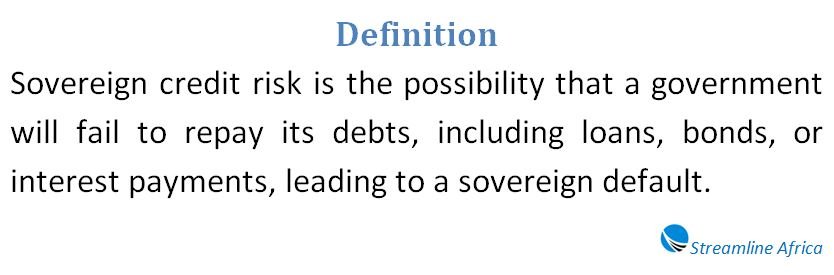
History offers many examples of governments struggling to meet their debt commitments, leading to widespread economic and social consequences. One notable case occurred in Cyprus in 2013, when the country was unable to fully meet its financial obligations, resulting in a bailout and severe economic restructuring. Similar crises emerged across the globe during the Great Recession of the late 2000s, when many nations faced shrinking revenues, rising unemployment, and escalating debt burdens.
Sovereign debt crises are rarely confined within borders. They often ripple into global markets, affecting investor confidence, weakening currencies, and at times destabilizing neighboring economies. This interconnected nature of finance means that sovereign credit risk is not just a concern for the borrowing nation, but also for international lenders, investors, and even global financial stability.
Managing Sovereign Credit Risk
For lenders and investors, dealing with sovereign risk requires a blend of caution and strategy. Unlike corporate lending, where contracts are enforceable through courts, sovereign debt relies largely on trust, credibility, and international relationships. Creditors may spread risk by diversifying across different countries, carefully analyzing credit ratings, or relying on international institutions such as the International Monetary Fund (IMF) for guarantees and support mechanisms.
Governments, on the other hand, can take measures to reduce their perceived credit risk. Maintaining strong fiscal policies, encouraging investment-driven growth, ensuring stable export earnings, and keeping inflation under control are all crucial steps. Political stability and transparent governance also play a significant role, as creditors are more likely to extend favorable terms to nations with reliable and consistent leadership.
Conclusion
Sovereign credit risk underscores the delicate balance between national borrowing needs and repayment capacity. While governments can access resources and instruments unavailable to individuals or corporations, their decisions carry broader implications for global financial systems. Investors must carefully evaluate the economic and political climate of a borrowing nation, while governments must recognize that maintaining credibility is just as important as securing immediate financial relief. Ultimately, managing sovereign risk requires mutual responsibility, foresight, and an understanding of the deeply interconnected nature of today’s global economy.
Sovereign Credit Risk – FAQs
How is sovereign credit risk different from individual or corporate risk?
Unlike private borrowers, governments cannot be forced by courts to pay back debts. Repayment depends on political will and policy decisions rather than enforceable contracts.

What role do credit rating agencies play?
Credit rating agencies assess a country’s ability to meet its debt obligations by evaluating factors like repayment history, fiscal policies, and economic stability, then assign ratings that influence investor confidence.
Can governments reduce their debts through inflation?
Yes, governments sometimes allow inflation or print more money to lessen the real value of debt, but this can weaken the currency and erode economic trust.
How can creditors pressure governments to repay?
Creditors may rely on diplomatic channels, international institutions, or even legal mechanisms like the U.S. Foreign Claims Settlement Commission to recover losses from sovereign defaults.
What economic indicators signal higher sovereign risk?
Key factors include a high debt service ratio, heavy reliance on imports, volatile export revenues, rapid money supply growth, and weak investment in productive sectors.
How does investment ratio affect sovereign risk?
Higher investment can boost productivity and reduce risk, but in some cases, it makes a country less dependent on foreign creditors, increasing the likelihood of debt rescheduling.
Why are export revenues so important?
Export earnings provide foreign currency needed to service international debts. If exports fall sharply, governments may struggle to meet repayment obligations.
What is an example of a sovereign debt crisis?
Cyprus in 2013 faced a severe crisis when it could not meet its debt obligations, requiring a bailout and restructuring. Many countries also faced sovereign risk during the Great Recession.
How do sovereign defaults affect global markets?
Defaults can shake investor confidence, disrupt financial flows, weaken currencies, and even spill over into neighboring economies, creating widespread instability.
How can investors manage sovereign credit risk?
Investors often diversify across different countries, pay attention to credit ratings, and sometimes rely on support from international organizations like the IMF.
What can governments do to lower their credit risk?
Strong fiscal policies, stable export performance, controlled inflation, transparent governance, and political stability all help reassure creditors and reduce perceived risk.