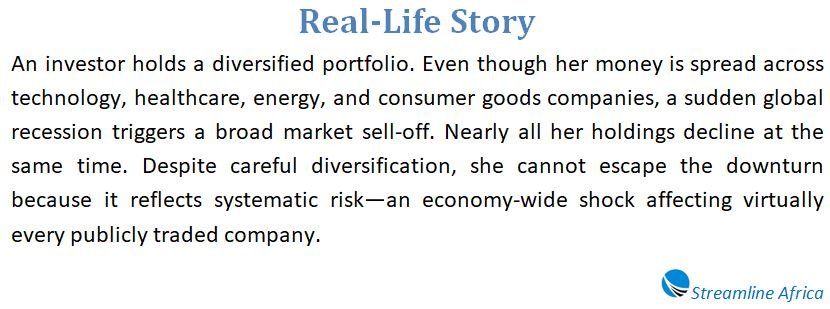
Systematic risk refers to the type of uncertainty that affects entire markets or economies, rather than individual companies or industries. It is sometimes called aggregate risk, undiversifiable risk, or market risk, because no matter how diversified an investor’s portfolio is, exposure to it cannot be fully avoided. Natural disasters, global recessions, wars, pandemics, or sudden shifts in government policy are all examples of forces that shake entire economies. Unlike risks tied to a single firm or sector, these broad forces alter the overall availability of resources and the performance of entire financial systems. This kind of risk can change the total value of wealth across an economy, not just how it is distributed. For instance, a devastating earthquake can simultaneously reduce output, income, and productivity at a national level, while an oil price shock can ripple through every industry. Because of its scale, systematic risk is considered a foundational concept in economics and finance, influencing everything from household decision-making to global trade.

Systematic vs. Unsystematic Risk
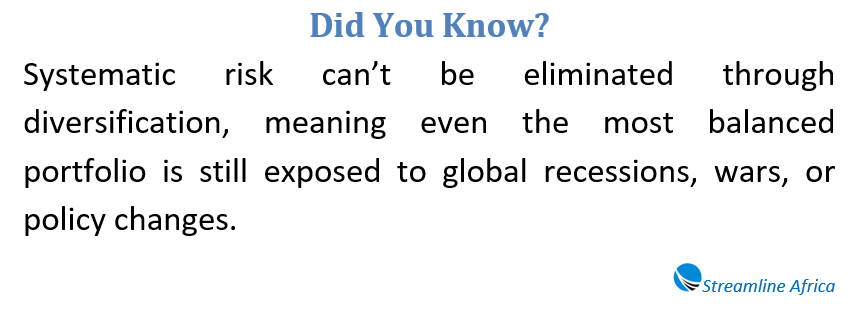
To fully grasp systematic risk, it helps to contrast it with unsystematic risk, sometimes called idiosyncratic risk. Unsystematic risks are specific to a company or industry—for example, a technology firm facing a cyberattack or a retailer struggling with declining brand reputation. These risks can be reduced or even eliminated through diversification: holding a wide range of investments lowers the impact of one firm’s misfortune. Systematic risk, however, is different. It arises from macroeconomic events and structural forces that affect all participants in a market simultaneously. Investors cannot diversify their way out of it because the shock is shared by everyone. At best, systematic risk can be partially managed through hedging, insurance, or shifting assets into safe havens such as government bonds. But because the entire system is vulnerable, it always remains present.
Sources of Systematic Risk
Systematic risk stems from a variety of causes. Economic policy changes—such as sudden tax reforms, monetary tightening, or deregulation—can shift the trajectory of markets overnight. International dynamics, like trade disputes or global financial crises, also play a role by altering capital flows and investor confidence. Nature can be just as influential. Severe storms, droughts, and pandemics disrupt supply chains, reduce productivity, and shrink demand. In small or developing economies, dependence on global trade means that fluctuations in commodity prices or currency values create additional vulnerability. These shocks are particularly costly where access to hedging markets is limited, leaving households, firms, and governments unable to shield themselves from broad losses.
Shiller’s Perspective on Global Risks
Economist Robert Shiller argued that despite globalization, national economies still carry significant aggregate risks. He suggested that the creation of global hedging mechanisms, such as macro futures markets, could allow countries to share or transfer some of these burdens. In theory, such systems would make risks that currently affect entire nations behave more like idiosyncratic risks—localized and potentially manageable. The feasibility of this, however, depends on how correlated economic conditions are across countries. If downturns happen everywhere at once, hedging opportunities shrink.
Why Systematic Risk Matters for Investors
For investors, systematic risk is not just an academic idea—it directly shapes portfolio returns. While diversifying across industries protects against firm-specific setbacks, it cannot insulate investors from market-wide downturns like recessions or interest rate hikes. This is why returns above the risk-free rate are tied to exposure to systematic risk, not unsystematic risk. Over time, the performance of a diversified portfolio is determined largely by how much systematic risk it carries. Investors seeking higher returns must accept greater vulnerability to such broad risks. Conversely, reducing exposure usually means moving money into assets with lower potential gains, like Treasury securities. The balance between risk and reward is therefore at the core of investment decisions.
The Role of Beta and CAPM
One of the most widely used tools for understanding systematic risk is the concept of beta. Beta measures how strongly an asset’s returns move in relation to the overall market. A beta above one signals higher sensitivity: the asset tends to rise more than the market in good times but also fall more sharply in downturns. A beta below one indicates weaker correlation. The Capital Asset Pricing Model (CAPM) formalizes this relationship. It argues that the expected return on an asset depends on its beta—its level of systematic risk—because investors must be compensated for bearing uncertainty they cannot eliminate. In this way, beta becomes a practical link between the abstract concept of aggregate risk and the concrete pricing of assets in markets.
A Practical Example
Imagine two investors. The first builds a portfolio spread across dozens of industries worldwide. By doing so, she minimizes the impact of any one company or sector collapsing. Yet she remains exposed to recessions or global inflation, because these affect all assets. To further reduce risk, she could purchase risk-free securities, but her returns would also fall. The second investor puts all of his money into one narrow sector, say agriculture. If agricultural returns happen to be uncorrelated with overall market swings, his portfolio might experience less systematic risk. But this investor is highly exposed to unsystematic risk: a drought or a shift in subsidies could devastate his returns. These contrasting strategies illustrate the trade-off between diversifying to avoid idiosyncratic shocks and managing unavoidable market-wide uncertainty.
Systematic Risk in Economics
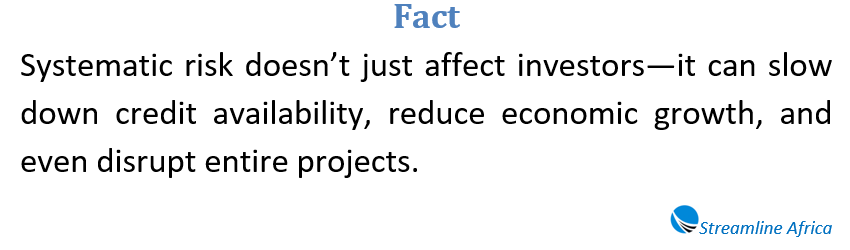
Economists study aggregate risk not only in financial markets but also in broader economic performance. Fiscal, monetary, and regulatory policies can trigger or amplify risks. For instance, unexpected interest rate hikes may lead to credit tightening, while trade sanctions can disrupt entire supply chains. Weather disasters and global pandemics add additional layers of uncertainty. The implications for growth are serious. When aggregate risk increases, banks may restrict lending to protect themselves. This credit rationing can lead to fewer productive investments, stunting capital accumulation and slowing the economy. Smaller firms are often hit hardest because they depend on external financing to grow. Over time, reduced access to credit can dampen innovation and productivity, making systematic risk a drag on long-term prosperity.
Aggregate Risk in Economic Models
In modeling economies, researchers often introduce aggregate risk through shocks to productivity, policy, or external conditions. These shocks help simulate how real-world events affect income, output, and consumption. In contrast, idiosyncratic risk is typically modeled through random changes in individual productivity or employment, which can be smoothed out if households have access to borrowing and asset trading. The welfare costs of aggregate risk, however, are usually larger. Since everyone is affected simultaneously, it is harder for agents to share or redistribute resources. In certain models, even small shocks at the micro level can combine to create significant macroeconomic volatility. For example, when firms depend heavily on each other’s performance—such as in global supply chains—disruptions can cascade, creating the appearance of a single large shock.
Arrow–Debreu Illustration
A classic way to illustrate aggregate risk comes from general equilibrium theory. Imagine two agents sharing one good in an economy with two possible states of the world. If each state leaves the economy with the same total amount of resources, then no aggregate risk exists: the outcome only shifts distribution, not the overall pie. Now suppose one state leaves the economy with more total resources than the other. This creates aggregate risk, because society as a whole faces uncertainty about how much wealth will be available. In such cases, financial instruments that pay off in “bad” states become more valuable, since they provide resources when the economy has less. This mirrors real-world finance, where claims that pay in downturns—such as certain government bonds—carry higher prices.
Challenges in Heterogeneous Agent Models
Modern economics often studies environments where agents differ in wealth, preferences, or opportunities. Incorporating aggregate risk into these models is notoriously difficult. The distribution of outcomes itself becomes a moving part of the system, making calculations highly complex. This issue, known as the curse of dimensionality, forces researchers to make simplifying assumptions or use advanced computational methods. One strategy is to assume that agents ignore certain details of the distribution, reflecting bounded rationality. Another is to develop numerical techniques that approximate outcomes without capturing every possible interaction. Each method comes with trade-offs, and economists continue to refine tools to better understand how aggregate shocks play out in societies with diverse participants.
Systematic Risk in Projects
Beyond finance and economics, systematic risk appears in project management. Here, it refers to uncertainties from external environments—political shifts, regulatory changes, or global crises—that affect entire projects regardless of internal planning. This differs from systemic risk, which is tied to specific internal processes, structures, or cultural issues within the project itself. For example, a project may be well-organized and efficiently managed, but sudden currency fluctuations or geopolitical instability can undermine its success. Recognizing these distinctions helps organizations prepare better strategies. While internal risks can often be mitigated with planning and monitoring, external systematic risks require contingency frameworks and adaptability.
Conclusion
Systematic risk is one of the cornerstones of both finance and economics. Unlike firm-specific risks that can be avoided through diversification, it touches everyone by altering entire markets and economies. Whether it arises from government actions, global crises, or natural disasters, systematic risk underscores the limits of control in an interconnected world. For investors, it defines the trade-off between risk and reward, shaping portfolio strategies and the valuation of assets. For economists, it frames questions of growth, credit, and welfare. And for project managers, it highlights the need to prepare for forces outside organizational control. Ultimately, systematic risk reminds us that no matter how carefully we plan or diversify, there are always larger uncertainties shaping outcomes. Learning to measure, anticipate, and adapt to these risks remains one of the greatest challenges for individuals, businesses, and policymakers alike.
Frequently Asked Questions about Systematic Risk
Why is it called undiversifiable risk?
It’s called undiversifiable because no matter how much an investor spreads their money across different sectors, they can’t escape broad market shocks—these hit all assets at once.
How does systematic risk differ from unsystematic risk?
Unsystematic risk is company- or industry-specific and can be reduced through diversification. Systematic risk, however, is linked to global or market-wide forces and cannot be eliminated this way.
Can investors completely avoid systematic risk?
No. While they can manage exposure by holding safer assets like government bonds, they cannot fully escape market-wide events that affect everyone.
What are common sources of systematic risk?
They include fiscal and monetary policy changes, international trade disputes, global recessions, inflation, pandemics, wars, and natural disasters.
How does systematic risk impact investors’ returns?
It determines the level of return investors expect above the risk-free rate. Higher exposure to systematic risk usually means higher potential returns, but also greater vulnerability to downturns.
What role does beta play in measuring systematic risk?
Beta shows how closely an asset’s returns move with the market. A high beta means the asset is more volatile than the market, while a low beta signals less sensitivity.
How does the Capital Asset Pricing Model (CAPM) use systematic risk?
CAPM ties an asset’s expected return directly to its beta, arguing that investors must be compensated for bearing unavoidable, market-wide risk.
What happens when systematic risk rises in the broader economy?
Banks may restrict lending, firms may cut investments, and overall productivity can slow down, reducing growth and opportunities for businesses and workers.
Why do economists include aggregate risk in models?
Aggregate risk helps simulate real-world shocks to productivity, policy, or trade. It highlights how everyone can be affected at the same time, making it more disruptive than individual risks.
How does systematic risk appear in project management?
In projects, it shows up as external uncertainties—like political changes or global crises—that can derail plans regardless of how well the project is managed internally.
Why is systematic risk so important to understand?
Because it influences everything from investment decisions to economic growth and project planning, systematic risk reminds us of the limits of control in an interconnected world.