
Understanding how many people are without work is one of the most basic ways economists evaluate the strength of an economy. Yet the unemployment rate is often misunderstood, oversimplified, or taken out of context. Behind the headline figure is a carefully defined measurement system designed to capture labor market conditions with consistency over time. This article presents a fully reimagined explanation of the unemployment rate—using new examples, new locations, and a fresh narrative—while preserving the core structure and meaning of the original concept.
Defining the Unemployment Rate
At its core, the unemployment rate represents the share of a country’s labor force that does not currently have a job but is actively seeking employment. It does not include everyone who is without work. Instead, it focuses on individuals who are both available for work and have taken recent steps to find a job.
This distinction is crucial. Someone who is retired, enrolled in school full-time, caring for family members, or who has stopped looking for work altogether is not counted as unemployed, even if they would prefer to have a job. The unemployment rate, therefore, reflects job-seeking activity rather than total joblessness.
How the Headline Number Is Released
In the United States, national unemployment figures are published monthly, typically on the first Friday, and reflect conditions from the previous month. These figures are compiled and released by a federal statistical agency responsible for labor data. Economists, investors, policymakers, and journalists closely monitor these releases because they offer insight into whether the economy is expanding, slowing, or contracting.
Because employment trends tend to respond after broader economic shifts have already begun, the unemployment rate is considered a “lagging indicator.” It often rises after an economic downturn is underway and falls only after recovery has gained momentum.
Key Points to Know
- The unemployment rate measures people without jobs who are actively searching for work.
- Only individuals in the labor force—those working or looking for work—are included.
- The headline rate is published monthly and is widely used as a benchmark for economic health.
- Alternative unemployment measures exist to capture broader forms of labor underutilization.
How Employment Status Is Determined
To understand the unemployment rate, it helps to know who is considered “employed.” Anyone who worked for pay during the survey period is counted, whether their job is full-time, part-time, temporary, or permanent. Individuals who worked unpaid hours for a family-owned business or farm also qualify as employed, provided they meet a minimum time threshold.
Conversely, people who want a job but have not searched recently are not classified as unemployed. Instead, they are labeled as “not in the labor force.” This group includes discouraged workers who believe no suitable jobs are available for them, as well as people facing barriers such as lack of transportation, caregiving responsibilities, or health limitations.

Seasonal Adjustments and Why They Matter
Employment patterns fluctuate throughout the year. Retail hiring spikes during holidays, agricultural work increases during harvest seasons, and construction slows during colder months. To make month-to-month comparisons meaningful, statisticians apply seasonal adjustments that smooth out these predictable changes.
Alongside the adjusted figures, unadjusted data is also published. Analysts often examine both to gain a fuller picture of short-term trends and underlying labor market momentum.
Beyond the Headline: Alternative Unemployment Measures
While the most commonly cited unemployment rate captures a narrow definition of joblessness, additional metrics provide broader perspectives on labor market slack. These alternative measures are often grouped into a series, each expanding the definition of underutilized labor.
One measure focuses only on people who have been unemployed for extended periods, highlighting long-term joblessness. Another isolates individuals who recently lost jobs or completed temporary assignments. Broader measures add discouraged workers and those loosely connected to the labor force—people who want work but have not searched recently.
The most expansive metric includes all of these groups plus individuals working part-time who would prefer full-time hours but cannot find them due to economic conditions. This broader view is sometimes referred to as the most comprehensive snapshot of labor underutilization.
Although commentators sometimes label this expanded measure as the “real” unemployment rate, policymakers and media outlets continue to treat the narrower headline rate as the official benchmark for consistency and historical comparison.
How Labor Market Data Is Collected
Unemployment statistics are not based on tax records or unemployment insurance claims. Instead, they come from a large, ongoing household survey conducted each month. Tens of thousands of households across the country participate, providing a representative snapshot of the civilian population.
Survey participants are asked detailed questions about their work activity, job searches, hours worked, industries, occupations, and earnings. Interviewers do not label respondents as employed or unemployed; they simply record answers. Statistical analysts later apply standardized criteria to classify each individual.
The survey design rotates participants over time, allowing researchers to track changes while maintaining continuity. Certain groups are excluded from the survey, including people under a specific age, active-duty military personnel, and individuals living in institutional settings such as prisons or long-term care facilities.
Why Unemployment Matters to the Economy
The unemployment rate is one of the most closely watched indicators of economic performance, alongside measures of output and inflation. Changes in unemployment influence monetary policy decisions, business investment strategies, and government spending priorities.
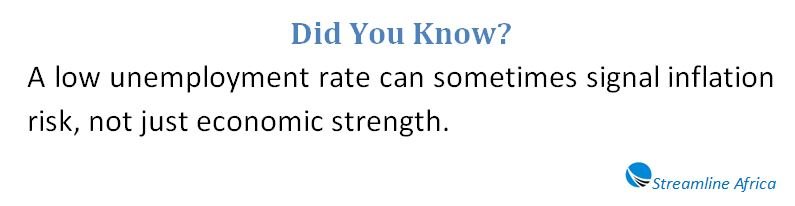
When unemployment is low, employers compete more aggressively for workers. This often leads to rising wages, which can boost consumer spending but also contribute to inflation if businesses raise prices to cover higher labor costs. Strong labor markets are also associated with higher corporate earnings and, in many cases, rising stock prices.
On the other hand, high unemployment reduces household income, weakens consumer demand, and can strain public assistance programs. Prolonged joblessness may also lead to skill erosion, making it harder for affected workers to reenter the labor force.
What Is Considered a “Healthy” Unemployment Rate?
There is no universally agreed-upon ideal unemployment rate. Extremely low unemployment can signal an overheated economy, where labor shortages push wages and prices upward too quickly. Extremely high unemployment, however, reflects economic distress and reduced living standards.
Many economists suggest that a moderate range—often cited between roughly three and five percent—balances job availability with price stability. Still, the appropriate level depends on broader conditions, including productivity growth, demographics, and global economic trends.
Understanding the Difference Between Narrow and Broad Measures
The most commonly reported unemployment rate focuses on people who are currently out of work and actively searching. This narrow scope ensures consistency but excludes several groups facing real employment challenges.
Broader measures incorporate discouraged workers, marginally attached individuals, and involuntary part-time workers. Comparing these metrics can reveal hidden weakness or strength in the labor market. For example, a stable headline rate paired with a rising broad measure may suggest growing underemployment rather than outright job losses.
Frequently Asked Questions
What does the unemployment rate actually show?
It shows the proportion of the labor force that is jobless but actively seeking employment, not the share of the total population without work.
Why aren’t discouraged workers counted as unemployed?
Because they have not searched for work recently, they are classified as outside the labor force under standard definitions.
Is unemployment data based on benefits claims?
No. It comes from a household survey, not administrative records.
Why do markets react strongly to unemployment reports?
Because the data influences expectations about economic growth, interest rates, and corporate profits.
Final Takeaway
The unemployment rate is far more than a single percentage reported in the news. It is a carefully constructed indicator that reflects job-seeking behavior, labor market conditions, and economic momentum. While the headline figure provides a useful benchmark, alternative measures and contextual data are essential for a complete understanding.
By knowing how unemployment is defined, measured, and interpreted, readers can better evaluate economic headlines and understand what labor market shifts truly mean for workers, businesses, and policymakers alike.