
The price-to-earnings ratio, commonly known as the P/E ratio, is one of the most recognizable numbers in the world of investing. When people say a stock has a P/E of 30, they are referring to how the market values a company’s profits relative to its share price. While the number itself may seem straightforward, the implications behind it can be far more layered and revealing. A P/E ratio of 30 often reflects investor optimism, strong expectations for future growth, or even broader trends shaping the industry a company operates in. Understanding how this figure works and what it signals can help investors make more thoughtful and informed decisions.
A P/E ratio of 30 means the market price of one share is thirty times the amount of earnings the company generated per share over a specified period, typically the past year. This ratio captures how much investors are willing to pay for each dollar of earnings and sums up the market’s sentiment toward the company’s prospects. To see why this matters, it helps to look deeper into how the ratio is formed and how it is used.
What a P/E Ratio of 30 Represents
The P/E ratio itself is calculated by dividing the current share price by the company’s earnings per share (EPS). If a company’s stock trades at 90 dollars and its EPS is 3 dollars, the P/E ratio is 30. This indicates that investors are paying thirty dollars for every single dollar of the company’s annual profits. When this number sits at 30, the market is essentially saying that it expects substantial earnings growth ahead or that the company’s future potential is promising enough to justify such a price.
Because the P/E ratio reflects what investors collectively believe about a company’s performance and trajectory, it can serve as a quick point of reference for determining whether a stock appears expensive or reasonably priced. In simple terms, a higher P/E ratio generally means investors expect more from the company. A lower one suggests more modest expectations or concerns about the company’s stability or long-term prospects.
Why a P/E of 30 Is Considered High
A P/E of 30 stands above the long-term average for most major stock markets. Historically, broad indexes such as the S&P 500 tend to hover around much lower ranges during typical economic conditions. When a company carries a P/E this elevated, it suggests that investors see rapid growth, significant innovation, or strong competitive advantages on the horizon. Companies in technology, biotech, renewable energy, or digital platforms often fall into this category during periods of expansion.
High P/E ratios are often seen in younger companies that are still scaling their operations or entering new markets. These businesses may not yet have large profits, but their potential is compelling. As firms mature, however, their growth rate typically slows, leading investors to adjust their expectations. This shift often results in a declining P/E ratio even if earnings continue to rise.
It is important to note that a high P/E ratio does not automatically make a stock overpriced, just as a low P/E does not guarantee a great bargain. The ratio must be considered in context: industry norms, economic cycles, and competitive landscapes all contribute to how appropriate a P/E of 30 may be for a given company.

How Analysts Interpret a P/E of 30
Investors and financial analysts rely on the P/E ratio not only to assess individual stocks but also to compare companies. A stock with a P/E of 30 may look expensive beside a competitor trading at a P/E of 12, but the difference could come from varying levels of risk, growth potential, or business maturity.
Analysts carefully examine whether a P/E of 30 is justified by the company’s earnings trends, product pipeline, market expansion, and overall strategic direction. If the company’s earnings are expected to accelerate meaningfully, the high P/E may be seen as reasonable. On the other hand, if the company’s profits are stagnating or declining, a P/E of 30 might be viewed as unsustainable or speculative.
Some analysts caution that the traditional P/E ratio, while simple and widely used, can sometimes paint an incomplete picture. Companies can experience short-term fluctuations in earnings due to one-time events, write-downs, or accounting changes, all of which can distort the ratio. For these reasons, analysts often pair the P/E with other valuation tools, such as the price-to-sales ratio, price-to-cash-flow ratio, or forward P/E based on projected earnings rather than past results.
The Challenge of Comparing Companies Using P/E
Comparing the share price of two companies without considering their earnings, capital structure, or the number of shares outstanding can lead to misleading conclusions. Two firms might have share prices that look very different, but if one has far more shares in circulation or operates in a slower-growing sector, the comparisons break down.
The P/E ratio helps normalize these differences by relating price directly to earnings. However, even with this normalization, comparisons can still be tricky. Companies in different industries operate under different growth expectations, competitive pressures, and economic conditions. A P/E of 30 for a fast-growing software company may be perfectly normal, while the same ratio for a utility company might signal extreme overvaluation.
Additionally, companies at different stages of development naturally show varied P/E ratios. Early-stage firms often attract investor enthusiasm and carry higher valuations, while mature firms with predictable cash flows tend to settle into lower ranges. Investors must interpret a P/E of 30 with an understanding of not just the company itself but also the broader ecosystem it participates in.
P/E Ratios in a Modern Financial Landscape
The traditional understanding of P/E ratios has evolved as technology-driven companies and digital platforms have become more prominent. These firms often operate on very different models than those that dominated financial markets decades earlier. Some fast-growing companies reinvest heavily in expansion rather than maximizing short-term profit, which can temporarily depress earnings and inflate P/E ratios.
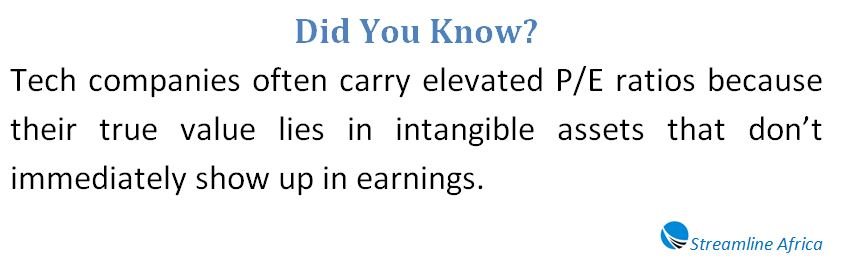
Furthermore, intangible assets such as software, brand equity, and intellectual property can significantly influence a company’s value without directly appearing in earnings. As a result, traditional valuation metrics sometimes fail to fully capture the underlying value of modern businesses. This shift has encouraged the development of refined versions of the P/E ratio, including forward P/E and cyclically adjusted P/E (CAPE), which attempt to smooth out distortions and better predict long-term performance.
Despite these complications, the P/E ratio remains a central component of stock evaluation because it offers an intuitive way to compare price and earnings.
What a P/E of 30 Means for Investors
When an investor encounters a stock trading at a P/E of 30, the number itself acts as a starting point rather than a conclusion. It raises questions about the company’s growth plans, competitive position, and long-term viability. An investor might consider whether the company’s innovations justify its premium valuation or whether broader market conditions have inflated prices across the sector.
A P/E of 30 can indicate optimism, but it can also reflect market speculation. Investors may be rushing into a trend without fully examining whether the company can actually deliver the growth that such a valuation implies. Because of this, relying solely on the P/E ratio can be risky. Thoughtful investors compare this metric with other indicators, analyze the company’s strategic direction, and consider how economic conditions might affect future earnings.
Final Thoughts
A P/E ratio of 30 suggests the market is placing a high value on a company’s earnings, expecting strong performance moving forward. While it can signal growth potential, it may also raise caution if the underlying fundamentals do not support such optimism. The ratio remains a crucial part of stock analysis, but it must be used alongside a deeper understanding of the company’s industry, business model, and financial structure.
The P/E ratio continues to be one of the simplest yet most powerful tools available to investors. When interpreted with care, a P/E of 30 offers insights into how the market views a company’s future and how investors can position themselves more wisely in a dynamic and ever-changing financial landscape.
FAQs
Why is a P/E of 30 considered high?
Because it sits above long-term market averages and is typically associated with companies that investors believe will grow rapidly or dominate their industries.
Does a high P/E mean a stock is overpriced?
Not necessarily. It may indicate strong growth potential, but it could also signal overly optimistic speculation. Context matters.
How should investors compare companies using P/E ratios?
They should compare companies within the same industry or growth stage since different sectors have different norms and earnings patterns.
Why do analysts use additional metrics beyond the P/E ratio?
Earnings can be distorted by temporary events, so analysts use other valuation tools to get a clearer picture of a company’s true financial health.
How do modern digital businesses affect P/E interpretation?
Digital and tech-driven companies often reinvest heavily and rely on intangible assets, leading to higher P/E ratios that require careful interpretation.
What risks come with investing in a company with a P/E of 30?
The biggest risk is that the company fails to deliver the growth the market expects, which can cause the stock price to fall.
How should investors approach a stock trading at a P/E of 30?
They should treat it as a starting point for deeper analysis, looking at growth prospects, competitive strengths, and broader economic conditions before deciding.