In many rapidly expanding companies, a paradox is quietly taking shape. Leaders trim middle management roles in the hope of accelerating productivity and reducing bureaucracy, only to discover that execution becomes slower and more chaotic. What initially appears to be a move toward efficiency often ends up disrupting the very systems that enable consistent progress.
When organizations eliminate managerial layers, they may assume they are simplifying decision-making. However, the reality is more complex. Work still needs direction, coordination and oversight. When these responsibilities are not clearly assigned to capable managers, they do not disappear. Instead, they migrate upward to senior executives or disperse unevenly across teams, creating confusion and inefficiencies. Employees can feel uncertain about priorities, and projects can lose momentum due to a lack of structured guidance.
Rather than streamlining operations, removing middle management frequently shifts operational strain to leadership while weakening alignment across departments. This can cause a breakdown in execution, even when the strategic vision remains strong.
Why Middle Managers Matter More Than Organizations Realize
Senior leadership teams often excel at defining goals and outlining strategic direction. They can leave planning meetings feeling aligned and confident about the company’s future. But agreement at the top does not automatically translate into coordinated action on the ground.
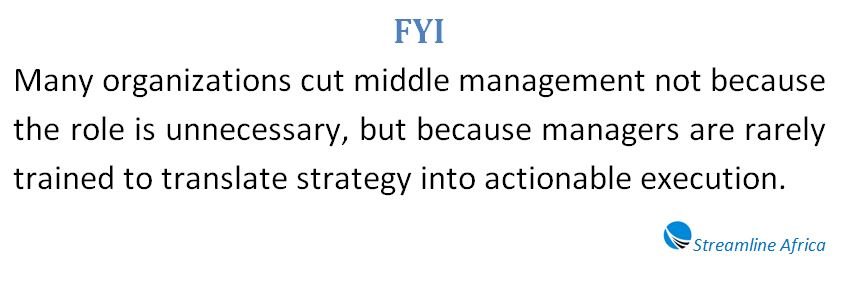
Execution requires interpretation. Strategic objectives must be broken down into actionable plans that individual teams can understand and implement without constant supervision. This translation process is one of the most vital functions of middle managers. They bridge the gap between broad organizational goals and day-to-day operations.
When this layer is functioning effectively, managers convert abstract strategies into clear priorities, timelines and measurable objectives. They also ensure that different departments operate cohesively rather than in isolation. Without this layer, even well-designed strategies can stall because employees lack clarity on how to apply them in practice.
Additionally, middle managers foster ownership. They monitor progress, provide feedback and hold teams accountable for outcomes. In their absence, tasks may still get done, but consistency, coordination and long-term improvement often suffer.

What Really Happens When the Middle Layer Disappears
Organizations that reduce middle management frequently expect fewer delays and faster decision cycles. Instead, several predictable challenges tend to emerge.
First, decision-making becomes centralized. Teams still encounter obstacles, conflicts and priority questions that require resolution. Without department-level leaders to handle these issues, employees escalate them directly to senior executives. Over time, executives become deeply involved in operational matters, diverting their focus away from long-term strategy and innovation.
Second, accountability becomes diluted. When no one is clearly responsible for overseeing progress within a function, initiatives may lose direction. Teams may work autonomously, but autonomy without structured leadership can lead to inconsistent results, duplicated efforts and incomplete follow-through. Clear ownership is essential for maintaining momentum and measuring success.
Third, cross-functional collaboration weakens. Many organizational challenges arise not within individual departments but between them. Marketing, product, operations and sales must coordinate closely to achieve meaningful outcomes. Middle managers typically facilitate this coordination by aligning priorities and resolving interdepartmental conflicts. Without them, silos can solidify, miscommunication increases and rework becomes more common.
The Misconception That Flatter Always Means Faster
Flattening an organizational structure can be effective in small or less complex environments where communication flows naturally and teams operate closely together. However, as companies grow, complexity increases. More teams, markets and processes require structured leadership to maintain cohesion.
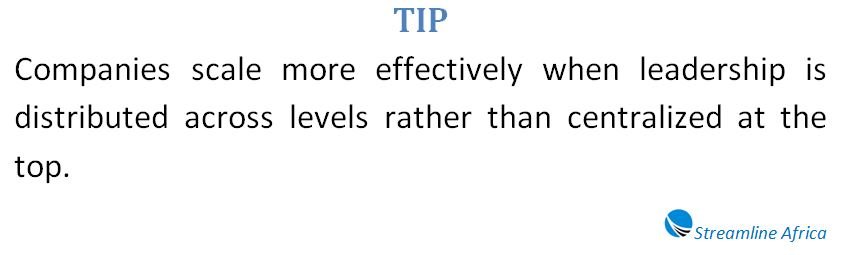
Scaling is not about reducing leadership; it is about distributing it appropriately. Sustainable growth depends on empowering leaders at multiple levels who can make informed decisions while staying aligned with the organization’s vision. When authority is overly centralized, bottlenecks form and responsiveness declines.
A scalable organization relies on managers who can interpret strategy, coordinate across functions and make timely decisions without constant executive involvement. This is not unnecessary bureaucracy but essential infrastructure that supports sustainable execution.
When Middle Management Underperforms
It is important to acknowledge that middle management sometimes fails to deliver value. In many cases, managers are promoted because they excelled as individual contributors, not because they were trained to lead teams or think strategically. As a result, they may focus heavily on tasks and coordination rather than leadership and alignment.
When managers operate primarily as administrators rather than decision-makers, executives may conclude that the entire layer is inefficient. This perception can lead to widespread cuts, even though the root issue is not the existence of middle management but the lack of proper development and support.
Organizations that neglect leadership training often end up with managers who lack the confidence or skills to translate vision into action. Without a clear understanding of organizational goals and the reasoning behind them, managers may simply relay instructions instead of driving meaningful progress.
Strengthening the Middle Instead of Eliminating It
Rather than removing middle management, companies should focus on improving its effectiveness. This begins with intentional development programs that help managers understand strategic priorities, not just operational tasks. When managers grasp the “why” behind decisions, they are better equipped to align their teams and make informed choices independently.
Structured forums and leadership workshops can also help mid-level leaders think beyond their immediate responsibilities. By encouraging broader perspective and cross-functional awareness, organizations create managers who can coordinate efforts more effectively and reduce unnecessary escalations.
Another valuable approach is establishing clear communication channels between executives and mid-level leaders. When managers are consistently informed about strategic shifts, they can adapt team priorities quickly and maintain alignment across departments.
External advisors or leadership coaches can further support this process by introducing repeatable systems for decision-making, accountability and performance tracking. This ensures that as the organization grows, its leadership structure remains resilient and adaptable.
Building Accountability Through Distributed Leadership
Effective organizations cultivate leadership at every level rather than concentrating authority at the top. Middle managers play a crucial role in reinforcing accountability by setting expectations, monitoring progress and ensuring that teams remain focused on outcomes instead of just activity.
When leadership responsibilities are shared appropriately, teams gain clarity about ownership and performance standards. This creates a culture where decisions are made closer to the work itself, leading to faster responses and better-informed actions.
Distributed leadership also enhances employee engagement. When team members receive consistent guidance and feedback from capable managers, they are more likely to feel supported and aligned with organizational goals. This reduces uncertainty and improves overall productivity.
A More Sustainable Path to Organizational Efficiency
Cutting middle management may create the appearance of efficiency in the short term, particularly in cost-focused environments. However, the long-term consequences often include slower execution, increased executive overload and fragmented collaboration. These outcomes undermine the very efficiency such restructuring is meant to achieve.
Organizations that prioritize sustainable growth recognize that execution is a system, not just a strategy. That system requires leaders who can translate vision into actionable plans, align diverse teams and maintain accountability throughout the organization.
Instead of viewing middle management as expendable, companies should see it as a critical layer of operational infrastructure. By investing in leadership development, clarifying roles and empowering mid-level managers to make decisions, organizations can achieve both speed and alignment.
Ultimately, scalable companies do not succeed by concentrating control at the top. They succeed by building capable leaders across all levels who can carry the vision forward, coordinate execution and maintain momentum as complexity increases. Strengthening the middle layer, rather than removing it, provides a more balanced and effective path toward long-term organizational success.