
When investors examine a company’s earnings, the headline profit number often gets the most attention. But profit alone rarely tells the full story. A business earning $500 million annually may seem impressive until you discover it needed enormous resources and heavy borrowing to generate those returns.
That is why experienced analysts rely on profitability ratios like Return on Assets (ROA) and Return on Equity (ROE). These two measurements help investors understand not just how much money a company makes, but how efficiently it generates those profits.
Although the terms sound closely related, ROA and ROE highlight entirely different dimensions of financial performance. One focuses on operational efficiency, while the other centers on shareholder returns and the impact of financing decisions.
Understanding how these metrics work together can help investors identify financially disciplined companies and avoid businesses masking weaknesses behind excessive debt.
Return on Assets (ROA): Measuring Operational Productivity
Return on Assets evaluates how effectively a company converts its resources into net profit. It reflects management’s ability to use everything the company owns — including cash reserves, property, inventory, patents, and equipment — to produce earnings.
In simple terms, ROA answers one question: how much profit is generated from every dollar tied up in company assets?
The formula is straightforward:
ROA=Total AssetsNet Income
A higher ROA generally signals stronger operational efficiency. Businesses that can produce substantial earnings without maintaining massive asset bases often demonstrate better resource allocation and management discipline.
Investors commonly interpret ROA using broad benchmarks:
- Below 5% often suggests weak asset utilization
- Between 5% and 10% usually reflects healthy efficiency
- Above 10% may indicate exceptional operational performance
However, these ranges vary significantly across industries.
Consider two fictional businesses. Aurora Cloud Systems, a software developer based in Singapore, operates with relatively few physical assets. Most of its value comes from intellectual property and digital infrastructure. Because of this lean structure, the company may achieve a very high ROA.
Meanwhile, Northern Freight Airways in Canada requires billions of dollars in aircraft, maintenance equipment, fuel contracts, and airport infrastructure. Even if the airline generates large profits, its ROA will naturally remain lower due to the enormous asset base required to operate.
This is why ROA is especially useful for comparing companies within the same industry rather than across unrelated sectors.
Return on Equity (ROE): Evaluating Shareholder Performance
While ROA focuses on company-wide efficiency, Return on Equity concentrates specifically on shareholder capital.
ROE measures how effectively a business generates profits using money invested by shareholders. Because it directly evaluates returns on investor capital, many stock analysts consider ROE one of the most important long-term performance indicators.
The formula looks like this:
ROE=Shareholders’ EquityNet Income
Shareholders’ equity represents the remaining value of a company after subtracting liabilities from total assets. In other words, it reflects the ownership stake investors truly hold in the business.
General ROE interpretations include:
- Under 10% may indicate inefficient capital use
- Between 10% and 20% often reflects solid financial management
- Above 20% can signal strong shareholder returns
Imagine two retail chains operating in different parts of Europe.
The first company, Baltic Home Furnishings, earns $8 million annually while carrying very little debt. Its shareholder equity totals $80 million, giving it an ROE of 10%.
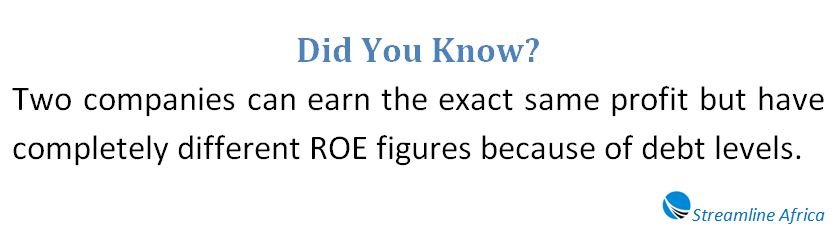
The second company, Verona Living Stores, also earns $8 million annually but operates with heavy borrowing. Because its equity base has been reduced to just $16 million, its ROE jumps to 50%.
At first glance, Verona Living Stores appears far more attractive to investors. But the dramatic difference is largely driven by leverage rather than operational superiority.
This distinction is critical.
The Key Difference Between ROA and ROE
The most important factor separating ROA from ROE is debt.
ROA ignores financing structure and evaluates pure operational performance. It does not matter whether assets were purchased using investor money or borrowed capital.
ROE, however, is directly influenced by liabilities because debt reduces shareholder equity. As borrowing increases, equity becomes smaller, which can artificially inflate ROE.
This relationship explains why ROE is usually higher than ROA.
A useful way to understand this concept is through real estate investing.
Suppose an entrepreneur purchases a commercial property worth $1 million that generates $100,000 annually in profit.
If the entire property is purchased with cash, both ROA and ROE would be roughly 10%.
But imagine the investor contributes only $200,000 personally and finances the remaining $800,000 through loans. The property still generates the same profit, so ROA remains tied to the full asset value. However, ROE is now calculated using only the investor’s $200,000 equity contribution.
As a result, the ROE increases dramatically.
Debt acts like a financial amplifier. It can boost returns during profitable periods, but it also magnifies losses and risk during downturns.
Why Analysts Use the DuPont Framework
Professional investors often go beyond basic ROE calculations by applying the DuPont Analysis framework.
Rather than treating ROE as a standalone figure, this method breaks it into three separate components:
- Profit margin
- Asset turnover
- Financial leverage
This helps analysts identify the true driver behind strong shareholder returns.
The relationship can be expressed as:
ROE=Profit Margin×Asset Turnover×Financial Leverage
A company with high ROE may genuinely deserve praise because it maintains strong margins and efficient operations. Alternatively, the same impressive ROE could simply result from aggressive borrowing.
For example, Horizon Beverage Group in Australia may post a high ROE because its products command premium pricing and generate strong margins.
On the other hand, a construction company with weak operating performance could display a similar ROE simply because it relies heavily on debt financing.
Without deeper analysis, investors may mistake financial risk for operational excellence.
Industry Context Is Essential
Profitability ratios mean little without industry context.
Different sectors require vastly different levels of assets and financing structures, making direct comparisons misleading.
Heavy manufacturing firms, shipping companies, utilities, and telecom providers are capital-intensive businesses. They require expensive infrastructure and large equipment investments, which naturally suppress ROA figures.
By contrast, digital consulting firms, software developers, and media agencies operate with minimal physical assets. These businesses can produce high profits while maintaining relatively small balance sheets, resulting in much stronger ROA values.
ROE also varies widely by industry norms.
Banks, for example, typically operate with substantial leverage as part of their business model. A higher ROE may be common and acceptable in financial institutions, whereas excessive leverage in another sector could indicate dangerous financial stress.
Investors should therefore compare profitability ratios against:
- Industry averages
- Direct competitors
- Historical company performance
A declining ROA over several years may indicate that new investments are producing weaker returns. Similarly, a rapidly rising ROE paired with growing debt levels may signal excessive financial risk.
When High ROE Becomes a Red Flag
Many beginner investors assume higher ROE always means a stronger company. In reality, extremely high ROE can sometimes indicate serious financial problems.
If a business accumulates excessive debt, shareholder equity can shrink dramatically. Since ROE uses equity as the denominator, even moderate profits can create inflated returns on paper.
This becomes especially dangerous when interest rates rise or economic conditions weaken.
Imagine a fashion retailer in South Africa that finances aggressive expansion almost entirely through loans. Initially, its ROE climbs sharply, attracting investor excitement.
But if consumer demand slows, debt payments remain fixed while profits decline. The company suddenly faces mounting financial pressure despite previously impressive ROE figures.
This is why ROA and ROE should always be evaluated together.
A company with stable ROA and healthy ROE often demonstrates balanced growth and sound financial management.
However, if ROA weakens while ROE remains artificially elevated, leverage may be masking deteriorating fundamentals.
Negative ROA and ROE: What They Mean
Both ROA and ROE can become negative when a company reports a net loss.
Negative ROA indicates the company is losing money relative to its asset base, while negative ROE shows shareholder capital is generating losses instead of returns.
Temporary negative ratios may occur during restructuring phases, economic downturns, or heavy investment periods. However, persistent negative values often point to deeper operational or financial problems.
Investors should examine whether losses stem from temporary circumstances or structural weaknesses within the business model.
Final Thoughts
ROA and ROE are among the most valuable tools for evaluating corporate performance, but they serve different purposes.
ROA reveals how efficiently management uses total company resources to generate profits. ROE shows how effectively shareholder capital is producing returns.
Together, these ratios provide a clearer picture of whether growth is driven by operational strength or financial leverage.
Smart investors avoid relying on a single metric. Instead, they examine profitability ratios alongside debt levels, industry standards, historical trends, and overall business quality.
The strongest companies usually demonstrate a healthy balance: consistent ROA supported by disciplined operations and sustainable ROE backed by responsible financing.
The next time you research a company, go beyond headline earnings. Study how efficiently it uses assets, how responsibly it handles debt, and whether shareholder returns are built on solid foundations or borrowed money. That deeper analysis often separates durable investments from future disappointments.
Frequently Asked Questions
What Does ROA Actually Measure?
ROA measures how efficiently a company uses all its assets to generate profit. It helps investors understand whether management is making smart use of the company’s resources, including equipment, cash, inventory, and property.
Why Is ROE So Important to Investors?
ROE shows how much profit a company earns from shareholders’ invested capital. Investors often use it to judge whether a business is rewarding its owners effectively over time.
Why Is ROE Usually Higher Than ROA?
ROE is often higher because companies use debt financing. Borrowing money reduces shareholder equity, which can make returns on equity appear larger even if profits stay the same.
Can A High ROE Be Misleading?
Yes. A very high ROE may look impressive, but it can sometimes result from excessive debt rather than strong business performance. That is why investors should always compare ROE with ROA.
What Is Considered A Good ROA?
For many industries, an ROA above 5% is viewed as healthy, while figures above 10% often indicate strong operational efficiency. However, industry comparisons matter greatly.
What Is A Healthy ROE Range?
An ROE between 10% and 20% is commonly considered strong. Companies consistently maintaining high ROE without relying heavily on debt are often attractive investments.
Why Should Investors Compare Companies Within The Same Industry?
Different industries operate with different asset requirements. For example, airlines need expensive equipment, while software firms require fewer physical assets. Comparing unrelated industries can create misleading conclusions.
How Does Debt Affect Profitability Ratios?
Debt can amplify shareholder returns during profitable periods, but it also increases financial risk. Too much leverage may weaken a company during economic downturns or rising interest rate environments.
What Does Negative ROA Or ROE Mean?
Negative ratios usually indicate the company is losing money. It means the business is failing to generate positive returns from its assets or shareholder capital.
Why Do Analysts Use The DuPont Analysis?
The DuPont framework helps investors break ROE into smaller components like profit margin, asset turnover, and leverage. This reveals whether strong returns come from operational success or heavy borrowing.