
South Africa’s agricultural sector entered 2026 with significantly improved momentum, supported by favourable production conditions, stronger export performance, lower feed costs, and increased investor confidence. While agriculture remains inherently exposed to weather, disease, and price volatility, the sector’s recent performance suggests that the current expansion may extend beyond a single successful season.
The combination of higher output, improved commercial sentiment, and growing access to climate-focused finance is strengthening the sector’s overall investment proposition. For businesses and investors assessing opportunities across African agriculture, South Africa provides an increasingly relevant example of how productivity, technology, sustainability, and trade can converge to support long-term growth.
Agricultural Output Accelerates in Early 2026
Agricultural gross value added increased by 3.9 percent quarter-on-quarter during the first three months of 2026. This represented a substantial improvement from the 0.4 percent growth recorded in the preceding quarter and highlighted the sector’s stronger contribution to national economic activity.
The improved performance has been underpinned by expectations of a record summer grain and oilseed harvest of approximately 21.1 million tonnes. This would represent growth of about 3 percent compared with the previous year. Favourable La Niña rainfall contributed to improved production conditions, while larger planted areas demonstrated that producers were willing to increase exposure rather than adopt a defensive position.
This expansion in planting activity is particularly significant from an investment perspective. It indicates that farmers are responding positively to market signals and are sufficiently confident to commit additional land, working capital, labour, and inputs to production.
Export Growth Reinforces Sector Competitiveness
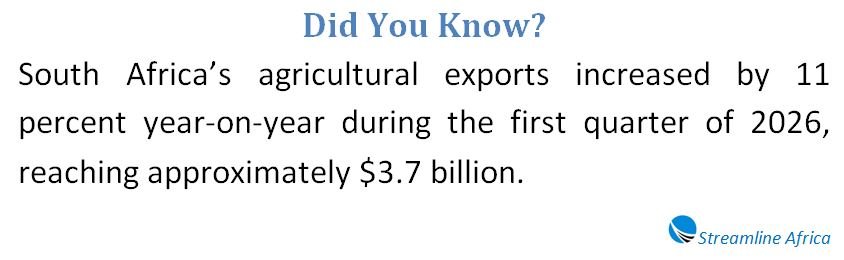
Agricultural exports reached approximately $3.7 billion in the first quarter of 2026, increasing by 11 percent year-on-year. The expansion was driven by a combination of higher shipment volumes and stronger prices across selected agricultural commodities.
This performance reinforces South Africa’s position as one of the continent’s most commercially developed agricultural exporters. The country benefits from established farming operations, processing capacity, logistics infrastructure, and access to multiple international markets. Continued export growth may create further opportunities in cold-chain logistics, port services, warehousing, packaging, certification, and value-added processing.
Commercial confidence has also improved. The Agbiz/IDC Agribusiness Confidence Index is currently 17 points above its neutral midpoint, indicating a more positive outlook among farmers, agribusinesses, processors, financiers, and input suppliers. Sustained confidence is important because it influences investment in machinery, irrigation, storage, technology, employment, and future production capacity.
Lower Input Costs Support Livestock Producers
The decline in maize and soybean prices has provided meaningful cost relief to livestock industries. Prices for these key feed commodities are currently between 10 percent and 30 percent below year-earlier levels.
This reduction is particularly beneficial to the poultry sector, where feed represents a substantial share of total production costs. Lower feed prices may improve operating margins, support production growth, and ease some of the pricing pressure experienced by consumers.
Fruit and vegetable production has also remained relatively resilient, despite localised flood-related disruptions. The ability of these subsectors to maintain volumes under challenging conditions demonstrates the value of diversified production systems, infrastructure investment, and more responsive supply-chain management.
Climate-Smart Agriculture Attracts Institutional Capital
The finance sector is increasingly recognising agriculture as both a commercial and sustainability-focused investment opportunity. Standard Bank’s R3.4 billion commitment to climate-smart agriculture is a notable example of this shift.
The financing is expected to support investments in solar-powered irrigation, water-efficient technologies, precision agriculture, and tools that improve producers’ ability to respond to drought, energy costs, and input price volatility.
Importantly, climate-smart investment is no longer being positioned solely as an environmental or regulatory requirement. It is increasingly being assessed on its ability to improve operational efficiency, reduce production costs, protect yields, and strengthen long-term financial performance.
For financial institutions, this creates an opportunity to develop more specialised agricultural products linked to energy efficiency, water management, equipment financing, and data-driven production systems. For farmers, access to appropriately structured capital may improve resilience and competitiveness.
Africa’s Agrifood Market Presents Significant Untapped Value
South Africa’s performance should be viewed within the context of a broader continental transformation. Africa’s food market is projected to expand from approximately $280 billion to nearly $1 trillion by 2030, reflecting population growth, urbanisation, changing consumer demand, and increasing regional trade.
Investment in agrifood technology is also rising. The sector attracted approximately $192 million in 2024, representing a 63 percent year-on-year increase and a sixfold expansion over the past decade.
Despite this growth, agriculture continues to receive only about 4 percent of total investment flows into Africa. This imbalance indicates that the sector remains materially undercapitalised relative to its economic importance and growth potential.
Investment opportunities extend beyond primary production. Attractive areas include agricultural technology, irrigation, mechanisation, input distribution, storage, processing, logistics, insurance, finance, and market information services. Businesses capable of reducing post-harvest losses, improving productivity, or connecting producers to markets may be particularly well positioned.
Regional Trade Integration Could Expand Market Access
The African Continental Free Trade Area is expected to support stronger intra-African agricultural trade by reducing tariffs, simplifying customs processes, and encouraging investment in cross-border infrastructure.
Improved regional integration could provide producers with access to larger and more diversified markets. It may also reduce dependence on distant export destinations and create stronger incentives for local processing and regional value-chain development.
However, the commercial benefits of regional trade will depend on improvements in transport, border administration, product standards, cold-chain systems, and payment infrastructure. Investors should therefore assess both market demand and the operational constraints that may affect cross-border distribution.
Risk Exposure Remains Material
The positive outlook does not eliminate the sector’s underlying risks. Foot-and-mouth disease continues to disrupt livestock markets, while African swine fever remains a concern for pork producers.
Geopolitical developments, particularly conflict-related disruptions in the Middle East, may increase the cost of fuel, fertiliser, and other agricultural inputs. The potential emergence of El Niño conditions also presents a downside risk for the 2026–27 production season.
Trade policy uncertainty adds another layer of complexity. Exporters may need to respond to changing tariff arrangements, market-access requirements, and negotiations involving major trading partners, including the United States.
Businesses entering the sector should therefore incorporate climate, biosecurity, logistics, regulatory, and foreign-exchange risks into their investment models.
Strategic Outlook
South Africa’s agricultural performance in early 2026 provides a strong indication of the sector’s growing commercial relevance. Record production expectations, rising exports, lower feed costs, improved confidence, and increased climate-focused financing are creating a more supportive operating environment.
Across Africa, agriculture is gradually transitioning from a predominantly subsistence-oriented sector into a more integrated, technology-enabled, and investment-ready industry. The strongest opportunities are likely to emerge where capital, infrastructure, climate resilience, and market access are combined effectively.
For investors and agribusiness operators, the sector offers substantial potential, but success will depend on disciplined risk assessment, local market knowledge, operational efficiency, and a long-term approach to value-chain development.
Major Highlights
Agricultural Growth Accelerated in Early 2026
South Africa’s agricultural gross value added increased by 3.9 percent in the first quarter of 2026, marking a strong improvement from the previous quarter and reinforcing the sector’s contribution to national economic growth.
A Record Harvest Is Supporting Market Optimism
The country is expected to produce approximately 21.1 million tonnes of summer grains and oilseeds. Favourable rainfall and expanded planting areas have strengthened expectations for one of the best harvests in recent years.
Farmers Are Showing Greater Commercial Confidence
The decision by producers to increase planted areas reflects growing confidence in market conditions. Farmers appear more willing to invest in land, labour, machinery, and agricultural inputs despite the sector’s traditional risks.
Agricultural Exports Continue to Expand
South Africa exported agricultural products worth about $3.7 billion in the first quarter of 2026. The 11 percent year-on-year increase was supported by stronger shipment volumes and favourable commodity prices.
Agribusiness Sentiment Has Improved
The Agbiz/IDC Agribusiness Confidence Index remains well above its neutral midpoint. This indicates a more positive outlook among farmers, processors, financiers, traders, and agricultural service providers.
Lower Feed Prices Are Supporting Poultry Producers
Declining maize and soybean prices are reducing operating costs for livestock businesses. Poultry producers, in particular, are benefiting because animal feed represents a substantial portion of their total production expenses.
Climate-Smart Agriculture Is Becoming Commercially Attractive
Sustainable farming technologies are increasingly viewed as practical business investments rather than environmental obligations. Solar irrigation, precision farming, and water-efficient systems can lower costs, protect yields, and improve resilience.
Financial Institutions Are Increasing Agricultural Investment
Standard Bank’s R3.4 billion commitment to climate-smart agriculture demonstrates growing institutional interest in the sector. The funding is expected to help producers invest in technology, energy efficiency, and improved water management.
Africa’s Food Market Offers Significant Growth Potential
Africa’s food economy is projected to approach $1 trillion by 2030. Population growth, urbanisation, changing consumer demand, and expanding regional trade are expected to create new opportunities across agricultural value chains.
Agriculture Remains Underfunded
Despite its economic importance, agriculture receives only a small share of total investment entering Africa. This funding gap presents opportunities in production, storage, processing, technology, logistics, insurance, and agricultural finance.
Regional Trade Could Strengthen Market Access
The African Continental Free Trade Area could improve cross-border agricultural trade by reducing tariffs and simplifying market access. However, progress will also depend on better transport, border systems, product standards, and logistics infrastructure.
Investors Must Continue to Manage Major Risks
Disease outbreaks, drought, geopolitical instability, rising input costs, and changing international trade policies remain significant concerns. Successful agricultural investment will require strong local knowledge, careful risk assessment, and resilient operating models.