
As economic advisory professionals, we view demand shocks as one of the most important signals for understanding sudden changes in market behaviour. They can affect individual products, entire sectors, or national economies, and their consequences often extend beyond immediate movements in sales or prices. A demand shock can alter production decisions, investment priorities, employment levels, inflation expectations, and government policy responses.
For business leaders and policymakers, the critical issue is not only identifying that demand has changed, but understanding why it changed, how long the disruption may last, and whether existing supply systems can respond effectively.
Demand shocks are particularly important because they frequently emerge with limited warning. A new technology, a policy decision, a financial crisis, a natural disaster, or a sudden shift in consumer confidence can rapidly change spending patterns. Organizations that understand these forces are better equipped to protect margins, adjust capacity, manage inventories, and make more informed investment decisions.
How We Define a Demand Shock
From an economic advisory standpoint, a demand shock is a sudden and significant change in the willingness or ability of consumers, businesses, governments, or other buyers to purchase goods and services.
A positive demand shock occurs when spending rises unexpectedly. This may lead to stronger sales, higher production, increased employment, and rising prices, particularly when suppliers cannot immediately increase output.
A negative demand shock develops when spending falls sharply. Businesses may experience declining revenues, excess inventories, weaker utilization of productive capacity, and pressure to reduce prices, staffing, or investment.
The key feature is the speed and unexpected nature of the change. Normal fluctuations in consumer demand occur continuously. A demand shock becomes economically significant when the shift is strong enough to disturb previously established market conditions.
How Demand Shocks Change Market Equilibrium
In conventional economic analysis, demand and supply interact to determine market prices and quantities. When demand changes unexpectedly while supply remains relatively fixed in the short term, the existing equilibrium is disrupted.
A positive demand shock shifts the demand curve to the right. Buyers are prepared to purchase more at prevailing prices. Because producers may not immediately have the capacity, inventory, labor, raw materials, or infrastructure required to meet the additional demand, prices often rise.
A negative demand shock shifts the demand curve to the left. Consumers or businesses purchase less, leaving suppliers with more goods or services than the market currently requires. Prices may weaken, production may be reduced, and companies may postpone expansion plans.
At the macroeconomic level, the same principle applies to aggregate demand. When total spending across households, businesses, governments, and external markets increases rapidly, economic output may expand. However, where productive capacity is already heavily utilized, the result may be stronger inflation rather than substantially higher production.
Policy Decisions Can Trigger Demand Shocks
Government and central bank decisions are among the most powerful drivers of demand conditions.
Fiscal policy can influence demand through taxation, government expenditure, subsidies, transfers, and public investment. If a government reduces taxes significantly, households may retain more disposable income and increase consumption. Businesses may also benefit from stronger customer spending.
Large public infrastructure programmes can create a similar effect by increasing demand for construction services, equipment, fuel, transportation, labor, and raw materials.
Conversely, higher taxes or reductions in public expenditure can weaken aggregate demand. Where these policies are introduced during already fragile economic conditions, businesses may experience falling sales and slower investment.
Monetary policy also plays a central role. Lower interest rates generally reduce borrowing costs, encouraging households and businesses to spend and invest. Higher rates can produce the opposite effect by increasing the cost of credit and encouraging saving.
As advisers, we therefore assess demand conditions alongside fiscal and monetary policy rather than viewing consumer spending in isolation.
Technology Can Reshape Demand Very Quickly
Technological change is one of the most powerful sources of both positive and negative demand shocks.
When consumers adopt a new technology, demand can rapidly migrate away from established products. The transition from traditional cathode-ray television sets to flat-screen displays provides a clear example. Once lighter and more convenient alternatives became affordable, demand for older television technology fell sharply.
Similar patterns have occurred in photography, telecommunications, entertainment, banking, and transportation. Digital cameras reduced demand for photographic film. Streaming platforms altered spending on physical entertainment products. Smartphones absorbed functions that had previously required separate cameras, music players, calculators, maps, and communication devices.
For businesses, these examples demonstrate that a demand shock may not arise because an existing product has become defective. Demand can collapse simply because customers believe another solution provides greater value.
This is why market intelligence and innovation monitoring should form part of long-term strategic planning.
Consumer Expectations and Confidence Matter
Demand is influenced not only by income but also by expectations.
Households that expect their incomes to rise may spend more today. Those concerned about job security or future economic conditions may delay purchases, even if their current income has not changed.
Similarly, businesses may postpone capital expenditure when uncertainty rises. A company that originally planned to build a new factory, expand its vehicle fleet, or hire additional staff may reconsider if management expects weaker market conditions.
This makes confidence an important economic variable. Negative sentiment can reduce demand before actual economic conditions deteriorate substantially, while improving confidence can support recovery even before all underlying problems have been resolved.
Economic advisers therefore examine indicators such as consumer confidence, business surveys, credit demand, retail activity, investment intentions, and purchasing behaviour when assessing the direction of demand.

Natural Disasters and Emergencies Can Distort Demand
Some demand shocks arise from sudden events that have little connection with normal economic cycles.
Ahead of severe weather, households may rush to purchase food, bottled water, fuel, batteries, generators, construction materials, and emergency supplies. Retailers can face unusually high demand within a very short period.
Public health emergencies can generate similar disruptions. Demand may increase sharply for selected medical products, cleaning materials, digital communication services, and essential household goods, while collapsing in sectors such as tourism, hospitality, and entertainment.
These situations demonstrate an important strategic lesson: the same event can create positive demand shocks in some industries and negative shocks in others.
For this reason, businesses should evaluate demand shocks at sector level rather than relying only on broad economic indicators.
Positive Demand Shocks Can Create Inflationary Pressure
Positive demand shocks are often welcomed because they produce higher sales and stronger commercial activity. However, rapid increases in demand can become problematic when supply cannot adjust at the same speed.
If many households increase spending simultaneously, companies may face shortages of labor, transport capacity, raw materials, imported inputs, warehouse space, and production equipment.
Businesses then compete for limited resources, increasing operating costs. Suppliers may raise prices, wages may come under pressure, and companies may pass higher costs to consumers.
Where this occurs across several sectors, inflation can rise.
From a policy perspective, the important question is whether stronger demand is supporting unused productive capacity or pushing an already constrained economy beyond its sustainable limits.
Demand growth in an economy with high unemployment and idle factories can stimulate output. The same level of demand growth in an economy operating near full capacity may instead create substantial price pressure.
Negative Demand Shocks Can Produce Wider Economic Contraction
A negative demand shock creates a different set of risks.
When consumer spending falls unexpectedly, companies may experience reduced revenue while many operating costs remain unchanged. Inventories accumulate, capacity utilization falls, and management teams may postpone investment.
If the decline continues, firms may reduce working hours, freeze recruitment, or cut employment.
These responses can create a reinforcing economic cycle. Lower employment reduces household income. Lower household income weakens consumption further. Weak consumption reduces business revenue, leading to further reductions in production and investment.
This mechanism helps explain why severe negative demand shocks can develop into broader recessions.
Our advisory approach therefore considers not only the initial decline in demand but also the potential secondary effects on employment, credit, investment, tax revenue, and business confidence.
Lessons From Major Financial Disruptions
Financial crises provide some of the clearest examples of negative demand shocks.
During a major financial downturn, falling property values and declining asset prices can reduce household wealth. Banks may become reluctant to lend, businesses may face difficulty accessing credit, and consumers may become concerned about employment.
Even households that remain financially stable may reduce discretionary spending because of uncertainty.
Businesses respond to weaker sales expectations by slowing investment and recruitment. Financial institutions tighten lending standards, which can further weaken consumption and investment.
Governments and central banks often respond by reducing interest rates, increasing liquidity, expanding expenditure, or introducing targeted fiscal support.
The broader lesson is that demand shocks rarely remain confined to one market. Financial conditions, household wealth, confidence, investment, and employment are closely interconnected.
Electric Mobility Illustrates a Modern Positive Demand Shock
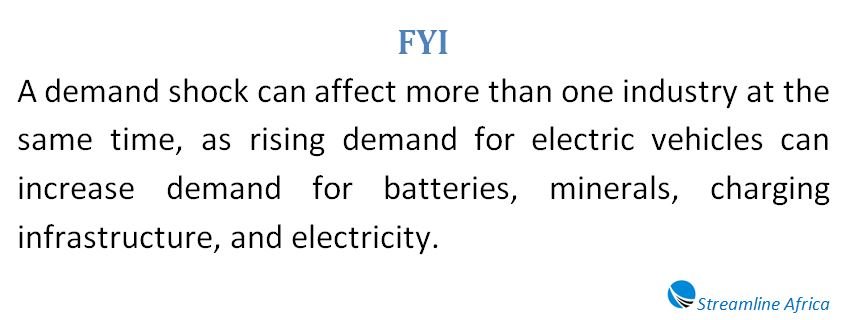
The global transition toward electric vehicles provides an important example of how structural economic change can generate powerful demand effects.
As manufacturers increased electric vehicle production and consumers became more willing to purchase these vehicles, demand expanded for batteries and associated raw materials.
Lithium became particularly important because of its role in rechargeable battery production.
However, the supply of minerals cannot be increased instantly. New mines require exploration, financing, permitting, infrastructure, construction, and processing capacity. These processes may take several years.
When battery demand expanded faster than mineral production, lithium markets experienced significant price volatility.
This illustrates how positive demand shocks can spread across value chains. The growth of electric mobility affects not only vehicle manufacturers but also mining companies, battery producers, charging infrastructure providers, electricity networks, logistics companies, software developers, and engineering firms.
For investors and businesses, this means demand analysis should extend beyond the final consumer product to the entire commercial ecosystem supporting it.
Demand Shocks and Supply Shocks Must Be Distinguished
One of the most important analytical distinctions we make is between demand shocks and supply shocks.
A demand shock begins with buyers. Consumers, businesses, governments, or foreign customers suddenly decide to purchase significantly more or less.
A supply shock begins with producers or production conditions. Supply may be disrupted by crop failures, energy shortages, industrial shutdowns, shipping problems, shortages of critical materials, or labor disruptions.
The distinction matters because policy responses can differ substantially.
Stimulating demand may be appropriate when economic activity is weak because households and businesses are not spending. However, if the primary problem is a severe supply shortage, additional demand can worsen inflation without increasing output significantly.
Accurate diagnosis is therefore essential for effective economic policy.
What Businesses Should Do During a Demand Shock
Organizations should avoid treating demand shocks purely as forecasting failures. They are better understood as tests of strategic resilience.
Businesses need forecasting systems that incorporate several possible scenarios rather than relying exclusively on historical averages.
Supply chains should also contain sufficient flexibility. Companies that depend heavily on one supplier, product category, customer group, or geographic market can become especially vulnerable when demand changes unexpectedly.
Management teams should closely monitor indicators such as order volumes, inventory levels, customer inquiries, competitor pricing, consumer confidence, financing costs, digital search trends, and broader industry activity.
If demand strengthens rapidly, businesses may need to increase procurement, expand capacity, adjust pricing, improve logistics, or prioritize high-margin customers.
If demand weakens, management may need to reduce inventory, preserve cash, reconsider capital expenditure, diversify revenue sources, or reposition products.
The objective is not to predict every shock. It is to ensure the organization can respond quickly when conditions change.
Why Demand Shock Analysis Matters for Decision-Makers
For policymakers, demand shock analysis supports better decisions on interest rates, taxation, public expenditure, investment incentives, and economic stabilization.
For businesses, it provides a framework for understanding sudden changes in revenue, customer behaviour, pricing, production, and capital requirements.
For investors, demand conditions can provide early insight into which industries are likely to expand, struggle, or experience price pressure.
Demand shocks also show why economic decisions should not be made from isolated indicators. Rising prices, for example, may reflect stronger demand, restricted supply, or both. Falling production may result from weak consumer spending or production constraints.
Understanding the underlying cause is therefore more valuable than simply observing the outcome.
Our Economic Advisory Perspective
As economic advisory experts, we see demand shocks as both economic disruptions and strategic signals.
A positive shock can create growth opportunities, but it may also expose limitations in production capacity, infrastructure, labor availability, or supply chains.
A negative shock can reduce revenue and investment, but it may also force organizations to improve efficiency, diversify markets, reassess products, and strengthen financial resilience.
The most important question is not whether demand will change. Demand is constantly changing. The more important question is whether businesses and governments have the analytical capacity and operational flexibility to respond when that change occurs faster than expected.
Organizations that understand demand conditions, monitor early indicators, stress-test alternative scenarios, and maintain flexible strategies are more likely to navigate economic shocks successfully.
Demand shocks may be temporary, but the decisions made during them can shape competitiveness, investment performance, employment, and economic stability for many years.
Critical Questions and Answers about Demand Shocks
What is a positive demand shock?
A positive demand shock happens when demand rises sharply. Businesses may experience stronger sales, but prices can also increase if supply cannot expand quickly enough.
What is a negative demand shock?
A negative demand shock occurs when demand falls unexpectedly. This can lead to excess inventory, lower revenues, reduced production, and weaker employment.
What usually causes demand shocks?
They can be triggered by government policies, interest-rate changes, technological innovation, economic crises, natural disasters, consumer confidence, or sudden changes in preferences.
How do demand shocks affect prices?
Strong positive demand can push prices upward when supply is limited, while falling demand can put downward pressure on prices as businesses compete for fewer buyers.
Why can demand shocks lead to inflation?
When spending rises faster than an economy can increase production, businesses compete for limited labor, materials, transport, and other resources, creating upward pressure on prices.
How can technology create a demand shock?
New technology can rapidly increase demand for emerging products while reducing demand for older ones. Electric vehicles, for example, have increased demand for batteries and critical minerals.
What is the difference between a demand shock and a supply shock?
A demand shock begins with a sudden change in buying activity, while a supply shock results from an unexpected change in the availability or production of goods and services.
How should businesses respond to demand shocks?
Businesses should strengthen forecasting, monitor customer behaviour, manage inventories carefully, diversify supply chains, preserve financial flexibility, and prepare for different demand scenarios.
Why should policymakers understand demand shocks?
Correctly identifying a demand shock helps governments and central banks determine whether changes in taxation, public spending, interest rates, or other interventions are appropriate.