
Supply shocks represent some of the most disruptive forces an economy can experience because they affect the productive side of markets rather than simply changing consumer spending. A supply shock occurs when the availability, cost, or productive capacity associated with a good, service, or essential input changes unexpectedly.
These shocks can emerge quickly and may affect prices, business profitability, employment, household purchasing power, and economic growth at the same time. Their significance depends not only on the size of the disruption but also on how deeply the affected product is embedded within the wider economy.
A temporary shortage of a niche product may have limited consequences. By contrast, a disruption affecting fuel, electricity, food staples, transportation networks, semiconductors, or major industrial materials can spread across numerous sectors.
For policymakers and business leaders, understanding supply shocks is therefore essential for distinguishing between temporary price disturbances and more persistent economic risks.
Positive and Negative Supply Shocks
In our economic analysis, supply shocks are most usefully divided into positive and negative developments.
A positive supply shock expands productive capacity or lowers the cost of producing goods and services. Technological innovation is one of the clearest examples. Advances in automation, agricultural productivity, energy efficiency, logistics, or manufacturing can enable businesses to generate greater output using the same or fewer resources.
When productivity improves significantly, businesses may experience lower unit costs, greater profitability, and stronger competitiveness. Consumers may also benefit through greater product availability and lower prices.
Positive supply developments can also arise from unusually strong agricultural harvests, improved access to natural resources, reductions in trade barriers, or major improvements in transportation infrastructure.
Negative supply shocks move the economy in the opposite direction. They reduce available output or increase the cost of production. Businesses may respond by raising prices, reducing production, cutting investment, or reconsidering their operating models.
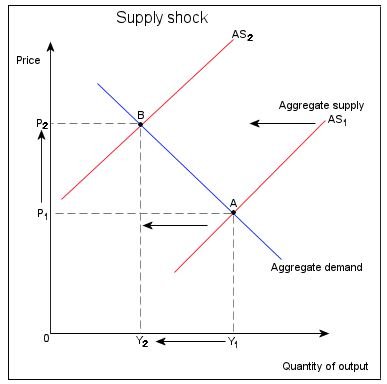
This relationship can be visualized through the conventional supply-and-demand framework: a negative supply shock shifts supply inward, placing upward pressure on prices while reducing the quantity of output exchanged in the market.
Major Sources of Supply-Side Disruption
Our assessment is that supply shocks rarely emerge from a single type of event. Instead, they can originate from environmental, political, technological, regulatory, or operational developments.
Natural disasters remain an important source of disruption. Flooding, droughts, earthquakes, storms, and wildfires can damage agricultural output, factories, transport infrastructure, storage facilities, and energy systems.
Agricultural economies are particularly exposed because harvest volumes depend heavily on weather conditions. A severe drought in an important grain-producing region, for example, can reduce supply and raise food prices well beyond the affected location.
Geopolitical instability represents another major source of supply risk. Wars, sanctions, trade restrictions, diplomatic disputes, and border closures can interfere with production and international distribution.
These risks become especially significant where global supply is concentrated in a small number of countries or producers.
Government policy can also alter supply conditions. Changes in taxation, import duties, environmental standards, labor regulation, licensing requirements, or production rules may increase or reduce operating costs. While such measures may pursue legitimate social or economic objectives, businesses may still experience short-term supply adjustments.
The Link Between Supply Shocks and Production Costs
One of the most important aspects of supply-shock analysis is the transmission of higher costs across industries.
Consider a sharp rise in fuel prices. The initial impact occurs within the energy market, but the consequences rarely remain there. Transportation providers face greater operating expenses, manufacturers pay more to move raw materials, retailers experience higher distribution costs, and agricultural producers may spend more on machinery and logistics.
Businesses then face difficult choices. They can absorb the additional costs and accept lower margins, reduce production, improve efficiency, or transfer some of the expense to customers through higher prices.
The wider the use of the affected input, the more broadly the shock can spread through the economy.
This is why energy, transportation, food commodities, and critical industrial inputs deserve particular attention in economic risk assessments.
When Supply Shocks Become Inflationary
We advise distinguishing carefully between a change in the price of one product and a broader inflationary process.
A shortage that increases the price of one commodity does not automatically produce economy-wide inflation. Consumers may simply redirect spending toward substitutes while prices elsewhere remain relatively stable.
The situation becomes more serious when several important inputs become more expensive simultaneously or when the affected resource is used extensively across industries.
Energy shocks provide a classic example. Higher fuel and electricity prices can increase the cost of transportation, agriculture, manufacturing, construction, and household consumption at the same time.
Supply-chain disruptions can generate similar effects. When shipping delays, material shortages, port congestion, and production interruptions occur together, businesses throughout the economy can face higher costs.
If these pressures persist and begin influencing wages, contracts, and inflation expectations, a temporary supply disturbance can develop into a wider inflationary challenge.
The 1970s Energy Crisis and Stagflation
The energy disruptions of the 1970s remain one of the most important historical cases for understanding the macroeconomic consequences of supply shocks.
Restrictions on oil exports to several Western economies substantially reduced the effective availability of petroleum in affected markets. Because oil was fundamental to transportation, industrial operations, heating, and manufacturing, rising energy costs spread throughout the economy.
Businesses faced higher production expenses while consumers paid more for fuel and many related goods.
Economic growth weakened at the same time that prices increased. This created the difficult combination of stagnating economic activity and high inflation commonly described as stagflation.
From an advisory standpoint, this episode illustrates a fundamental limitation of demand-management policies.
If an economy suffers because an essential resource has become scarce, increasing spending cannot automatically restore the missing productive capacity. Monetary or fiscal stimulus may support demand, but it does not immediately create additional oil, food, electricity, or transportation infrastructure.
Indeed, excessive stimulation during a severe supply constraint can intensify price pressures.
Global Supply Chains and Modern Vulnerability
Modern production systems have created significant efficiency gains, but they have also increased interdependence.
Many companies now rely on suppliers, manufacturers, transportation providers, and distribution hubs spread across several countries. While this structure can lower production costs, it also means that disruptions in one location can affect businesses thousands of kilometres away.
Consider the closure of an important shipping corridor. Cargo vessels may be delayed or forced onto longer routes. Freight costs can rise, delivery schedules may deteriorate, and businesses waiting for raw materials or components may be unable to maintain normal production.
Similarly, concentrated production creates vulnerability. If only a small number of firms or countries produce a critical component, an interruption in those facilities can affect entire industries.
The semiconductor shortages experienced across global manufacturing demonstrated how one relatively small component could restrict production in automobiles, consumer electronics, telecommunications equipment, and other industries.
How Businesses Can Improve Supply Resilience
From a corporate advisory perspective, supply shocks should be treated as strategic risks rather than purely operational inconveniences.
Supplier diversification is one of the strongest forms of protection. Businesses that depend entirely on one producer, region, or transport route may face severe disruption when that source becomes unavailable.
Establishing qualified alternative suppliers can improve operational flexibility.
Inventory strategy is equally important. Extremely lean inventory models can reduce storage costs during stable periods, but they can expose companies when deliveries are interrupted. Organizations should therefore identify the materials whose absence would immediately threaten production and consider maintaining appropriate safety stocks.
Scenario planning can further strengthen resilience. Management teams should periodically assess how long operations could continue if key suppliers, transportation corridors, or utilities were temporarily unavailable.
Digital tools can support this process through supplier monitoring, inventory visibility, demand forecasting, and early-warning systems.
The Policy Response to Supply Shocks
Governments face difficult choices when responding to supply-side disruption because not every conventional economic policy addresses the underlying problem.
Fiscal policy may provide temporary relief by supporting vulnerable households, reducing selected taxes, assisting affected industries, or investing in critical infrastructure.
Authorities may also release strategic reserves, facilitate alternative imports, temporarily reduce trade barriers, or accelerate investment in domestic production.
Monetary policy is less direct. Central banks influence credit conditions and aggregate demand, but they cannot directly repair factories or increase the immediate availability of scarce commodities.
Nevertheless, monetary authorities may need to respond when temporary supply-related price increases begin affecting broader inflation expectations.
The policy challenge is therefore one of balance: governments must avoid allowing short-term disruptions to create lasting economic instability while also avoiding interventions that unintentionally worsen supply constraints.
Why Consumers Often Bear the Greatest Burden
Although businesses and governments manage many aspects of supply disruption, households frequently experience the consequences most visibly.
Higher prices reduce purchasing power, particularly when essential items such as food, electricity, transport, and housing-related expenses become more expensive.
Lower-income households tend to face greater exposure because necessities account for a larger share of their overall spending.
Consumers may respond by changing brands, postponing discretionary purchases, reducing consumption, or switching to cheaper alternatives. These behavioral adjustments can help markets move toward a new equilibrium, but they can also reduce overall living standards in the short term.
Supply shocks therefore have an important distributional dimension. Their impact is rarely shared equally across households, businesses, or regions.
Strategic Implications for Economic Decision-Makers
Our advisory assessment is that supply shocks should be understood as more than temporary changes in availability. They reveal structural vulnerabilities within economies and corporate operating models.
Governments need resilient infrastructure, diversified trade relationships, credible monetary frameworks, and clear contingency strategies. Businesses require strong supplier networks, effective risk monitoring, flexible logistics arrangements, and informed inventory policies.
The central economic lesson is that growth depends not only on the willingness of households and firms to spend but also on an economy’s capacity to produce and distribute goods efficiently.
Supply shocks can weaken that capacity suddenly. When they do, prices, output, investment, employment, and consumer welfare may all be affected.
Although markets often adapt through substitution, new investment, alternative suppliers, and changing consumption patterns, major shocks can permanently reshape economic behavior.
For economic leaders and business decision-makers, resilience is therefore becoming as important as efficiency. Understanding where critical dependencies exist—and preparing for their potential disruption—can significantly improve an economy’s or organization’s ability to withstand future supply shocks.
Frequently Asked Questions
What Is the Difference Between a Positive and Negative Supply Shock?
A positive supply shock increases output or lowers production costs, often through technology, better infrastructure, or stronger harvests. A negative supply shock reduces output or raises costs, usually pushing prices higher.
What Commonly Causes Supply Shocks?
Typical causes include natural disasters, wars, trade restrictions, labor disruptions, regulatory changes, energy shortages, transportation problems, and sudden technological improvements.
How Can Supply Shocks Affect Inflation?
A supply shock can contribute to inflation when higher costs spread across many industries. This is especially likely when essential inputs such as energy, food, transport, or industrial materials become significantly more expensive.
Why Are Energy Supply Shocks So Important?
Energy affects almost every part of the economy. When fuel or electricity prices rise sharply, transportation, manufacturing, agriculture, logistics, and household expenses can all become more costly.
How Can Supply Shocks Lead to Stagflation?
A severe negative supply shock can reduce economic output while simultaneously increasing prices. When weak growth and high inflation occur together, the economy may experience stagflation.
Why Are Global Supply Chains Vulnerable to Supply Shocks?
Modern businesses often depend on suppliers and transportation networks spread across multiple countries. A disruption in one important region, port, shipping route, or manufacturing center can therefore affect production elsewhere.
How Can Businesses Prepare for Supply Shocks?
Companies can strengthen resilience by diversifying suppliers, maintaining appropriate safety stocks, developing alternative transport routes, improving supply-chain visibility, and conducting regular scenario planning.
What Can Governments Do During a Supply Shock?
Governments may provide targeted financial support, release strategic reserves, reduce certain trade barriers, improve infrastructure, encourage alternative supply sources, or temporarily adjust taxes and regulations.
Why Do Supply Shocks Matter to Consumers?
Consumers often experience supply shocks through higher prices, shortages, and reduced purchasing power. Lower-income households can be especially affected because essential goods typically account for a larger share of their budgets.