
Egypt’s personal income tax system considers both an individual’s residency status and the source of their earnings. Resident individuals are generally taxed on net income earned within Egypt. Income generated abroad may also become taxable when the resident’s main commercial, industrial, or professional activities are based in Egypt.
Non-residents are generally taxed only on income arising from Egyptian sources. This can include payments received from the Egyptian treasury and earnings from work performed within Egypt.
Personal Income Tax Rates
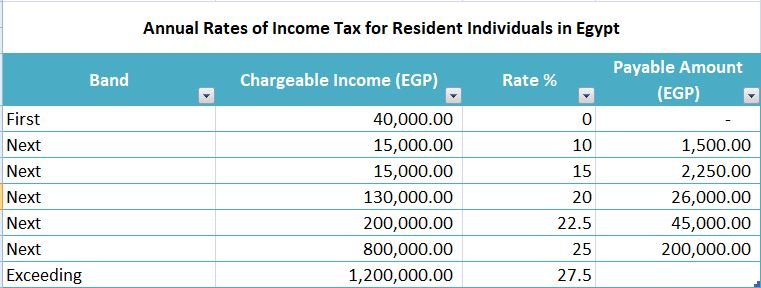
Egypt applies progressive income tax rates. This means income is divided into different bands, with each portion taxed at the rate assigned to that bracket.
| Annual Earned Income (EGP) | Tax Rate |
|---|---|
| EGP 1 – 40,000 | 0% |
| EGP 40,000 – 55,000 | 10% |
| EGP 55,000 – 70,000 | 15% |
| EGP 70,000 – 200,000 | 20% |
| EGP 200,000 – 400,000 | 22.5% |
| EGP 400,000 – 1,200,000 | 25% |
| Above EGP 1,200,000 | 27.5% |
Under this structure, moving into a higher tax bracket does not mean that all income is taxed at the higher rate. Instead, each applicable portion is taxed separately.
Practical Tax Calculation
Consider an employee with annual earnings of EGP 300,000. For this simplified example, applying the EGP 20,000 annual salary tax exemption leaves EGP 280,000 for the illustrative calculation.
| Income Portion | Rate | Tax Amount |
|---|---|---|
| First EGP 40,000 | 0% | EGP 0 |
| Next EGP 15,000 | 10% | EGP 1,500 |
| Next EGP 15,000 | 15% | EGP 2,250 |
| Next EGP 130,000 | 20% | EGP 26,000 |
| Remaining EGP 80,000 | 22.5% | EGP 18,000 |
| Total Tax | EGP 47,750 |
The estimated annual tax in this simplified example is EGP 47,750, or approximately EGP 3,979 per month.
Annual Salary Tax Exemption
Resident and non-resident taxpayers may qualify for an annual salary tax exemption of EGP 20,000. Actual tax payable can vary depending on the taxpayer’s income type, residency position, available deductions, exemptions, and other applicable tax rules.
Because tax thresholds, exemptions, and rates can be amended, individuals and employers should confirm the applicable rules when calculating their current tax obligations.
Frequently Asked Questions
Who is required to pay personal income tax in Egypt?
Resident individuals are generally taxed on qualifying Egyptian income, while certain foreign income may also be taxable. Non-residents are generally liable on income sourced from Egypt.
How does Egypt’s personal income tax system work?
Egypt uses progressive tax brackets. Different portions of an individual’s taxable income are charged at different rates as earnings increase.
What is the tax-free income bracket?
Under the rates presented in this guide, annual earned income of up to EGP 40,000 falls within the 0% tax bracket.
What is the highest personal income tax rate?
Income exceeding EGP 1.2 million falls within the 27.5% tax bracket under the schedule outlined in the article.
Are non-residents taxed in Egypt?
Yes. Non-residents may be subject to Egyptian income tax on earnings sourced from Egypt, including income connected with work performed in the country.
Is there an annual salary tax exemption?
Yes. The framework covered in this guide provides an annual salary tax exemption of EGP 20,000 for qualifying resident and non-resident taxpayers.
How is progressive income tax calculated?
Income is divided across applicable tax bands. Each portion is taxed at its corresponding rate rather than applying the highest applicable rate to the taxpayer’s entire income.
Can actual tax payable differ from a basic calculation?
Yes. The final liability may vary depending on income classification, residency, available deductions, exemptions, and other applicable tax provisions.