

In Ghana the corporate tax system considers a company’s residency, income sources, and industry. Understanding these requirements helps businesses manage their tax obligations, maintain compliance, and plan their finances effectively.
How Corporate Income Tax Works in Ghana
Companies classified as tax residents in Ghana generally pay taxes on income earned both domestically and internationally. This includes profits from commercial activities and investments, regardless of where the income originates.
Foreign companies face different obligations. Their Ghanaian-sourced earnings are taxable, including income attributable to a permanent establishment operating within the country.
Read Also: Ghana Corporate Tax Incentives and Tax Credits: A Guide for Businesses and Investors
Corporate Income Tax Rates Across Industries
Ghana’s standard corporate income tax (CIT) rate is 25%, although certain industries benefit from preferential rates or face higher charges.
Mining businesses and upstream petroleum operators pay 35%, while companies primarily operating hotels are taxed at 22%.
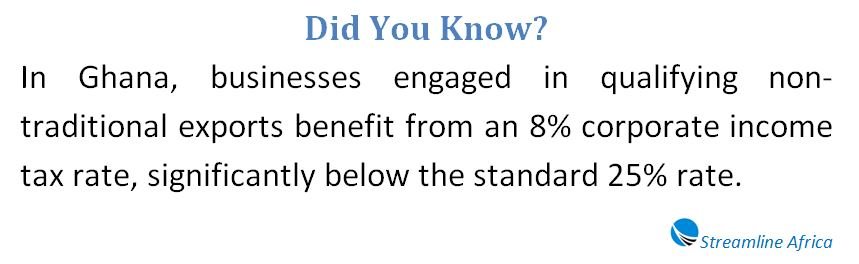
Businesses exporting non-traditional products enjoy an 8% rate. Banks earning income from agricultural financing and leasing activities face a 20% rate on those earnings. Lottery operators also pay 20% on gross gaming revenue.
Businesses reporting losses for five consecutive assessment years may become liable for minimum taxation calculated at 5% of turnover. However, farming businesses and enterprises within their first five operating years are excluded.
Growth and Sustainability Levy
Beyond corporate income tax, Ghana imposes the Growth and Sustainability Levy (GSL) to support economic development and fiscal stability.
The levy varies according to business classification:
- Category A: Financial institutions, telecommunications providers, breweries, oil distributors, and other specified businesses pay 5% of profit before tax.
- Category B: Gold mining companies pay 3% of gross production, while other mining and upstream petroleum businesses pay 1%.
- Category C: Businesses outside the first two categories pay 2.5% of profit before tax.
The levy applies even where companies enjoy existing tax exemptions. Payments are divided into four quarterly instalments, with corresponding filing obligations. Importantly, GSL payments cannot reduce taxable corporate income.
The applicable assessment period runs from 2023 through 2028.
Financial Sector Recovery Levy
Ghana also maintains a Financial Sector Recovery Levy targeting commercial banks, excluding rural and community banks.
Affected institutions contribute 5% of their profit before tax to support financial sector reforms. Payments fall due quarterly, and the levy cannot be claimed as a deductible business expense when determining taxable profits.
Local Taxes and Business Compliance
Ghana does not impose separate regional, provincial, or municipal income taxes on corporate profits.
Nevertheless, district assemblies and municipal authorities may collect business-related charges, particularly those associated with commercial premises and operating locations.
Companies should therefore distinguish national income tax obligations from local administrative levies when preparing budgets and assessing their overall tax exposure. Regular compliance reviews can help businesses avoid penalties and maintain accurate financial records.
Frequently Asked Questions About Corporate Income Tax in Ghana
What is the corporate income tax rate in Ghana?
Ghana’s standard corporate income tax (CIT) rate is 25%. However, certain industries qualify for reduced rates, while mining and upstream petroleum businesses face higher rates.
Are foreign companies required to pay corporate income tax in Ghana?
Yes. Foreign companies generally pay tax on income earned from Ghanaian sources, including profits attributable to a permanent establishment operating in the country.
Which businesses benefit from reduced corporate tax rates in Ghana?
Companies engaged in non-traditional exports enjoy an 8% tax rate, while qualifying hotel businesses pay 22%. Certain agricultural financing and leasing income earned by banks attracts a 20% rate.
What is the Growth and Sustainability Levy in Ghana?
The Growth and Sustainability Levy (GSL) is an additional charge on specified businesses. Depending on their classification, companies pay between 2.5% and 5% of profit before tax, or 1% to 3% of gross production.
Who must pay the Financial Sector Recovery Levy?
Commercial banks, excluding rural and community banks, are subject to a 5% levy on profit before tax to support Ghana’s financial sector reforms.
Can companies deduct the Growth and Sustainability Levy from taxable profits?
No. Payments made under the Growth and Sustainability Levy are not deductible when calculating corporate income tax liabilities.
Do companies operating at a loss still pay corporate income tax?
Businesses reporting tax losses for five consecutive assessment years may face minimum taxation of 5% of turnover. Farming businesses and companies within their first five years of operation are exempt from this requirement.
When are corporate levies paid in Ghana?
The Growth and Sustainability Levy and Financial Sector Recovery Levy are payable quarterly, with deadlines falling on 31 March, 30 June, 30 September, and 31 December.
Are businesses subject to local corporate income taxes in Ghana?
No. Ghana does not impose separate municipal or regional corporate income taxes. However, local authorities may charge businesses fees and levies associated with their premises and operations.