

Ghana maintains a range of tax credits, concessions, and investment incentives aimed at supporting capital formation, strengthening priority industries, encouraging exports, and improving the country’s overall investment proposition. These measures can materially influence the cost structure and long-term returns of businesses operating in sectors such as agriculture, manufacturing, construction, mining, tourism, financial services, housing, and export-oriented production.
For investors, however, the practical value of these incentives depends on eligibility, sector classification, approval requirements, the source of income, and the duration of the applicable concession. Businesses considering entry into Ghana should therefore assess available tax benefits alongside broader commercial, regulatory, and operational considerations.
Foreign Tax Credits for Ghanaian Residents
A Ghanaian tax resident that earns taxable income from another jurisdiction may generally claim a credit for foreign income tax already paid on that income. The purpose of the credit is to mitigate double taxation where the same income falls within the tax systems of both Ghana and another country.
The available relief is subject to a statutory limitation. For each category of foreign income, the amount of credit claimed cannot exceed the average Ghanaian income tax rate applicable to the resident for the relevant year of assessment.
This limitation is particularly important for businesses with subsidiaries, branches, investments, or other income-generating activities outside Ghana. Where the foreign tax rate exceeds the effective Ghanaian rate, the excess foreign tax may not necessarily be recoverable through the Ghanaian tax credit mechanism.
Companies with cross-border operations should therefore maintain adequate documentation supporting the source of income, the foreign tax paid, and the basis of the credit claimed.

Investment Incentives for Businesses Entering Ghana
Ghana provides a number of investment incentives intended to attract both domestic and foreign capital into strategically important areas of the economy. The Ghana Investment Promotion Centre framework has historically played an important role in facilitating major investments, particularly in agriculture, manufacturing, construction, mining, tourism, and industries that use local raw materials or produce goods for export.
Depending on the nature and structure of an approved investment, businesses may benefit from customs duty exemptions on qualifying plant, machinery, and equipment. Additional support may include reduced corporate income tax rates, favourable capital allowances, investment-related deductions, or other mechanisms that reduce the effective tax burden of the project.
These measures can significantly lower the initial cost of establishing operations, particularly for capital-intensive businesses that require substantial imported machinery or production equipment.
Capital Repatriation and Investor Protection
Tax incentives are only one component of Ghana’s investment framework. Foreign investors may also benefit from protections relating to the movement of capital and investment income.
Subject to applicable regulations, qualifying investors may transfer dividends, net profits, loan repayments, technology-transfer fees, and other authorised payments outside Ghana. In certain circumstances, businesses may also be permitted to retain foreign currency earnings in accordance with prevailing foreign exchange rules.
The investment framework further provides safeguards against unlawful expropriation. These protections are intended to provide greater confidence to investors committing long-term capital to Ghanaian operations.
For international businesses, these provisions should be considered together with tax, exchange-control, financing, and corporate structuring requirements when evaluating an investment.
Tax Incentives for Venture Capital Activity
Ghana also provides preferential tax treatment intended to support venture capital investment and improve access to long-term financing for developing businesses.
Qualifying subscriptions for newly issued equity shares in approved venture capital funds may receive relief from stamp duty. In addition, certain income generated from venture capital investments may benefit from significantly reduced tax rates during the early stages of the investment.
Interest and dividend income from an investment in a qualifying venture capital company may be taxed at 1 percent during the first ten years of assessment. Chargeable income may also qualify for a reduced rate of 5 percent over the same period.
These measures are intended to improve the attractiveness of venture funding while recognising the relatively high risks associated with investing in emerging businesses.
Read Also: High Profit Margin Businesses in Ghana: Smart Opportunities for Entrepreneurs and SMEs
Treatment of Venture Capital Investment Losses
The venture capital framework also provides relief where an investor disposes of an investment at a loss.
Qualifying losses arising from the disposal of a venture capital investment may generally be carried forward for up to five years after the year in which the disposal occurred. Losses connected with investments in venture capital subsidiaries may also qualify for carryforward treatment following the initial concessionary period.
This mechanism can help reduce the overall tax exposure of investors across a portfolio of venture investments by allowing certain losses to be recognised against future taxable outcomes, subject to the relevant rules.
Free Zone Tax Advantages
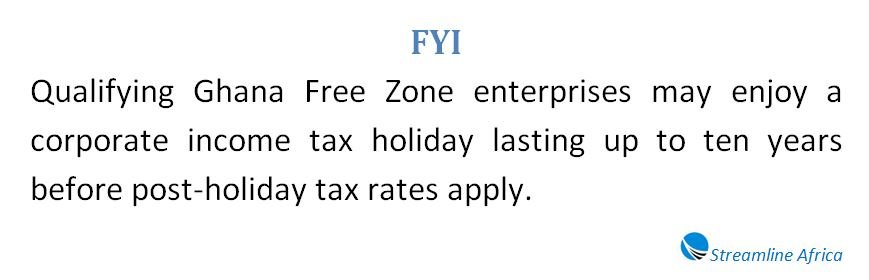
Ghana’s free zones regime is an important component of the country’s export development strategy. Companies approved as free zone enterprises or developers may benefit from a substantial corporate income tax concession during their early years of operation.
A qualifying free zone business generally enjoys an exemption from corporate income tax for its first ten years of operation. This tax holiday can provide significant cash-flow advantages to businesses establishing export-focused manufacturing, processing, logistics, or service activities in Ghana.
After the ten-year exemption period, the applicable tax treatment depends on the market from which the income is generated. Income derived from exports outside Ghana is subject to corporate income tax at 15 percent, while income earned from sales into the domestic market is taxed at 25 percent.
Businesses considering the free zones regime should therefore carefully evaluate export requirements, domestic market restrictions, compliance obligations, and the tax position that will apply once the initial concession expires.
Incentives for Low-Cost Housing Development
The construction of affordable housing is another area in which Ghana offers targeted tax support.
A certified company carrying on a qualifying low-cost housing business may benefit from a corporate income tax rate of 5 percent for a period of five years of assessment.
From an investment perspective, the concession can improve project economics by reducing the tax burden during the early stages of development. However, the benefit is dependent on certification and compliance with the relevant conditions governing qualifying residential projects.
Developers should therefore confirm eligibility before incorporating the reduced rate into financial projections or investment models.
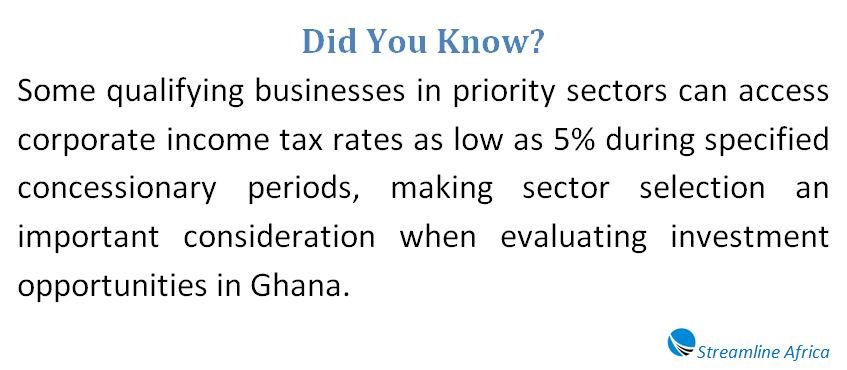
Concessionary Rates for Priority Economic Activities
Certain sectors may also qualify for temporary corporate income tax concessions because of their contribution to employment, rural development, agricultural value addition, environmental sustainability, or financial inclusion.
Qualifying businesses engaged in farming, agro-processing, production of cocoa by-products, rural banking, waste processing, unit trusts, and mutual funds may be subject to an income tax rate of 5 percent during the applicable concessionary period.
The duration and conditions of these incentives can vary depending on the activity concerned. Businesses should therefore distinguish between temporary concessions and permanent sector-specific tax rates when preparing long-term forecasts.
Strategic Considerations for Investors
Ghana’s corporate tax incentives can materially affect the financial viability of an investment. Reduced income tax rates, customs exemptions, foreign tax credits, capital allowances, tax holidays, and sector-specific concessions may improve cash flow, shorten investment payback periods, and enhance expected returns.
Nevertheless, investors should avoid evaluating a project solely on the basis of headline incentives. The commercial benefit of a tax concession depends on several factors, including qualification criteria, approval procedures, timing, restrictions on eligible income, compliance requirements, and the tax treatment that takes effect when the concessionary period ends.
A robust investment assessment should therefore incorporate both the immediate value of available incentives and the longer-term tax profile of the business. Early tax and regulatory planning can help companies structure their operations appropriately, identify legitimate reliefs, and reduce the risk of relying on incentives that may not ultimately apply.
For businesses evaluating Ghana as an investment destination, tax incentives are best viewed as part of a wider strategic framework that includes market potential, operating costs, sector regulation, foreign exchange exposure, financing arrangements, and long-term commercial objectives.
Frequently Asked Questions
What corporate tax incentives are available to businesses in Ghana?
Ghana offers several incentives, including reduced corporate income tax rates, tax holidays, foreign tax credits, customs duty exemptions, capital allowances, and sector-specific concessions. Eligibility depends on the company’s activities, investment structure, location, and applicable tax rules.
Can a Ghanaian company claim credit for tax paid overseas?
Yes. A Ghanaian tax resident earning taxable foreign income may generally claim a credit for income tax paid in another jurisdiction. The relief helps reduce the risk of the same income being taxed twice.
Is there a limit on Ghana’s foreign tax credit?
Yes. The credit available for a particular category of foreign income cannot generally exceed the average Ghanaian income tax rate applicable to the resident for that year of assessment.
Which sectors may benefit from Ghana’s investment incentives?
Priority areas can include agriculture, manufacturing, construction, mining, tourism, export-oriented businesses, and industries that rely significantly on locally sourced raw materials. The precise benefits depend on the investment and applicable legislation.
Are imported machinery and equipment eligible for tax relief?
Qualifying investments may benefit from customs duty exemptions or concessions on approved plant, machinery, and equipment. This can reduce the initial capital expenditure required to establish operations in Ghana.
Can foreign investors transfer profits earned in Ghana abroad?
Subject to Ghana’s applicable regulations, qualifying investors may generally transfer dividends, net profits, loan repayments, capital, and approved technology-transfer payments outside the country.
What tax advantages are available to venture capital investors?
Qualifying venture capital investments may benefit from stamp duty relief, a 1% tax rate on certain interest and dividend income, and a 5% rate on chargeable income during the first ten years of assessment.
Can venture capital investment losses be carried forward?
Yes. Certain qualifying losses arising from the disposal of venture capital investments may be carried forward for up to five years, subject to the relevant tax requirements.
What tax benefits do Ghana Free Zone companies receive?
Qualifying free zone developers and enterprises may enjoy a corporate income tax exemption for their first ten years of operation. This can provide a substantial cash-flow advantage during the establishment and expansion phases.
What happens when the Free Zone tax holiday expires?
After the initial ten-year exemption, qualifying income from exports outside Ghana is taxed at 15%, while income generated from domestic-market sales is taxed at 25%.
Are there tax incentives for affordable housing developers?
Yes. A certified company undertaking qualifying low-cost residential development may benefit from a reduced corporate income tax rate of 5% for five years of assessment.
Which other businesses may qualify for a 5% concessionary tax rate?
Depending on the applicable concessionary period and eligibility requirements, businesses involved in farming, agro-processing, cocoa by-products, rural banking, waste processing, unit trusts, and mutual funds may qualify for a 5% income tax rate.