

In Gabon, valued added tax (VAT) applies to taxable supplies of goods and services rendered or used within the country. For businesses, the practical task is to establish whether a transaction falls within the VAT system, identify the appropriate treatment, and account for the resulting liability.
The framework described here follows the supplied tax information reviewed on 6 August 2026. Alongside VAT, businesses may encounter solidarity contributions, customs charges, excise duties, and other obligations that affect their costs.
Who Falls Within the VAT System?
Gabon’s VAT rules cover individuals and legal entities independently undertaking economic activities in return for payment. Transactions may be conducted regularly or occasionally. Consequently, the scope extends beyond businesses making sales to include operators whose taxable activities arise less consistently.
The turnover threshold is XAF 60 million, calculated before taxes. Persons subject to corporate income tax or personal income tax become liable to VAT when their turnover reaches this amount. Liability applies whether they have registered or remain unregistered. Registration status therefore cannot be treated as the sole indication of whether VAT obligations exist.
Read More: Gabon Withholding Tax Guide: Corporate Rates, Treaties and Cross-Border Payments
Applying the Standard and Reduced Rates
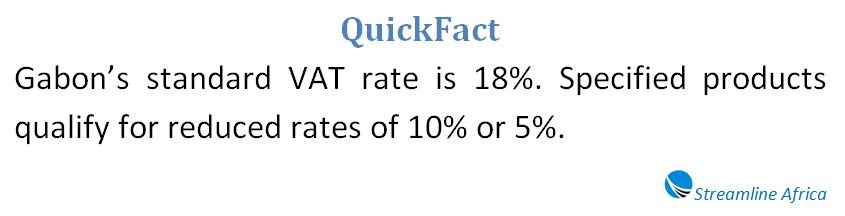
The standard VAT rate is 18%. It applies to taxable transactions unless a specific provision allows a reduced rate, zero rating, or exemption. Businesses should begin by identifying the nature of the goods or services involved before deciding which treatment applies.
Two reduced rates operate alongside the standard rate. A 10% rate applies to production and sales transactions involving specified listed products, while a 5% rate covers another designated product group. These concessions depend on the relevant product classification. A business cannot assume that every product within a commercial category receives the same preferential treatment.
Zero Rating and Exempt Supplies
A zero VAT rate applies to exports and qualifying international carriage. It also covers designated activities involving aircraft and ships assigned to international traffic, including refuelling, operations, maintenance, and repairs. The connection with qualifying international transport is therefore important when assessing eligibility.
Separately, the General Tax Code exempts certain goods and services. Exemption and zero rating are distinct classifications, even though both may result in no VAT being charged on a particular sale. Businesses should identify the applicable legal category accurately rather than describing all transactions without a VAT charge as exempt.
VAT on Construction and Property Sales
Property development can generate VAT obligations where transactions form part of a taxable person’s economic activities. Relevant operations include sales of land intended for construction, deliveries of new buildings, and certain cases where buildings are delivered for the developer’s own use.
The builder bears responsibility for the property VAT, which becomes payable on delivery. The applicable rate is 18%. Tax is calculated using the selling price agreed between the parties, unless the property’s actual value is higher, in which case that higher value forms the assessment basis.
Transfers involving buildings subject to property VAT must also undergo registration formalities. Paying VAT does not remove this separate procedural requirement. Property transactions therefore require attention to both the tax calculation and the documentation supporting the transfer.
Deferred VAT Payments on Imports
Industrial companies and exporters may qualify to postpone VAT payments on certain imported goods. The arrangement covers qualifying imports whose total value exceeds XAF 100 million, including materials, equipment, industrial machinery, and spare parts.
Access depends on meeting several conditions together. The company must comply with its tax declaration and payment responsibilities, satisfy customs obligations, and benefit from a credit removal arrangement involving a commission agent authorised by customs. Meeting only one or two conditions is insufficient.
The facility excludes operations that do not qualify for VAT deductions. It therefore provides targeted payment flexibility rather than a general exemption from import VAT. Outside the permitted arrangement, import VAT generally cannot be settled through the credit removal regime.
Separating VAT from Other Transaction Taxes
The Special Solidarity Contribution operates alongside VAT and follows broadly similar taxation arrangements. Its threshold is lower: businesses undertaking taxable transactions must invoice it when annual turnover excluding taxes reaches XAF 30 million. The contribution is 1% of the invoiced amount before taxes.
Importers must also consider customs duties and supplementary border charges. These include a 0.4% community integration levy and a 0.05% OHADA levy on customs value. Products originating outside African Union member states additionally attract a 0.2% African Union contribution.
Keeping VAT Decisions Consistent
Accurate VAT treatment depends on reviewing turnover, classifying supplies, and distinguishing ordinary sales from property transactions and qualifying imports. Businesses handling several activities should assess each transaction according to its own characteristics.
Maintaining records of sales values, product classifications, property deliveries, and import eligibility helps support consistent tax decisions. Other obligations, including payroll deductions, property taxes, business licence charges, and excise duties, require separate attention within the company’s wider tax administration.
Frequently Asked Questions about VAT in Gabon
When does a business become liable for VAT?
VAT liability arises when turnover before taxes reaches XAF 60 million. This applies whether the business has registered or remains unregistered.
Can occasional transactions attract VAT?
Yes. VAT can apply to both regular and occasional transactions undertaken independently as part of an economic activity for payment.
Which transactions qualify for zero-rated VAT?
Exports, qualifying international transport, and specified services involving aircraft and ships used in international traffic qualify for the 0% rate.
Is zero-rated VAT the same as a VAT exemption?
No. They are separate tax classifications. Businesses should check which category applies rather than treating every sale without a VAT charge as exempt.
How does VAT apply to property transactions?
Qualifying building land sales, new building deliveries, and certain self-deliveries attract 18% VAT. The builder pays the tax when delivery occurs.
Can businesses defer VAT on imported equipment?
Eligible industrial companies and exporters may defer VAT on qualifying imports exceeding XAF 100 million, provided they meet all required tax, customs, and credit arrangement conditions.
How does the Special Solidarity Contribution differ from VAT?
It is a separate 1% contribution with a lower annual turnover threshold of XAF 30 million, excluding taxes.