

Companies conducting cross-border transactions involving Gabon should carefully assess whether payments to overseas businesses, consultants, investors, or intellectual-property owners trigger withholding tax obligations. The rules generally focus on income sourced from, generated through, or economically connected with activities in Gabon.
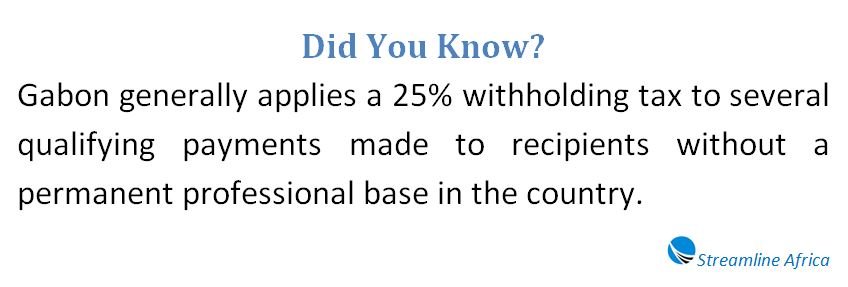
Where a Gabon-based business makes qualifying payments to an individual or company that is subject to corporate or personal income tax but has no permanent professional establishment in the country, a standard withholding tax rate of 25% may apply.
Payments Generally Subject to 25% Withholding Tax
The 25% rate covers several categories of income. For example, if a Libreville engineering company hires an independent specialist based abroad to perform professional work connected with a local project, the resulting fee may fall within the withholding tax regime.
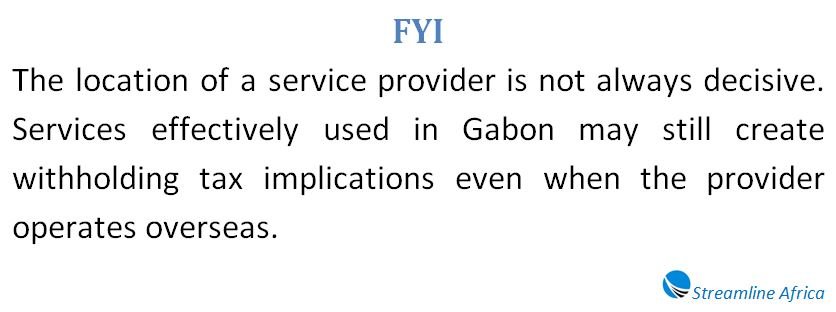
The rules also extend to remuneration connected with patents, inventions, copyrights and other intellectual or commercial property rights. Similarly, payments for services physically performed or effectively utilized within Gabon may attract withholding tax even when the recipient operates from another jurisdiction.
Certain interest payments, arrears and returns from fixed-income investments may also be taxable where they constitute professional income of the recipient. In addition, profits generated by a Gabonese branch of an overseas enterprise can face 25% withholding before those profits are attributed to the foreign head office.
Read Also: Gabon Business Environment 2026: Investment Opportunities, Economic Outlook and Market Risks
How Tax Treaties Can Change the Rate
Gabon’s double taxation treaties may reduce the domestic 25% rate when treaty requirements are satisfied. For non-treaty recipients, dividends, interest and royalties generally remain subject to the standard 25% treatment.
Treaty rates vary considerably. Belgium provides rates of 18% on dividends, 15% on interest and 10% on royalties. Canada, France, Italy and Morocco generally provide dividend rates of 15%, while interest and royalties can fall to 10%.
China provides particularly differentiated treatment: dividends may qualify for 5% withholding and interest for 10%. Royalties can attract 5% where payments concern studies or technical, financial, accounting or tax assistance, while other qualifying royalties may face 7.5%.
Access to reduced treaty rates generally depends on conditions such as beneficial ownership and tax residence. Businesses should therefore verify treaty eligibility and supporting documentation before applying any reduced withholding rate.
Important Questions and Answers
What is the standard withholding tax rate in Gabon?
The standard withholding tax rate is generally 25% for qualifying payments made to individuals or companies without a permanent professional base in Gabon.
Which professional services can attract withholding tax?
Fees paid for independent professional activities carried out in Gabon may be subject to 25% withholding tax when the applicable conditions are met.
Are intellectual property payments taxable?
Yes. Payments connected with inventions, copyrights, intellectual property, commercial rights and similar rights can fall within Gabon’s withholding tax framework.
Do services performed outside Gabon escape withholding tax?
Not necessarily. A service may still attract withholding tax when it is effectively used in Gabon, depending on the circumstances and applicable treaty provisions.
How are foreign company branches treated?
Net profits generated by Gabonese branches of foreign companies may be subject to 25% withholding tax before being attributed to their overseas head offices.
Can tax treaties reduce the 25% rate?
Yes. An applicable double taxation treaty can provide lower withholding tax rates for dividends, interest and royalties when the relevant treaty conditions are satisfied.
What rates apply when there is no tax treaty?
For the categories shown, non-treaty payments of dividends, interest and royalties are generally subject to withholding tax at 25%.
What rates are available under the Canada treaty?
Qualifying payments may benefit from rates of 15% on dividends and 10% on both interest and royalties, subject to treaty requirements.
How does the China treaty treat royalties?
Qualifying royalties may attract 5% for specified studies and technical, financial, accounting or tax assistance, while other royalties may be subject to 7.5%.
Why is beneficial ownership important?
Several treaty reductions depend on the recipient being the beneficial owner of the relevant dividends, interest or royalties rather than merely receiving the payment for another party.
Should treaty rates be applied automatically?
No. Businesses should establish the recipient’s tax residence, beneficial ownership status and eligibility under the relevant treaty before applying a reduced rate.
Why should companies review cross-border payments carefully?
Incorrect withholding can create tax exposure, penalties and compliance problems. Reviewing the payment type, recipient and applicable treaty before payment helps manage these risks.