
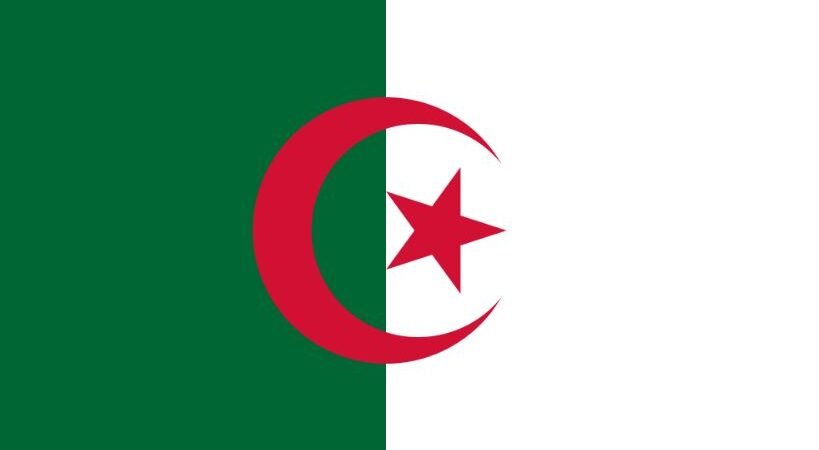
Algeria is one of North Africa’s most strategically important markets, supported by its scale, energy resources, geographic position, and sizeable domestic population. As Africa’s largest country by land area and one of the region’s largest economies, it offers investors exposure to energy, industry, infrastructure, consumer markets, and regional trade.
Economic activity is concentrated along the Mediterranean corridor, where major cities, ports, transport networks, industrial centres, and government institutions are located. This concentration supports direct commercial access to Europe and strengthens Algeria’s regional position.
The investment proposition is complex. Strong macroeconomic assets coexist with extensive state involvement, regulatory uncertainty, and administrative inefficiencies. Investors therefore require structured market-entry plans, informed local advice, and realistic timelines.
Economic Structure and Hydrocarbon Dependence
Algeria’s economy remains heavily dependent on hydrocarbons. Oil and natural gas generate most export earnings, foreign exchange inflows, and government revenue. This resource base supports infrastructure, subsidies, public programmes, and resilience during external pressure.
Foreign currency reserves have improved Algeria’s ability to manage energy-price volatility. However, continued reliance on hydrocarbons exposes the economy to fluctuations in global demand, commodity prices, and energy-transition policies.
The concentration of investment in oil and gas has also constrained the development of manufacturing, agriculture, and higher-value services. Algeria imports many consumer goods, industrial inputs, equipment, and food products. This structural weakness creates opportunities for investors supporting import substitution, domestic production, supply-chain localisation, and industrial upgrading.
Priority Investment Opportunities
Hydrocarbons will remain central to Algeria’s economic outlook. Opportunities extend beyond exploration and production to engineering, maintenance, industrial safety, logistics, equipment supply, technical training, and infrastructure optimisation. Technologies that improve efficiency or reduce environmental impact may be especially competitive.
Manufacturing represents a major diversification opportunity. Algeria’s large domestic market and import requirements support investment in food processing, pharmaceuticals, construction materials, packaging, household products, machinery, and selected consumer goods. Projects creating employment, industrial capacity, and import substitution are likely to align with government priorities.
Tourism remains underdeveloped. Algeria possesses Mediterranean beaches, historic cities, Roman archaeological sites, mountain landscapes, and extensive Saharan destinations. The sector requires investment in accommodation, transport, destination management, and international marketing.
Renewable energy, water management, and climate-resilient infrastructure are also gaining strategic importance. Algeria’s solar potential, water scarcity, and exposure to extreme heat create demand for solar generation, irrigation, desalination, waste treatment, energy efficiency, and environmental advisory services.
Regulatory Framework and Market Entry
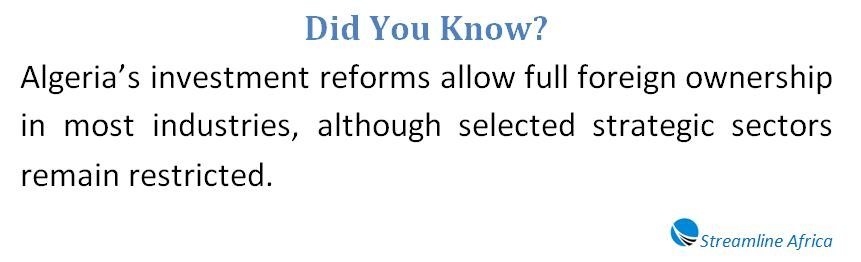
Algeria has introduced reforms intended to improve the investment climate. Investment Law 22-18 established a freedom-to-invest principle and removed the former requirement for Algerian majority ownership in most sectors. Foreign investors may now hold full ownership in many activities, although restrictions remain in designated strategic industries.
The framework also introduced a national investment portal and digital platform designed to simplify registration, licensing, and investor support. These measures are positive, although implementation remains uneven.
Company incorporation may still require several weeks. Investors should expect procedures involving document certification, translation, tax registration, licensing, banking arrangements, and coordination with multiple institutions. A formal office lease is generally required, while corporate documents may need translation into Arabic, Tamazight, or French.
Local legal, tax, and regulatory advisers are essential for foreign market entrants. Early engagement can reduce delays, clarify obligations, and improve project scheduling.
Incentives and Government Support
The Algerian authorities provide incentives for qualifying investment projects. These may include temporary corporate tax exemptions, customs-duty relief, value-added tax waivers on imported equipment, and access to state-owned land through long-term concessions.
Manufacturing and large projects aligned with national priorities may qualify for extended benefits. However, investors should verify eligibility before incorporating incentives into financial models.
Qualification often depends on project size, location, sector, employment creation, local value addition, and compliance with approval conditions. Businesses should assess whether ownership, financing, scope, or scheduling changes could affect benefits.
Principal Business Risks
Regulatory opacity remains a major operating risk. Rules may change, administrative interpretation can differ between institutions, and approval processes may lack transparency. Customs procedures, currency controls, international transfers, and banking requirements can also delay operations.
Political and regional factors require monitoring. Algeria’s relationship with Morocco remains strained, largely because of competing positions on Western Sahara. The closed land border and wider diplomatic tensions may limit regional integration and affect logistics planning.
Climate exposure presents a further long-term risk. Water scarcity, desertification, extreme heat, and agricultural stress are placing growing pressure on infrastructure and public resources. Private investment in adaptation and green growth remains insufficient.
Business Culture and Commercial Practice
Business in Algeria is strongly relationship-driven. Trust, reputation, and personal credibility are central to commercial progress. Negotiations often require repeated in-person engagement, and important discussions are generally more effective when senior representatives participate directly.
Decision-making may be slower than in more developed markets. Investors should allow additional time for relationship building, internal approvals, and government interaction.
Algeria is a conservative Islamic society, and commercial conduct should reflect local expectations. Professional dress, culturally appropriate advertising, and respect for religious customs are essential. Marketing materials should ensure that language, imagery, and messaging suit the local market.
Strategic Assessment
Algeria offers a long-term investment proposition for businesses capable of operating in regulated environments and aligning with national priorities. Its advantages include energy wealth, market size, strategic location, infrastructure demand, and a clear need for economic diversification.
The market also presents material execution risks, including bureaucracy, regulatory uncertainty, currency restrictions, and inconsistent implementation. Successful investors will require strong governance, reliable local partners, disciplined compliance, and patience.
The most attractive opportunities are likely to arise in sectors supporting industrialisation, employment creation, import substitution, technological development, and climate resilience. Companies adopting a long-term, locally informed, and risk-adjusted approach will be best positioned to participate in Algeria’s evolving economy.
FAQs about Investing in Algeria
What Makes Algeria an Attractive Investment Destination?
Algeria combines a large domestic market, significant oil and gas reserves, strategic access to Europe, and growing demand for infrastructure, manufacturing, and consumer goods.
Which Sector Dominates Algeria’s Economy?
The hydrocarbon sector remains the backbone of the economy. Oil and natural gas generate most export earnings, foreign exchange revenue, and government income.
Why Is Economic Diversification Important for Algeria?
Heavy dependence on energy exports exposes the country to global price fluctuations. Expanding manufacturing, agriculture, tourism, and services would create jobs and reduce import dependence.
What Are the Main Investment Opportunities in Algeria?
Promising sectors include energy services, manufacturing, food processing, pharmaceuticals, construction materials, tourism, renewable energy, water management, logistics, and climate-resilient infrastructure.
Can Foreign Investors Fully Own Businesses in Algeria?
Foreign investors can hold full ownership in most sectors following recent reforms. However, ownership restrictions continue to apply in certain strategic industries.
What Incentives Are Available to Investors?
Eligible projects may benefit from corporate tax exemptions, customs-duty relief, value-added tax waivers on imported equipment, and long-term access to state-owned land.
What Are the Main Challenges of Doing Business in Algeria?
Investors may encounter complex bureaucracy, slow approvals, customs delays, currency controls, regulatory uncertainty, and difficulties transferring funds internationally.
How Important Are Local Relationships in Algeria?
Personal trust and professional reputation are critical. In-person meetings, consistent engagement, and strong local networks often influence the success of negotiations and partnerships.
What Climate-Related Risks Affect Algeria?
Water scarcity, desertification, extreme temperatures, and pressure on agriculture are becoming increasingly serious. These challenges also create demand for environmental and adaptation solutions.
What Type of Investor Is Most Likely to Succeed in Algeria?
Companies with a long-term outlook, strong compliance systems, reliable local advisers, and the ability to operate patiently within a regulated environment are best positioned for success.