
What Arbitrage Really Means
Arbitrage is the practice of taking advantage of price differences across different markets to make a profit. In simple terms, it involves buying something where it is undervalued and selling it where it is priced higher. The gap between the two prices becomes the profit. While it sounds straightforward, arbitrage plays a crucial role in global finance because it pushes similar assets in different markets toward price consistency.
In economic theory, arbitrage is often considered a risk-free profit opportunity—something that generates no losses under any circumstance and guarantees at least one favorable outcome. In practice, though, real-world arbitrage always comes with some risks, whether minor, such as fees or price delays, or major, such as currency crashes.

Origins of the Word
The term “arbitrage” comes from French, originally referring to decisions made by an arbitrator. It was introduced into finance in the early 18th century by the French mathematician Mathieu de la Porte, who described it as the process of comparing exchange rates across different locations to find the most favorable way to settle bills. Since then, the concept has evolved into a cornerstone of modern trading.
When Markets Reach Balance
In markets where no profitable arbitrage exists, economists say prices are in an “arbitrage equilibrium.” This condition is necessary for a stable economy because it reflects fair pricing. Finance professionals often assume markets will naturally move toward this balance. In fact, the principle of no-arbitrage underlies how complex instruments like derivatives are valued, ensuring they align with realistic expectations.
Pricing Bonds Without Arbitrage
One important application of arbitrage theory lies in valuing bonds. Instead of assuming a single interest rate over the life of a bond, investors can use multiple discount rates—each tied to the timing of different cash flows. By treating each payment as if it were a separate zero-coupon bond, the resulting valuation better reflects market conditions.
If the calculated price diverges from the actual trading price, investors may uncover an arbitrage opportunity. For example, if a bond appears overpriced, one strategy might be to short the bond while simultaneously investing in related zero-coupon instruments. As maturity approaches, the two prices are expected to converge, creating a chance to profit.
The Core Conditions for Arbitrage
Arbitrage typically becomes possible when one of three conditions exists. First, if the same asset sells at different prices across markets. Second, if two assets that should deliver identical future cash flows are priced differently. Third, if an asset with a known future value trades at an incorrect present value.
However, for true arbitrage to exist, trades must occur nearly simultaneously. Otherwise, traders face exposure to price shifts—a problem known as execution risk or leg risk. Modern technology helps minimize this danger by enabling instant transactions, though competition among traders makes opportunities fleeting.
Why Prices Converge
Arbitrage naturally encourages prices across regions and currencies to move closer together. If a car costs less in the United States than in Canada, Canadians might cross the border to buy cheaper vehicles. In doing so, they increase demand for U.S. dollars while supplying Canadian dollars, shifting exchange rates until the gap narrows.
This phenomenon isn’t limited to consumer goods. It affects international trade, government bonds, and currencies. By chasing these differences, arbitrageurs make markets more efficient and promote global price consistency.
Risks Hidden Beneath Arbitrage
Though often perceived as low risk, arbitrage carries dangers that can be devastating. On a daily basis, risks are small since trades usually exploit tiny price discrepancies. But in rare situations, these small bets can escalate into huge losses, especially when leverage is involved.
Execution risk occurs when one side of a transaction is completed but the other cannot be matched in time, leaving the trader exposed. Counterparty risk emerges when the other party in the trade fails to honor its obligations, while liquidity risk arises when traders lack sufficient cash or credit to maintain positions during volatile markets. These challenges, collectively known as “limits to arbitrage,” explain why not every theoretical profit is captured.
Different Faces of Arbitrage
Arbitrage comes in many forms, depending on the market and assets involved.
Spatial Arbitrage
The most basic form involves geographic differences. A trader might notice that a bond is cheaper in one city and more expensive in another, buying in the first and selling in the second.
Crypto Arbitrage
With the rise of digital currencies, arbitrage has found new life in crypto markets. A token may trade at one price on one exchange and slightly higher elsewhere. Traders who act quickly can pocket the spread, though network fees and withdrawal delays introduce unique challenges.
Latency Arbitrage
In electronic trading, even microseconds matter. Sometimes, related assets briefly lose their pricing alignment. Arbitrageurs with advanced hardware can capture profits in these fleeting moments, earning billions globally each year.
Merger Arbitrage
When a company announces plans to acquire another, the target’s stock price often rises but still trades below the offer price. Traders buy the target’s stock and sometimes short the acquirer’s stock, betting that the deal will close and the gap will vanish.
Municipal Bond Arbitrage
This strategy compares the tax advantages of municipal bonds with taxable bonds. Hedge funds construct portfolios that exploit the difference in yields while hedging interest rate risks. Though potentially lucrative, callable bonds introduce complexity and risk.
Convertible Bond Arbitrage
A convertible bond allows its holder to swap it for company stock. Traders often buy the bond while hedging interest rate and credit risks, effectively gaining cheap exposure to the company’s shares. This approach relies heavily on advanced modeling.
Depositary Receipts
Companies often issue shares on foreign exchanges through depositary receipts. These securities may trade at discounts compared to the original stock, allowing traders to profit when the two prices eventually align.
Cross-Border Arbitrage
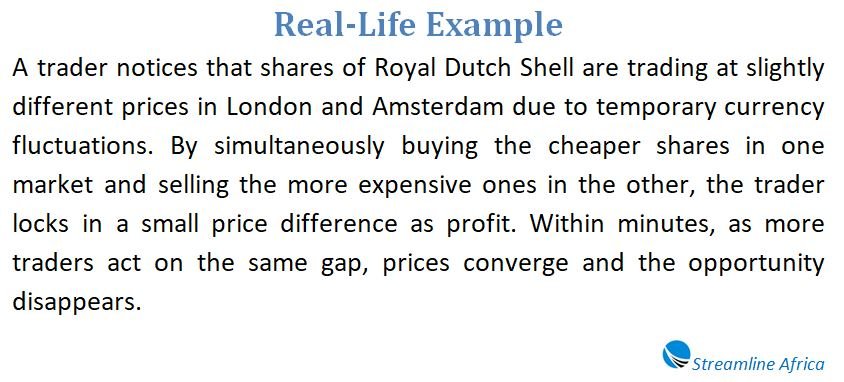
Stocks listed in multiple countries can have price mismatches due to currency fluctuations or local demand. Arbitrageurs trade simultaneously across markets to exploit these gaps.
Dual-Listed Companies
Some companies operate under a dual-listed structure, maintaining two separate listings. Ideally, both should move in sync, but history shows significant divergences, such as the famous case of Royal Dutch Shell, where traders like Long-Term Capital Management suffered massive losses trying to exploit the price gap.
Regulatory Arbitrage
Sometimes, arbitrage isn’t about trading assets but about navigating rules. Companies or banks may exploit differences in regulatory frameworks or tax regimes across jurisdictions to reduce costs or avoid restrictions. This practice has shaped industries ranging from banking to healthcare.
Telecom Arbitrage
In telecommunications, arbitrage appears when companies route international calls through cheaper networks, profiting from pricing inconsistencies in call termination fees.
Statistical Arbitrage
This form relies on mathematical models to detect pricing imbalances that are expected to correct over time. Casinos, for example, operate on this principle, ensuring that the odds always favor the house.
Grey Market Arbitrage
Goods sold outside authorized channels, such as luxury watches sold online at deep discounts, also represent arbitrage. Buyers exploit the gap between official retail prices and alternative markets.

Arbitrage and Market Efficiency
The existence of arbitrage reflects imperfections in markets. But the act of arbitrage reduces those imperfections. As traders rush to exploit discrepancies, their actions push prices toward balance, reducing future opportunities. This constant cycle ensures markets remain competitive and relatively fair.
Lessons from History
Not all arbitrage plays out as expected. Long-Term Capital Management, once hailed as a genius hedge fund, collapsed in 1998 after betting heavily on price convergences that failed during a financial crisis. The firm’s downfall showed that even strategies designed to exploit small, predictable differences can unravel when markets behave unpredictably.
The Role of Technology
Modern arbitrage would not exist without technology. High-frequency traders depend on cutting-edge systems to spot and execute opportunities in fractions of a second. This arms race for speed has raised debates about fairness, as well as concerns over whether such strategies truly benefit the broader economy.
Beyond Finance
Although arbitrage is rooted in finance, the idea applies to many areas of life. From people buying airline tickets through loopholes to companies shifting production to lower-cost regions, arbitrage reflects a universal drive: finding advantage in difference.
Final Thoughts
Arbitrage might sound like a niche financial trick, but its impact is enormous. It shapes how currencies move, how securities are priced, and how companies navigate regulations. It brings efficiency to markets but also reveals vulnerabilities, especially during crises. For traders, arbitrage represents both opportunity and risk—a delicate balance between seizing the moment and avoiding disaster.

Frequently Asked Questions about Arbitrage
Why is arbitrage important in finance?
It helps keep markets efficient by pushing prices of the same or similar assets into alignment, preventing unfair gaps across markets.
Is arbitrage really risk-free?
In theory, yes. But in reality, risks like execution delays, counterparty failure, or sudden market changes can wipe out profits.
How does arbitrage affect global prices?
When traders act on price gaps across countries or currencies, they create demand and supply pressures that push prices closer together.
What is an example of spatial arbitrage?
If gold is priced lower in London than in New York, a trader can buy in London and sell in New York, earning from the price gap.
How does crypto arbitrage work?
Cryptocurrencies often trade at slightly different prices across exchanges. Traders buy on the cheaper exchange and sell on the more expensive one.
What is merger arbitrage?
It’s a strategy where traders buy the stock of a company being acquired and sometimes short the acquirer’s stock, profiting as the deal closes.

Can arbitrage be risky during financial crises?
Yes. The collapse of Long-Term Capital Management in 1998 showed that even “safe” arbitrage strategies can fail in extreme conditions.
How does technology influence arbitrage today?
High-frequency trading systems allow firms to spot and act on opportunities in microseconds, making arbitrage highly competitive.
What is regulatory arbitrage?
It happens when companies or banks exploit differences in tax laws or regulations across regions to reduce costs or avoid restrictions.
Is arbitrage only about finance?
No. It also appears in areas like telecom pricing, airline tickets, luxury goods markets, and even cross-border shopping.
What lesson does arbitrage teach us?
That opportunities exist wherever markets are imperfect—but they often come with hidden risks that require caution and expertise.