
In the day-to-day life of a business, not every transaction ends in success. Customers sometimes fail to pay, inventory may lose value, and loans might never be recovered. Rather than ignoring these realities, businesses use a structured accounting process to reflect them accurately. One of the most important tools for doing this is the write-off.
At its core, a write-off helps a company acknowledge financial losses while also influencing how much tax it ultimately pays. Though it may sound like a technical accounting term, its implications reach far beyond bookkeeping—it directly affects profitability, tax obligations, and financial transparency.
What a Write-Off Really Means
A write-off is an accounting adjustment used when a business determines that a portion of its assets no longer holds value or cannot be recovered. This could involve unpaid customer invoices, damaged inventory, or loans that will never be repaid.
Instead of continuing to list these items as valuable assets, the business removes them from its books. This action reduces the company’s reported income because the loss is recognized as an expense. As a result, taxable income decreases.
Imagine a small logistics company in Nairobi that delivers goods across East Africa. If one of its major clients disappears without settling a large invoice, the company cannot keep counting that money as an asset. Writing it off ensures the financial records reflect reality rather than expectation.

How Write-Offs Appear in Accounting Records
Write-offs are not just conceptual—they are recorded through specific accounting entries. These entries typically involve two sides: an expense account and an asset account.
When a loss is recognized, the business increases its expenses (a debit entry) and reduces the value of the related asset (a credit entry). This dual entry ensures that financial statements remain balanced and accurate.
There are two widely used methods for handling write-offs:
The Direct Write-Off Method
Under this approach, a business records the loss only when it becomes certain that payment will not be received. For example, if a customer in Lagos fails to pay after months of follow-up, the company directly removes that amount from accounts receivable and records it as a bad debt expense.
This method is simple and straightforward, but it may not always align with more advanced accounting standards because it delays recognition of potential losses.
The Allowance Method
The allowance method takes a more proactive approach. Instead of waiting for a loss to occur, a business estimates potential bad debts in advance. It creates a reserve—often called an allowance for doubtful accounts—that anticipates future losses.
When a specific account becomes uncollectible, it is written off against this allowance rather than directly impacting expenses at that moment. This method provides a smoother and more realistic picture of financial performance over time.
Common Situations Where Write-Offs Occur
Write-offs arise in several recurring business scenarios. Understanding these helps clarify how widespread and necessary they are.
Unpaid Loans
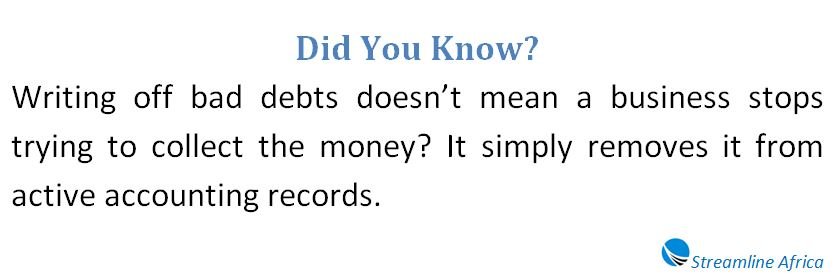
Financial institutions frequently deal with borrowers who fail to repay loans. After exhausting all recovery efforts, the remaining balance is written off. While this does not mean the lender stops attempting collection entirely, it acknowledges that the asset no longer holds reliable value.
Banks often track these losses alongside reserves set aside for expected defaults, ensuring that their financial position reflects both current and anticipated risks.
Outstanding Customer Receivables
Businesses that sell goods or services on credit often face delayed or missing payments. When it becomes clear that a customer will not settle their debt, the amount is written off.
Consider a wholesale trader in Accra who supplies goods to retailers on credit. If one retailer shuts down unexpectedly, the unpaid balance must be removed from the books to avoid overstating income.
Inventory Losses
Inventory can lose value in many ways—damage, theft, spoilage, or obsolescence. A technology retailer in Johannesburg, for instance, might find that older devices become unsellable once newer models dominate the market.
In such cases, the inventory’s value is written off, with the loss recorded as an expense and the inventory account reduced accordingly.
Write-Offs and Tax Benefits
Beyond reflecting financial reality, write-offs play a significant role in taxation. In everyday language, the term “write-off” is often used broadly to describe anything that reduces taxable income.
Businesses incur a wide range of expenses throughout their operations. Many of these expenses are deductible, meaning they can be subtracted from total revenue when calculating taxable profit. Common examples include rent, utilities, office supplies, insurance, and communication costs.
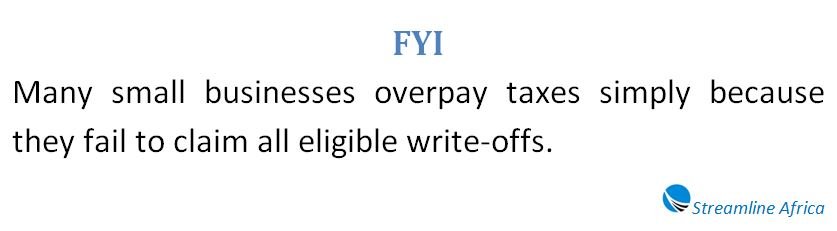
By increasing total expenses, write-offs reduce the amount of profit subject to tax. This does not mean the business is gaining extra cash; rather, it is ensuring that taxes are calculated based on actual, not overstated, earnings.
It is important to distinguish between deductions and tax credits. Deductions lower taxable income, while tax credits directly reduce the amount of tax owed. Both are valuable, but they function differently within the tax system.
The Difference Between Write-Offs and Write-Downs
Although the terms are sometimes used interchangeably, write-offs and write-downs represent different levels of asset reduction.
A write-down occurs when an asset loses part of its value but still retains some usefulness. For example, a delivery vehicle that has been damaged but remains operational may be written down to reflect its reduced worth.
A write-off, on the other hand, applies when an asset has lost all practical value. It is completely removed from the books because it no longer contributes to the business’s ability to generate income.
The distinction is subtle but important. A write-down signals partial loss, while a write-off represents a total loss.
How Write-Offs Affect Profit and Financial Statements
Every write-off ultimately flows through the income statement. When a loss is recorded, it increases expenses and reduces net profit.
This lower profit figure also affects taxable income, leading to reduced tax liability. However, it is important to understand that a write-off does not improve a business’s financial health—it simply ensures accurate reporting.
For example, if a company reports high revenue but fails to account for significant unpaid debts, its profit figure would be misleading. Write-offs correct this by aligning reported income with actual financial outcomes.
They also play a critical role in maintaining credibility with investors, lenders, and regulators. Transparent reporting builds trust and allows stakeholders to make informed decisions.
Everyday Business Expenses That Qualify as Write-Offs
Many routine operating costs can be treated as write-offs because they are necessary for running the business. These include expenses such as:
- Office rent and utilities
- Employee wages and benefits
- Internet and phone services
- Business insurance
- Office supplies and equipment
Each of these reduces taxable income when properly documented and claimed. For small businesses especially, understanding these deductions can make a significant difference in managing cash flow and tax obligations.
Why Understanding Write-Offs Matters
For business owners, write-offs are more than just accounting entries—they are essential tools for financial clarity and strategic planning. They ensure that losses are recognized promptly, profits are not overstated, and taxes are calculated fairly.
A company that ignores or mismanages write-offs risks presenting an inaccurate financial picture. This can lead to poor decision-making, compliance issues, and reduced credibility in the eyes of stakeholders.
By contrast, a business that handles write-offs correctly gains a clearer understanding of its performance and can plan more effectively for the future.
The Bottom Line
Write-offs are a fundamental part of business accounting, reflecting the reality that not all assets retain their value. Whether dealing with unpaid debts, failed loans, or unusable inventory, businesses rely on write-offs to maintain accurate records.
At the same time, these adjustments reduce taxable income, offering a practical benefit in terms of tax efficiency. Distinguishing between write-offs and write-downs further enhances financial clarity, helping businesses represent partial and total losses appropriately.
In the end, mastering the concept of write-offs is not just about compliance—it is about understanding the true financial position of a business and making smarter decisions based on that reality.
Frequently Asked Questions about Business Write-Offs
Why do businesses need to record write-offs?
Write-offs help businesses present accurate financial records. Without them, profits may appear higher than they actually are, which can mislead owners, investors, and tax authorities.
How does a write-off reduce taxes?
When a loss is recorded, it increases expenses on the income statement. Higher expenses reduce taxable income, meaning the business pays tax only on what it truly earned.
What is the difference between a write-off and a write-down?
A write-off removes an asset completely because it has no remaining value, while a write-down reduces its value partially when it still has some usefulness.
What are common examples of write-offs in business?
Typical examples include unpaid customer debts, defaulted loans, and inventory that is damaged, stolen, or outdated.
How do businesses record a write-off in accounting?
A write-off is recorded by debiting an expense account (increasing expenses) and crediting the related asset account (reducing its value).
What is the direct write-off method?
This method records a loss only when it becomes certain that payment won’t be received. It’s simple but may delay recognizing potential losses.
What is the allowance method and why is it useful?
The allowance method estimates future losses in advance. It helps businesses spread the impact of bad debts over time and provides a more accurate financial picture.
Can everyday expenses be considered write-offs?
Yes, routine business costs like rent, utilities, salaries, and office supplies are all considered write-offs because they reduce taxable income.
Do write-offs improve a company’s financial health?
Not really. Write-offs don’t create profit—they simply correct the books. However, they improve transparency and help businesses make better financial decisions.