

When Ama Mensah launched BlueCrest Agro-Processing Ltd in Sunyani, one of her earliest investments was a set of maize milling machines and delivery vehicles. These assets were essential for her business to operate, but they also came with significant upfront costs. From an accounting perspective, those machines would gradually lose value through depreciation. However, for tax purposes, the Ghana Revenue Authority does not rely on accounting depreciation. Instead, Ama benefits from a capital allowance, a statutory tax relief that allows businesses to deduct the cost of qualifying assets over time when calculating taxable income.
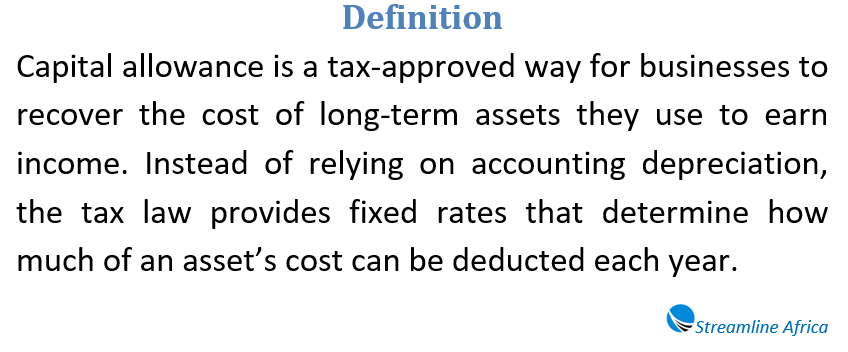
Capital allowance exists to recognize a simple reality: businesses must invest in long-term assets to generate income, and the cost of those assets should be recovered gradually through tax deductions. Rather than relying on subjective accounting estimates, the tax law applies standardized rates and rules to ensure fairness, consistency, and predictability.
What Capital Allowance Really Is
Capital allowance is a tax deduction granted in place of financial accounting depreciation. It applies to assets that wear out, become obsolete, or are consumed through use in business operations. The allowance is available only where the asset contributes directly to the generation of taxable business income.
In Ghana, capital allowance is governed by the Income Tax Act, 2015 (Act 896), as amended, with detailed rules set out in the Third Schedule. These rules specify which assets qualify, how they are grouped, and the rate at which their cost may be written off for tax purposes.
Unlike depreciation in financial statements, capital allowance is not based on management judgment or accounting policy choices. It is purely statutory. If an asset meets the legal requirements, the allowance is granted strictly in line with the rates prescribed by law.
Read More: Capital Allowances in the United Kingdom: Categories, Advantages, and Tax Planning Effects
Core Conditions for Claiming Capital Allowance
Not every asset purchased by a business automatically qualifies for capital allowance. The law imposes clear conditions that must be satisfied before a claim can be made.
First, the allowance applies only to depreciable assets. These are assets that have a limited useful life and are expected to decline in value as they are used. Land, for example, does not qualify because it does not depreciate.
Second, the asset must be owned by the taxpayer. Leasing an asset does not give the lessee the right to claim capital allowance unless ownership legally transfers. If BlueCrest Agro-Processing hires a truck from a logistics company, the allowance belongs to the owner of the truck, not BlueCrest.
Third, the asset must be used in carrying on the taxpayer’s business during the relevant basis period. An idle or unused asset does not qualify, even if it is owned by the business.
Fourth, the asset must still be owned at the end of the basis period that falls within the year of assessment. If an asset is purchased and disposed of within the same period, special treatment may apply, but the general rule requires ownership at period end.
Finally, capital allowance is not transferable across years. If an allowance is granted for a particular year of assessment, it must be claimed in that year. It cannot be deferred or carried forward to later years, as reinforced by the relevant provisions of the tax law.

Why Asset Classification Matters
To simplify administration and standardize deductions, the tax law groups depreciable assets into distinct classes. Each class has a prescribed rate, reflecting how quickly assets in that category typically lose value.
Rather than tracking each asset individually, businesses often maintain asset pools, where assets of the same class are grouped together. The applicable rate is then applied to the pool balance.
This system reduces complexity and limits disputes between taxpayers and the tax authority.
Class One: High-Turnover Technology Assets
The first category covers computers and data-handling equipment, including servers, laptops, printers, scanners, and peripheral devices. These assets experience rapid technological obsolescence, which is why they attract a relatively high allowance rate.
A fintech startup in Accra that invests heavily in cloud servers and workstations can recover a significant portion of those costs quickly through capital allowance, reflecting the short economic life of such equipment.
The statutory rate for this class is 40% per year.
Class Two: Vehicles, Machinery, and Certain Agricultural Investments
The second class is broader and includes a wide range of productive assets. These include cars, buses, minibuses, goods vehicles, as well as construction and earth-moving equipment, heavy trucks, trailers, and plant and machinery used in manufacturing.
For example, a quarry operator in Shai Hills using excavators and crushing equipment would place those assets in this class.
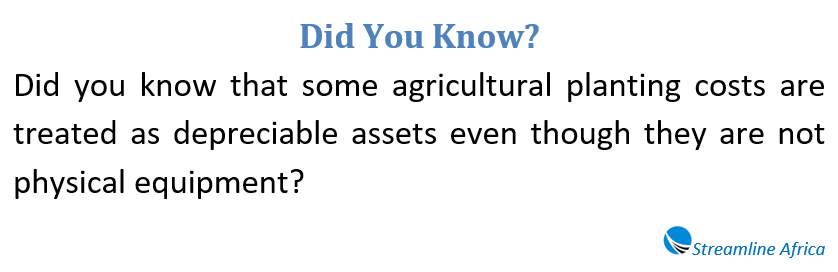
This category also extends beyond physical machinery. Certain expenditures incurred in producing income, particularly in agriculture, are treated as if they result in the acquisition of depreciable assets. Costs related to planting timber, rubber, oil palm, or other long-term crops fall under this category, especially where the business operates as a large-scale plantation or timber concern.
These agricultural development costs are capitalized and written off over time, even though they may not result in a conventional tangible asset.
The allowance rate for this class is 30% per year.
Class Three: Heavy Transport and General Business Assets
The third class captures assets used in rail, sea, air, and public utility operations, such as locomotives, railcars, vessels, barges, tugboats, and aircraft. It also includes specialized utility equipment and a wide range of office furniture, fittings, and equipment.
Importantly, this class acts as a residual category. Any depreciable asset not specifically included in another class generally falls here.
A logistics firm operating from Tema Harbour, for instance, may include cargo-handling equipment and administrative office furnishings within this category.
The prescribed rate for Class Three assets is 20% per year.
Class Four: Permanent Structures
Buildings and structures of a permanent nature are treated differently from movable assets. Because they generally have much longer useful lives, the tax law allows a slower recovery of their cost.
Warehouses, factories, office buildings, silos, and similar structures fall under this class. Even though such assets may remain in use for decades, the law recognizes gradual wear and tear through a modest annual allowance.
The applicable rate for this class is 10% per year.
Class Five: Intangible Assets
Not all valuable business assets are physical. Intangible assets such as licenses, software rights, patents, and certain contractual rights also qualify for capital allowance.
Unlike other classes with fixed rates, intangible assets are written off based on their useful life. The annual allowance is calculated as one divided by the useful life of the asset in the pool.
For example, if a telecommunications company acquires a license valid for ten years, the capital allowance would generally be spread evenly over that period.
Special Incentive for Excise Stamp Machinery
To support tax compliance and revenue protection, the law provides an enhanced incentive for specific assets. Importers or manufacturers of excisable goods who bring in machinery and equipment specifically for affixing Excise Tax Stamps are entitled to a 50% capital allowance on those qualifying assets.
This accelerated relief reduces the cost burden of compliance and encourages early adoption of stamp systems.
Depreciation Allowance in the Tax Context
Although businesses often use the term “depreciation allowance” informally, in tax law it refers to the capital allowance granted for the use of depreciable assets during the basis period.
The key distinction is that depreciation in financial statements is ignored for tax purposes. Only capital allowance, calculated under the statutory framework, is recognized when determining taxable income.
How Capital Allowance Is Calculated in Practice
Capital allowance is generally computed by applying the relevant statutory rate to the written-down value of the asset pool at the beginning of the basis period, adjusted for additions and disposals during the year.
The calculation follows a formulaic approach defined in the tax legislation, ensuring consistency across taxpayers and industries. The result is a deductible amount that reduces assessable income for the year of assessment.
Capital Allowance and Petroleum Operations
In the petroleum sector, capital allowance is subject to specialized rules that reflect the capital-intensive nature of exploration and production activities. Assets used in upstream petroleum operations are often governed by sector-specific provisions that override the general rules applicable to other businesses.
These rules are designed to align tax relief with the unique risk profile and investment horizons of petroleum operations.
Final Thoughts
Capital allowance is more than a technical tax concept. It is a practical tool that helps businesses recover the cost of long-term investments while maintaining fairness in the tax system. By replacing subjective accounting depreciation with standardized statutory deductions, the law creates certainty for both taxpayers and the revenue authority.
For business owners like Ama Mensah, understanding capital allowance is not optional. It directly affects taxable income, cash flow, and long-term financial planning. When applied correctly, it ensures that investment in productive assets is encouraged rather than penalized—exactly what a well-designed tax system is meant to achieve.
Frequently Asked Questions about Capital Allowance in Ghana
How Is Capital Allowance Different from Accounting Depreciation?
Accounting depreciation is based on management estimates and accounting policies, while capital allowance is strictly governed by tax law. For tax purposes, depreciation in financial statements is ignored and replaced entirely by capital allowance.
Who Can Claim Capital Allowance?
Only the person or business that owns a depreciable asset and uses it in generating business income during the year can claim capital allowance. Ownership and business use are both essential.
What Types of Assets Qualify for Capital Allowance?
Assets that wear out or become obsolete through business use qualify. These include machinery, vehicles, computers, buildings, and certain intangible assets such as licenses and software.
Are There Assets That Do Not Qualify?
Yes. Assets like land do not qualify because they do not depreciate. Also, assets not used in the business or not owned by the taxpayer are excluded.
Why Does the Law Group Assets into Classes?
Asset classification simplifies tax calculations and ensures fairness. Each class has a standard rate that reflects how quickly assets in that group typically lose value.
Why Do Computers Have a Higher Allowance Rate?
Computers and related equipment become obsolete quickly due to rapid technological change. The higher rate allows businesses to recover their cost faster, matching economic reality.
How Are Buildings Treated Differently from Equipment?
Buildings last much longer than machinery or vehicles, so their cost is written off more slowly. This is why permanent structures attract a lower annual allowance rate.
Can Agricultural Development Costs Be Capitalized?
Yes. Certain agricultural expenditures, such as planting long-term crops like oil palm or rubber, are treated as depreciable assets and written off over time through capital allowance.
What Happens If an Asset Is Not Used During the Year?
If an asset is not used in the business during the basis period, capital allowance cannot be claimed for that year, even if the business owns the asset.
Can Unused Capital Allowance Be Carried Forward?
No. Capital allowance granted for a specific year must be used in that year. It cannot be carried forward or deferred to future years.
Why Is Capital Allowance Important for Business Planning?
Capital allowance reduces taxable income and improves cash flow. Understanding it helps businesses plan investments better and avoid paying more tax than legally required.