
A capital injection refers to the introduction of additional financial resources into a business, financial institution, project, or investment vehicle. The funding may be provided through equity, debt, shareholder contributions, or other long-term financing arrangements. While capital injections are frequently associated with distressed businesses requiring financial support, they are equally relevant to companies pursuing expansion, transformation, acquisitions, or balance-sheet strengthening.
From a corporate finance perspective, a capital injection is not simply an increase in available cash. It can materially influence a company’s capital structure, ownership profile, financial risk, governance arrangements, and future strategic flexibility. The significance of the transaction therefore depends on both the amount of capital provided and the instrument through which the funding is structured.
For example, a growing technology company in Kigali may require additional funding to expand its engineering team, invest in cloud infrastructure, and enter new regional markets. If an investment fund provides fresh equity in return for shares, the company receives additional capital without creating fixed repayment obligations. If the same funding is provided through a long-term loan, ownership remains unchanged, but leverage and debt-servicing requirements increase.
The Strategic Role of Capital Injections
Capital injections can support organizations at different stages of the business life cycle. Early-stage companies typically require external funding because internal cash generation is insufficient to finance product development, market entry, recruitment, and customer acquisition. Initial funding may come from founders, private investors, angel investors, or venture capital firms.
As businesses mature, capital requirements often shift from basic operating needs toward scale, market expansion, infrastructure development, and acquisitions. A food-processing company operating in Kumasi, for instance, may require additional capital to increase production capacity, install automated packaging equipment, establish regional distribution centers, and obtain the certifications required for export markets.
Management may choose to raise equity, secure long-term debt, or combine both approaches depending on the company’s financial position and strategic priorities. The appropriate structure will typically depend on expected cash flows, existing leverage, shareholder objectives, funding costs, and the level of control existing owners are prepared to relinquish.
For established organizations, capital injections can also strengthen the balance sheet ahead of significant strategic initiatives. Companies may raise capital before entering new markets, investing in major technology platforms, undertaking acquisitions, or preparing for periods of increased operational expenditure.
Equity Capital and Its Implications
An equity capital injection involves an investor providing funds in exchange for an ownership interest in the business. This structure is commonly used by startups, high-growth companies, private businesses, and organizations that may not be able or willing to assume additional debt.
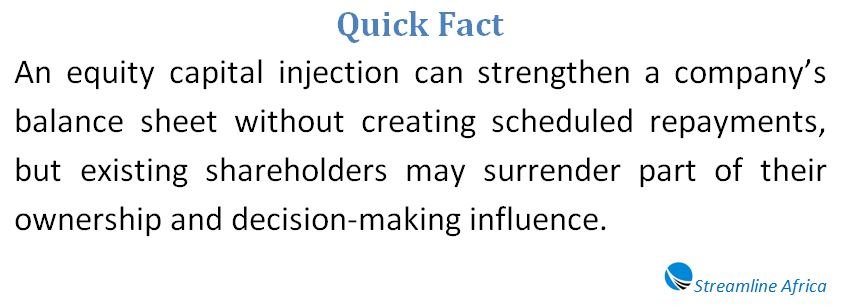
The principal advantage of equity financing is that the company generally does not face mandatory interest payments or scheduled principal repayments. This can provide valuable financial flexibility, particularly where cash flows are uncertain or substantial reinvestment is required.
The trade-off is dilution. Existing shareholders may own a smaller percentage of the business after new shares are issued. Investors may also negotiate board representation, voting rights, information rights, approval thresholds, or protections relating to future financing rounds.
Consider a renewable-energy developer in Cape Town seeking $20 million to construct a portfolio of commercial solar projects. An infrastructure investor may provide the required capital in exchange for a 25% equity interest. The funding enables the developer to execute its expansion strategy without placing immediate pressure on operating cash flows. However, existing shareholders must share future earnings and certain strategic decisions with the new investor.
Accordingly, equity capital should be assessed not only in terms of funding availability but also in relation to governance, control, valuation, and long-term shareholder returns.
Debt-Based Capital Injections
Debt financing provides another mechanism for injecting capital into a business. The company receives additional financial resources while existing shareholders retain their ownership interests. In exchange, the organization assumes contractual repayment obligations.
Debt can be an efficient source of capital where the business has predictable cash flows and sufficient capacity to service interest and principal repayments. It may be used to finance machinery, property, acquisitions, working capital, or other investment requirements.
However, increasing leverage can create financial risk. A company with high fixed repayment obligations may have reduced flexibility during periods of weaker revenue or unexpected market disruption. Debt agreements may also include financial covenants, security requirements, restrictions on additional borrowing, or limitations on dividend distributions.
Management therefore needs to evaluate debt capacity carefully. Relevant considerations include cash-flow resilience, interest coverage, collateral requirements, existing leverage, refinancing risk, and the expected returns generated by the investment being financed.
The central question is whether the additional capital is expected to generate sufficient economic value to justify the associated financial obligations.
Capital Injections in Financial Institutions
Capital injections play a particularly important role in banking and other regulated financial services businesses. Financial institutions are required to maintain prescribed levels of capital to absorb losses and protect depositors and other stakeholders.
Where a bank experiences significant credit losses or asset deterioration, its capital position may weaken. Existing shareholders may therefore be required to contribute additional funds, or the institution may raise capital from new investors.
A stronger capital base can improve financial resilience and support continued lending activity. It can also enable a bank to comply with regulatory capital requirements and maintain market confidence.
For example, if a regional bank experiences higher-than-expected losses from commercial property loans, additional shareholder capital may be necessary to restore its capital ratios. Without such support, the bank may need to reduce lending, sell assets, or pursue a broader restructuring program.
In this context, a capital injection serves both a financial and systemic function. It strengthens the individual institution while potentially reducing the risk of disruption to the broader financial system.

Capital Injections During Corporate Distress
Capital injections are frequently used as part of turnaround and restructuring strategies. A company experiencing financial distress may require fresh capital to maintain operations while management implements corrective measures.
Liquidity pressure can arise from declining revenue, excessive leverage, operational disruption, unexpected losses, or major changes in market conditions. In such circumstances, additional capital may be required to fund payroll, suppliers, debt obligations, restructuring costs, or essential operating expenditure.
Consider a regional airline headquartered in Nairobi that experiences a prolonged reduction in passenger demand. Although revenue declines sharply, the business continues to incur aircraft leasing costs, maintenance expenses, airport charges, and employee costs.
A group of investors may provide additional equity to support the airline during a restructuring period. The new funding could be used to preserve core routes, renegotiate supplier contracts, reduce fleet complexity, and strengthen liquidity.
However, capital alone does not resolve structural weaknesses. If the underlying business model remains uncompetitive, repeated injections may simply postpone further financial difficulty. Effective turnaround funding therefore needs to be accompanied by operational restructuring, governance improvements, and a credible path to sustainable profitability.
Government-Supported Capital Injections
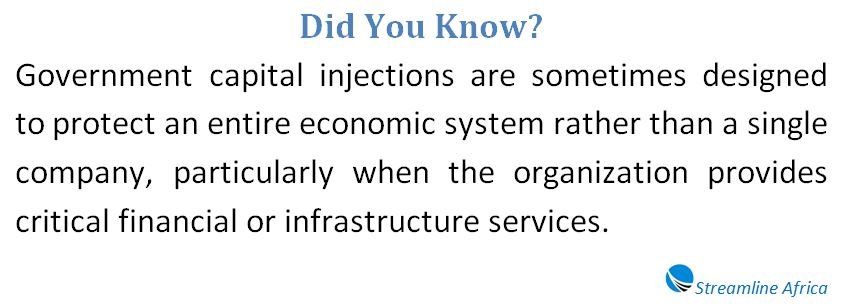
Governments may provide capital to strategically important companies or sectors where financial failure could have wider economic consequences. Such interventions are generally considered when the disruption associated with failure may affect employment, financial stability, public services, or critical infrastructure.
Assume that Meridian Commercial Bank, a fictional institution in a coastal emerging market, suffers substantial losses following a property-market correction. Confidence weakens, wholesale funding becomes more difficult to obtain, and regulatory capital ratios move toward minimum requirements.
Because the bank plays an important role in business lending and domestic payment processing, the government may decide that an uncontrolled failure could create significant economic disruption.
Authorities could therefore inject $2.5 billion in exchange for preferred shares and enhanced oversight rights. Conditions may include management changes, restrictions on dividends, restructuring targets, stronger risk controls, and a timetable for reducing government ownership.
Such an intervention can restore confidence and stabilize the institution, but it also creates important policy questions regarding taxpayer exposure, market discipline, governance, and the eventual exit strategy.
Government-backed capital should therefore be evaluated against both immediate stabilization objectives and longer-term economic consequences.
Capital Injections as a Growth Enabler
Although capital injections are often discussed in the context of financial distress, many are undertaken from a position of strength. Profitable businesses frequently raise additional capital because attractive investment opportunities exceed the funding available from retained earnings.
A healthcare diagnostics company in Casablanca, for example, may raise $15 million from a growth-equity investor to establish new laboratories, automate testing processes, build a digital patient platform, and enter additional regional markets.
In this situation, the purpose of the capital injection is not financial rescue but strategic acceleration. External funding allows the business to execute its growth program faster than would be possible through internally generated cash alone.
The success of such investment ultimately depends on capital allocation. Management must ensure that funding is directed toward initiatives capable of generating sustainable returns, strengthening competitive advantage, or improving operating performance.
Expansion for its own sake does not necessarily create shareholder value. Capital should therefore be deployed against clearly defined commercial objectives, supported by robust financial analysis and performance monitoring.
Assessing the Business Impact of a Capital Injection
The effectiveness of a capital injection should be assessed using both financial and strategic measures. Management should consider how the transaction affects liquidity, leverage, return on capital, ownership, governance, and future financing flexibility.
For growth investments, decision-makers should evaluate expected revenue growth, margin improvement, cash generation, and return on invested capital. For distressed businesses, attention should focus on liquidity runway, debt reduction, operational stabilization, and the feasibility of the turnaround plan.
The source of funding also matters. Equity may strengthen financial resilience but dilute existing shareholders. Debt can protect ownership but increase financial risk. Government funding may provide stability but introduce additional oversight and public accountability.
A well-structured transaction should therefore align the funding instrument with the company’s strategic objectives, financial capacity, and risk profile.
Conclusion
Capital injections are a significant component of corporate finance and can serve a range of strategic purposes. They can strengthen balance sheets, provide liquidity during periods of financial stress, fund expansion, enable acquisitions, support regulatory compliance, or accelerate the development of high-growth businesses.
Their impact depends heavily on how they are structured and how effectively the resulting capital is deployed. Equity financing can provide flexibility but may alter ownership and governance. Debt can preserve shareholder control while increasing repayment obligations and financial risk. Government interventions can protect wider economic interests but often involve substantial conditions and oversight.
For management teams and investors, the central issue is not simply whether additional capital is available. The more important consideration is whether the funding structure supports long-term value creation.
When supported by disciplined capital allocation, strong governance, and a clearly defined strategic objective, a capital injection can strengthen financial resilience and provide an organization with the resources required to execute its next phase of development.
Major Takeaways
Capital Injections Provide More Than Emergency Funding
Capital injections are not limited to rescuing struggling companies. Businesses also use fresh funding to expand operations, enter new markets, invest in technology, and pursue acquisitions.
Funding Structure Can Change a Company’s Risk Profile
The impact of a capital injection depends heavily on whether it is structured as equity or debt. Equity can dilute ownership, while debt creates repayment and interest obligations.
Equity Funding Can Improve Financial Flexibility
Companies receiving equity capital generally avoid fixed repayment schedules. This can be particularly valuable for startups and growing businesses that need to reinvest cash into expansion.
Debt Allows Owners to Retain Control
Debt financing can provide businesses with substantial additional capital without reducing existing shareholders’ ownership. However, higher debt levels can increase financial pressure when revenues weaken.
Capital Injections Can Strengthen Financial Institutions
Banks may require additional capital to absorb losses, satisfy regulatory requirements, maintain market confidence, and preserve their ability to lend to businesses and consumers.
Government Intervention Can Protect Wider Economic Interests
Governments may inject capital into strategically important organizations when their failure could threaten employment, financial stability, infrastructure, or other parts of the economy.
Fresh Capital Can Support Corporate Turnarounds
Distressed companies may use capital injections to maintain payroll, settle critical obligations, restructure operations, and create the financial breathing room required to implement recovery plans.
Additional Funding Cannot Fix a Weak Business Model
Capital alone does not guarantee a successful turnaround. Companies still need sound leadership, sustainable economics, effective governance, and a credible operational strategy.
Growth Capital Can Accelerate Expansion
Healthy companies can use capital injections to increase production capacity, develop new products, acquire businesses, improve technology, or expand geographically faster than retained earnings would allow.
Capital Allocation Determines Long-Term Value
The real value of a capital injection depends on what management does with the money. Capital directed toward productive and commercially viable investments can strengthen competitive advantage and long-term returns.