

A company can report a healthy profit and still struggle to meet its everyday obligations. The reason is that accounting profit does not always arrive as immediate cash. Net working capital focuses on the relationship between operating current assets and operating current liabilities. The movement in that balance from one reporting period to another shows whether routine business activities absorbed cash or released cash. This measure is important in financial analysis, valuation, budgeting, and cash flow forecasting because it connects the income statement, balance sheet, and cash flow statement.
What Change in Net Working Capital Represents
Change in net working capital measures the difference between a company’s operating working capital at the beginning of a period and its operating working capital at the end. It shows how changes in receivables, inventory, payables, accrued expenses, and similar accounts influence liquidity.
When operating assets rise faster than operating liabilities, additional cash is normally tied up in the business. The company may be waiting longer for customers to pay, purchasing more stock, or paying certain expenses in advance. In contrast, when operating liabilities grow more rapidly, the company temporarily keeps cash that would otherwise have been paid to suppliers, employees, or service providers.
Calculating Net Working Capital Properly
For operating analysis, net working capital is usually calculated by subtracting operating current liabilities from operating current assets.
Net Working Capital = Operating Current Assets – Operating Current Liabilities
Operating current assets generally include accounts receivable, inventory, and prepaid operating expenses. Operating current liabilities commonly include accounts payable, accrued payroll, taxes payable, and expenses incurred but not yet settled.
Cash, marketable securities, bank overdrafts, short-term loans, and other interest-bearing obligations are normally excluded from this operating calculation. Cash and investments relate more closely to treasury or investing decisions, while borrowings are financing items. Removing them allows the analyst to concentrate on the funds committed to normal trading activities.
The Formula for Measuring the Change
Once net working capital has been calculated for two periods, the movement can be determined. A cash flow presentation often uses the following approach:
Change in Net Working Capital = Beginning NWC – Ending NWC
Under this convention, an increase in net working capital produces a negative figure because cash has been invested in operating assets. A decline produces a positive figure because cash has been released.
Suppose net working capital was $18 million at the start of the year and $27 million at the end. The change would be negative $9 million. That amount represents a use of cash. If the balance instead fell from $18 million to $11 million, the resulting positive $7 million would represent a source of cash.
How Operating Accounts Affect Cash
Accounts receivable rises when revenue is recognised faster than cash is collected. Although the sale increases profit, the unpaid balance means the cash has not yet entered the company. An increase in receivables is therefore treated as a cash outflow within working capital analysis.
Inventory has a similar effect. Purchasing or producing more goods requires cash, even when those goods have not yet been sold. Growing inventory may support expansion, but excessive stock can indicate weak demand, poor planning, or obsolete products.
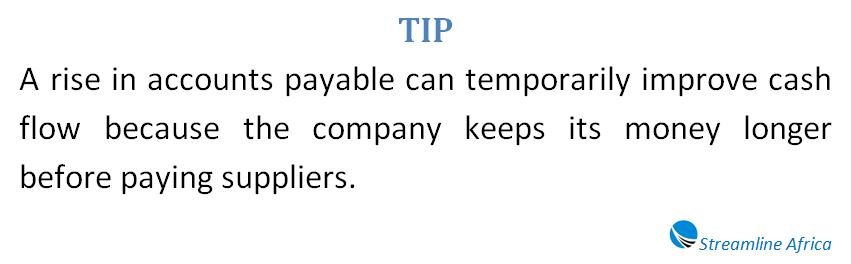
Accounts payable moves in the opposite direction. When a company purchases from suppliers without paying immediately, it retains cash for a longer period. An increase in payables is therefore a temporary cash inflow. Accrued expenses operate similarly because the company recognises a cost before payment occurs.
What Counts as a Favourable Change
There is no single working capital movement that is always desirable. A reduction in net working capital may improve short-term cash flow, but the underlying cause must be examined. Faster customer collections and efficient stock management are positive explanations. Delaying essential supplier payments because of financial distress is not.
Likewise, an increase in net working capital may appear unfavourable because it reduces free cash flow. Yet the increase could support rapid expansion. A growing retailer may need more inventory, while a manufacturer entering new markets may extend credit to dependable customers. In such cases, the cash investment may create future revenue.
Relationship With Free Cash Flow
Working capital is a central component of free cash flow. When net working capital increases, the additional investment is deducted from cash generated by operations. When it decreases, the released amount is added.
This adjustment is used in both levered and unlevered cash flow calculations. In valuation, overlooking working capital requirements can overstate the cash a company can distribute to lenders, shareholders, or potential buyers.
Interpreting Negative Net Working Capital
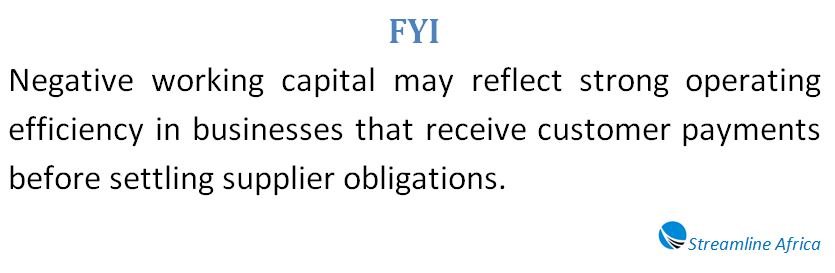
Negative net working capital occurs when operating current liabilities exceed operating current assets. This condition is not automatically a warning sign. Some businesses collect cash from customers before paying suppliers. Supermarkets, subscription services, and certain online platforms may operate successfully with negative working capital because they receive cash quickly and settle obligations later.
However, the same condition can signal difficulty when it results from unpaid bills, slow-moving inventory, weak collections, or a shortage of available funds. Context is essential. Analysts should review payment patterns, supplier relationships, customer behaviour, debt levels, and the company’s ability to access financing.
Where the Change Appears in the Cash Flow Statement
The cash flow statement usually presents working capital adjustments within cash flows from operating activities. Companies may show separate lines for receivables, inventory, payables, and other operating balances, or combine them into one total.
To interpret the section, compare the direction of each balance-sheet movement with its cash effect. Higher receivables and inventory normally reduce cash. Higher payables and accruals normally increase cash. The combined amount reconciles accrual-based profit with cash generated from ordinary business activities.
This section is especially useful when assessing earnings quality. If profit rises while operating cash flow falls because receivables are expanding rapidly, the company may be recording sales that have not yet been converted into cash.
Practical Calculation Example
Consider a distribution company with $42 million in receivables, $28 million in inventory, $31 million in payables, and $14 million in accrued expenses at the end of Year One.
Operating current assets equal $70 million, while operating current liabilities equal $45 million. Net working capital is therefore $25 million.
At the end of Year Two, receivables increase to $50 million and inventory rises to $34 million. Payables grow to $44 million, while accrued expenses increase to $20 million. Operating assets now total $84 million, and operating liabilities total $64 million. Ending net working capital is $20 million.
Using the cash flow convention, beginning net working capital of $25 million minus ending net working capital of $20 million produces a positive change of $5 million. The company released $5 million of cash from working capital because operating liabilities grew faster than operating assets.
The result may reflect stronger supplier credit, slower payment schedules, or improved inventory and collection management. Management would need to examine the supporting accounts before deciding whether the change is sustainable.
Final Perspective
Change in net working capital is more than a mechanical adjustment. It reveals how effectively a company converts sales into cash, manages stock, and uses supplier credit. Rising working capital usually absorbs cash, while falling working capital usually releases it. Neither outcome is automatically good or bad.
A sound conclusion requires attention to the accounts behind the total, the company’s growth stage, industry norms, and the reasons for the movement. When interpreted carefully, this measure provides a valuable bridge between reported profit and the cash a business can actually use.
Frequently Asked Questions
What Is Change in Net Working Capital?
It is the difference between a company’s net working capital at the beginning and end of a reporting period. It shows whether everyday operations used cash or released cash.
How Is Net Working Capital Calculated?
Net working capital is calculated by subtracting operating current liabilities from operating current assets.
Net Working Capital = Operating Current Assets – Operating Current Liabilities
Which Accounts Are Included in Net Working Capital?
Common operating assets include accounts receivable, inventory, and prepaid expenses. Operating liabilities usually include accounts payable and accrued expenses.
Why Are Cash and Debt Usually Excluded?
Cash, investments, loans, and other interest-bearing debts are not directly tied to core operating activities. Excluding them gives a clearer view of the money committed to running the business.
What Does an Increase in Net Working Capital Mean?
An increase usually means more cash has been tied up in receivables, inventory, or other operating assets. It is generally treated as a cash outflow.
What Does a Decrease in Net Working Capital Mean?
A decrease normally means the company has released cash from its operations. This may result from faster customer payments, lower inventory, or higher supplier credit.
How Does Net Working Capital Affect Free Cash Flow?
An increase in net working capital reduces free cash flow, while a decrease increases it. This is why working capital adjustments are important in valuation and financial forecasting.
Is Negative Net Working Capital Always a Bad Sign?
No. Some businesses collect cash from customers before paying suppliers, allowing them to operate successfully with negative working capital. However, it may also signal liquidity problems if bills are unpaid or inventory moves slowly.
Where Is the Change Shown in Financial Statements?
Working capital movements appear under operating activities in the cash flow statement. They help reconcile reported profit with the actual cash generated by the business.
How Should a Company Interpret Working Capital Changes?
The total figure should not be judged alone. Management must review the underlying causes, including customer payment behaviour, stock levels, supplier terms, growth plans, and industry conditions.
Reader Questions and Expert Insights
Is Change in Net Working Capital Calculated as Current NWC Minus Previous NWC?
I understand that net working capital is calculated by subtracting operating current liabilities from operating current assets. However, I am uncertain about the formula used to measure the change between two periods. Should the calculation be:
Current Period NWC – Previous Period NWC
or:
Previous Period NWC – Current Period NWC?
The article uses the second approach, but I would appreciate further clarification on why the periods are arranged in that order.
Why Does the Formula Use Previous NWC Minus Current NWC?
Using previous-period NWC minus current-period NWC makes the cash flow effect easier to interpret. When net working capital increases, more money is generally tied up in receivables, inventory, prepaid expenses, or other operating assets. The formula therefore produces a negative figure, indicating that cash has been absorbed by operations.
For example, if net working capital increases from $20 million to $28 million:
Change in NWC = $20 million – $28 million
Change in NWC = –$8 million
The negative $8 million represents a reduction in cash flow because additional funds have been committed to the company’s operating cycle.
Why Is an Increase in Inventory Subtracted From Net Income?
I understand that inventory is included in the calculation of net working capital. However, I am unclear about why an increase in inventory reduces operating cash flow when reconciling net income with cash generated from operations.
If inventory is an asset owned by the company, why is its increase treated as a use of cash rather than an improvement in the company’s financial position?
How Does Inventory Affect Operating Cash Flow?
An increase in inventory reduces operating cash flow because the company has spent money to purchase or produce goods that have not yet been sold. Although the inventory remains an asset on the balance sheet, the cash used to acquire it is no longer immediately available.
When converting net income into operating cash flow, common working capital adjustments can be understood as follows:
- An increase in accounts receivable is subtracted because revenue has been recognised without the related cash being collected.
- An increase in inventory is subtracted because cash has been invested in goods that remain unsold.
- An increase in accounts payable is added because expenses have been recognised even though payment has not yet been made.
- An increase in accrued expenses is added because the company has recorded costs while temporarily retaining the related cash.
These adjustments help convert accrual-based profit into the actual cash generated by business operations.
How Can Ending Inventory Increase Profit but Still Reduce Cash Flow?
The relationship between inventory, profit, and cash flow can initially appear contradictory. Under the cost of goods sold formula:
Cost of Goods Sold = Beginning Inventory + Purchases – Ending Inventory
A higher ending inventory reduces the amount recognised as cost of goods sold. Lower cost of goods sold increases gross profit and may also increase net income.
However, the company may still have spent cash to acquire or produce the inventory. Because the unsold goods remain on the balance sheet rather than being fully recognised as an expense, net income does not reflect the entire cash expenditure.
The increase in inventory is therefore subtracted during the operating cash flow calculation. This adjustment accounts for the cash invested in goods that have not yet contributed to recognised sales.
Why Do Profit and Cash Flow Treat Inventory Differently?
Profit measures financial performance using accrual accounting, while cash flow measures the actual movement of money.
When inventory is purchased, the company exchanges cash for an asset. The purchase does not immediately reduce profit because the inventory has not yet been sold. Once the goods are sold, their cost is transferred from inventory to cost of goods sold and recognised as an expense.
This timing difference explains why a company can report strong profits while experiencing weaker operating cash flow. A large amount of money may still be tied up in unsold products.
How Should Changes in Operating Assets Be Treated?
For operating assets, the cash flow adjustment can generally be expressed as:
Cash Flow Adjustment = Previous-Period Balance – Current-Period Balance
Therefore:
- An increase in an operating asset creates a negative cash flow adjustment.
- A decrease in an operating asset creates a positive cash flow adjustment.
For example, if accounts receivable rises from $30 million to $38 million:
Cash Flow Adjustment = $30 million – $38 million
Cash Flow Adjustment = –$8 million
The negative amount indicates that $8 million of additional revenue remains uncollected.
How Should Changes in Operating Liabilities Be Treated?
Operating liabilities follow the opposite pattern. Their cash flow adjustment can generally be expressed as:
Cash Flow Adjustment = Current-Period Balance – Previous-Period Balance
Therefore:
- An increase in an operating liability creates a positive cash flow adjustment.
- A decrease in an operating liability creates a negative cash flow adjustment.
For example, if accounts payable increases from $16 million to $22 million:
Cash Flow Adjustment = $22 million – $16 million
Cash Flow Adjustment = +$6 million
The positive amount reflects cash temporarily retained because payments to suppliers have not yet been made.
Why Do Operating Assets and Liabilities Use Opposite Signs?
Operating assets and operating liabilities affect available cash differently.
When an operating asset increases, the company generally commits additional cash to operations. More receivables mean additional sales remain uncollected, while more inventory means additional funds are stored in unsold goods.
When an operating liability increases, the company temporarily retains cash. Higher accounts payable means supplier payments have been postponed, while higher accrued expenses mean costs have been recognised before the related cash payments occur.
The opposite signs reflect these different effects on liquidity.
What Is the Simplest Way to Remember the Signs?
A useful rule is:
For operating assets:
Previous Period – Current Period
For operating liabilities:
Current Period – Previous Period
Another way to remember the relationship is:
An increase in operating assets generally uses cash.
A decrease in operating assets generally releases cash.
An increase in operating liabilities generally preserves cash.
A decrease in operating liabilities generally uses cash.
The sign convention may differ across financial models, but the underlying economic effect remains the same. Analysts should always confirm whether the calculation represents the accounting movement in net working capital or its direct impact on cash flow.