
For organisations pursuing charitable, educational, professional, social, cultural, scientific, religious, or community-based objectives in Kenya, selecting the right legal structure is an important strategic decision. A Company Limited by Guarantee, commonly referred to as a CLG, provides a formal corporate framework for organisations that require legal personality but are not established primarily to distribute profits to shareholders.
Unlike a conventional private company, a CLG does not issue shares or operate through shareholders. Instead, it has members who undertake to contribute a specified amount toward the company’s liabilities if the entity is eventually wound up. This structure makes it particularly relevant for non-governmental organisations, professional associations, foundations, clubs, industry bodies, social initiatives, and other mission-driven institutions.
From an advisory perspective, the value of a CLG lies in its ability to combine institutional credibility, limited liability, continuity, and a recognised corporate identity. However, organisations considering this structure should assess not only the registration requirements but also the governance and compliance responsibilities that follow incorporation.
Legal Framework and Corporate Status
Companies Limited by Guarantee in Kenya are governed principally by the Companies Act, 2015. Under the Act, a CLG is distinguished by the absence of share capital and by the commitment of its members to contribute an agreed amount toward the company’s assets if it is liquidated.
The guarantee should not be confused with an investment or capital contribution made when joining the organisation. Members do not purchase ownership interests in the way shareholders of an ordinary company do. Instead, the guarantee represents a limited financial commitment that may become payable during winding up.
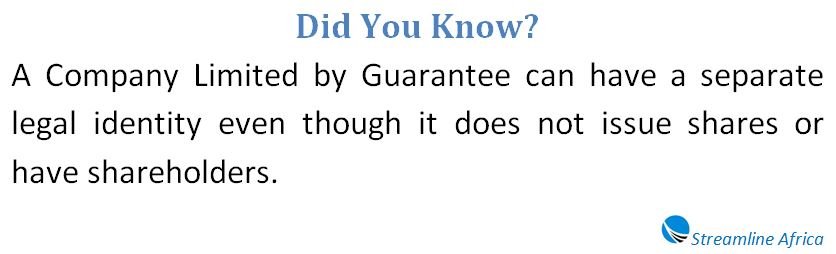
Once incorporated, the CLG becomes a legal entity separate from its members and officers. This distinction has significant practical implications. The company can acquire and hold property, enter into contractual arrangements, employ personnel, maintain bank accounts, receive funding, incur liabilities, and undertake legal proceedings in its own name.
For institutions seeking to operate beyond an informal association, this separate legal identity can substantially improve governance, accountability, and stakeholder confidence.
Core Characteristics of the CLG Structure
A defining feature of a Company Limited by Guarantee is that it has no share capital. Consequently, there are no shareholders holding percentage interests in the entity. Governance is instead organised around members, directors, and the constitutional framework established for the organisation.
Member liability is also restricted. Subject to the company’s constitutional documents and applicable law, each member’s financial exposure is generally limited to the amount that the member has formally undertaken to contribute if the company is wound up.
Another important feature is the organisation’s purpose. CLGs are commonly established where the principal objective is institutional or public benefit rather than the payment of dividends to investors. Revenue may still be generated through grants, subscriptions, membership fees, programmes, services, donations, investments, or other lawful activities, but such resources are generally applied toward advancing the organisation’s stated objectives.
For founders, this means the structure should be selected because it aligns with the organisation’s long-term mission, governance model, and funding strategy rather than simply because it carries a non-profit identity.

Selecting and Reserving the Company Name
The registration process begins with the selection of an appropriate company name through Kenya’s eCitizen platform and the Business Registration Service framework.
Applicants should choose a name that is distinctive, professionally appropriate, and consistent with the intended nature of the organisation. Where required, alternative names may be provided so that the Registrar can consider another option if the preferred name is unavailable, restricted, misleading, or too similar to an existing registered entity.
From a corporate advisory standpoint, name selection should be approached strategically. The organisation’s legal name may later appear on funding agreements, employment contracts, bank documents, regulatory filings, grant applications, partnership agreements, and public communications. It should therefore remain suitable as the institution develops and potentially expands its activities.
Once an acceptable name has been approved, the applicants can proceed to the substantive incorporation requirements.
Preparing the Incorporation Documentation
The documentation stage is one of the most important parts of the registration process because the information submitted establishes the legal foundation of the company.
Applicants are generally required to complete the prescribed incorporation documentation, including Form CR1, which captures essential information concerning the proposed company.
A memorandum of association must also be prepared. This confirms the intention of the founding members to establish the company and forms part of its constitutional framework. Depending on the organisation’s needs, the prescribed model documentation may be adopted or appropriate provisions may be developed to reflect the particular institutional objectives.
Another critical document is the statement of guarantee. This specifies the amount each member agrees to contribute if the company is wound up. The guarantee may be applied toward outstanding debts, liabilities, liquidation costs, and other legally payable obligations during dissolution.
Organisations should ensure that information across all incorporation documents is accurate and consistent. Discrepancies relating to names, identification details, offices, membership, or organisational objectives can create delays during regulatory review.
Security Vetting and Regulatory Review
Registration of a Company Limited by Guarantee in Kenya may involve an additional vetting process that distinguishes it from certain ordinary company incorporations.
Information relating to the proposed members and officials can be forwarded for security review before the Registrar completes the incorporation process. This additional stage may extend the overall registration timeline.
For organisations preparing funding applications, launching programmes, hiring employees, signing leases, or entering contractual commitments, this timing consideration should form part of the implementation plan. Operational activities that depend on the legal existence of the company should not be scheduled on the assumption that incorporation will necessarily be completed within the same timeframe as an ordinary private company.
Applicants should also ensure that requests for further information or clarification are addressed promptly to minimise avoidable delays.
Completion of Incorporation and Corporate Documentation
Once the required assessments have been completed and the application satisfies the Registrar’s requirements, the company can be formally incorporated.
The Certificate of Incorporation serves as the principal evidence that the organisation has been legally established as a Company Limited by Guarantee. Other official company records may provide details concerning its registered members, directors, or officers.
Depending on the organisation’s activities, incorporation may also need to be followed by other regulatory, tax, licensing, sector-specific, or operational registrations. A charitable organisation, professional association, educational institution, or entity receiving donor funding may face additional requirements beyond registration under company law.
For this reason, incorporation should be viewed as the beginning of the organisation’s compliance lifecycle rather than the completion of all regulatory obligations.
Strategic Advantages of a Company Limited by Guarantee
One of the strongest advantages of the CLG structure is separate legal personality. Contracts, assets, obligations, and institutional rights can be held by the company rather than by individual founders or members.
Limited liability also provides an important level of protection. Members are generally exposed only to the amount of their agreed guarantee rather than becoming automatically responsible for the organisation’s entire liabilities.
The structure can additionally enhance institutional credibility. Donors, development partners, banks, government agencies, corporate sponsors, and other stakeholders often prefer dealing with formally incorporated entities that have documented governance arrangements and legal continuity.
Perpetual succession is another important benefit. Changes in membership or leadership do not ordinarily bring the company’s existence to an end. This makes the structure suitable for organisations designed to operate beyond the involvement of their original founders.
Advisory Considerations Before Registration
In our view, organisations should evaluate a Company Limited by Guarantee within the broader context of their governance, funding model, regulatory exposure, and long-term strategic objectives.
Before proceeding, founders should clearly define the organisation’s purpose, membership framework, decision-making authority, governance structure, financial controls, and approach to managing institutional assets. These matters often become significantly more difficult to resolve after incorporation if they have not been addressed during the establishment phase.
A properly structured CLG can provide a strong platform for mission-driven organisations operating in Kenya. Its effectiveness, however, depends on more than obtaining a certificate of incorporation. Sustainable institutions require clear governance, transparent financial management, regulatory discipline, and a governance framework capable of supporting the organisation as its activities and stakeholder relationships develop.
FAQs
What is a Company Limited by Guarantee in Kenya?
A Company Limited by Guarantee is a legal entity without share capital. Instead of shareholders, it has members who agree to contribute a specified amount if the organisation is wound up.
Who should consider registering a Company Limited by Guarantee?
This structure is commonly suitable for charities, professional associations, foundations, clubs, educational bodies, community organisations, and other mission-driven institutions.
Does a Company Limited by Guarantee have shareholders?
No. A CLG does not issue shares or have shareholders. Its structure is based on members whose rights and obligations are defined by the company’s constitutional documents.
Are members personally responsible for all company debts?
Generally, no. Members’ liability is typically limited to the amount they have undertaken to contribute under the guarantee if the company is liquidated.
What law governs Companies Limited by Guarantee in Kenya?
Companies Limited by Guarantee are principally regulated under Kenya’s Companies Act, 2015, together with relevant registration and compliance requirements.
Where is a Company Limited by Guarantee registered?
The incorporation process is handled through Kenya’s Business Registration Service, with applications generally submitted through the eCitizen platform.
What documents are important during registration?
Key documentation includes the prescribed incorporation application, the memorandum of association, details of the company’s members and officials, and a statement setting out each member’s guarantee.
What is the purpose of the statement of guarantee?
It records the amount each member commits to contribute if the organisation is wound up and funds are required to settle eligible liabilities and winding-up expenses.
Is security vetting part of the registration process?
A CLG application may be subject to additional vetting and regulatory review involving details of its proposed members and officials. This can make incorporation longer than some ordinary company registrations.
What happens after a CLG is incorporated?
The organisation receives a Certificate of Incorporation confirming its legal existence. Depending on its activities, it may also need tax, sector-specific, licensing, or other regulatory registrations.
What are the main advantages of a Company Limited by Guarantee?
Key advantages include separate legal personality, limited member liability, institutional continuity, the ability to hold property and enter contracts, and stronger credibility with donors and other stakeholders.
Is registration enough to operate successfully as a CLG?
No. Incorporation is only the foundation. Effective governance, financial controls, regulatory compliance, transparent reporting, and clearly defined responsibilities remain essential to long-term sustainability.