
Competitive Advantage as a Strategic Priority
Competitive advantage is the combination of capabilities, resources, market positioning, and operational strengths that enables one organization to outperform another. It explains why customers choose a particular company, why some businesses maintain stronger margins, and why certain firms remain resilient even when markets become more difficult.
For African businesses, this issue is especially important because many companies operate in environments shaped by changing consumer expectations, infrastructure gaps, currency pressures, uneven digital adoption, regulatory complexity, and intense informal competition. Under these conditions, competitive advantage cannot depend on one successful product or a temporary pricing decision. It must be built into how the organization operates.
A transport company serving Accra, Kumasi, and Tema, for example, may appear similar to other logistics providers. Yet if it consistently offers real-time tracking, predictable delivery windows, stronger fleet maintenance, and reliable customer support, it creates value that competitors may struggle to match. That advantage can support stronger retention, repeat business, and better pricing power.
The real objective is not merely to be different. It is to be meaningfully better in areas customers value.
How Competitive Advantage Creates Business Value
A competitive advantage becomes strategically relevant when it contributes to measurable business performance.
This may be reflected in lower costs, faster service, higher customer loyalty, stronger margins, greater market share, or improved ability to withstand competitive pressure.
Some advantages are easy to imitate. A discount campaign can be copied quickly. A competitor can introduce similar packaging, promotional offers, or payment terms within weeks.
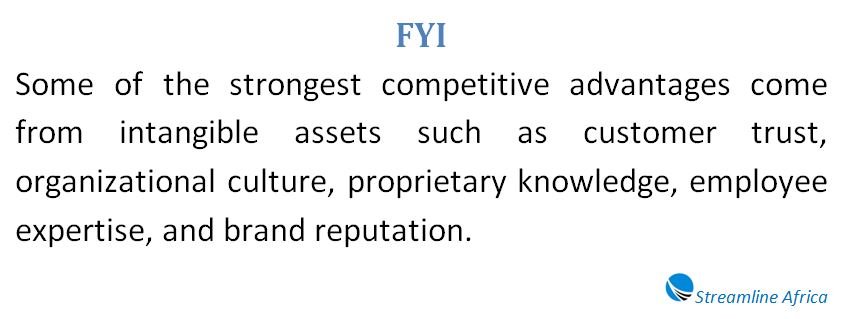
More durable advantages are usually embedded in systems that are more difficult to reproduce. These may include supplier relationships, proprietary technology, brand trust, specialized knowledge, distribution strength, regulatory approvals, customer data, intellectual property, or a high-performing workforce.
Consider a fintech company operating across Ghana and Côte d’Ivoire. Its advantage may not lie only in its mobile application. The real strength may come from merchant partnerships, fraud-detection systems, customer data, compliance capability, and integration with local payment networks.
When several capabilities reinforce one another, the business develops a stronger defensive position.
This is what makes sustainable competitive advantage particularly valuable: competitors cannot neutralize it simply by copying one visible feature.
Cost Leadership as a Competitive Strategy
One of the most established routes to competitive advantage is cost leadership.
A cost-efficient organization is able to produce or deliver comparable value at a lower economic cost than rivals. This may result from procurement scale, leaner processes, automation, local sourcing, efficient logistics, better workforce productivity, or stronger capacity utilization.
In many African markets, operational efficiency can be a major differentiator because businesses frequently face high transport, energy, financing, and import costs.
A food-processing company in northern Ghana, for instance, may gain an advantage by sourcing agricultural inputs directly from local cooperatives rather than relying heavily on intermediaries. If it also reduces wastage, improves storage, and optimizes transport routes, its unit costs can fall significantly.
Cost leadership does not necessarily mean offering the cheapest price in the market.
A company may choose to maintain market pricing and earn stronger margins instead. Alternatively, it can use part of its cost advantage to offer more competitive prices while protecting profitability.
The central principle is structural efficiency, not indiscriminate discounting.
Differentiation Through Customer Value
Differentiation allows a company to compete by offering something customers perceive as superior.
This can emerge from product quality, customer service, design, convenience, technology, reliability, speed, after-sales support, or brand reputation.
A private healthcare provider in Nairobi, for example, may differentiate through shorter waiting times, digital appointment scheduling, better patient communication, specialist access, and transparent billing.
The technical medical service may be broadly similar to what competitors offer, but the total customer experience creates a distinct position.
Differentiation can also protect margins because customers are often willing to pay more when they perceive stronger value.
However, differentiation must be meaningful.
Adding features customers do not value increases costs without necessarily improving competitiveness. Organizations therefore need evidence about what matters most to their target market before investing in new products, service models, or branding initiatives.
Effective differentiation connects customer expectations directly to business capability.
Specialization and Focused Market Leadership
A third approach is specialization.
Rather than competing across an entire market, a business concentrates on a specific customer group, industry, geography, or need.
This can be particularly effective for smaller and mid-sized African companies that may not have the financial resources to compete broadly with multinational corporations.
A consulting firm specializing in regulatory compliance for mining companies, for example, may build deeper expertise than a larger generalist advisory firm.
Similarly, an agribusiness focused exclusively on cold-chain logistics for horticultural exporters may develop infrastructure and knowledge that broader transport providers do not possess.
Specialization allows firms to build stronger credibility, deeper customer knowledge, and more efficient operating models within a clearly defined segment.
The risk is overdependence on a narrow market. Management must therefore assess whether the chosen niche is large enough, growing, and economically attractive.

Market Intelligence Should Shape Competitive Strategy
Strong competitive positioning begins with market understanding.
Businesses must know who their customers are, what problems they are trying to solve, what alternatives they currently use, and where existing providers are underperforming.
This requires more than occasional customer surveys.
Useful market intelligence can come from sales data, interviews, complaints, digital analytics, customer retention patterns, competitor benchmarking, industry reports, and frontline employee observations.
For example, a retail chain may initially assume customers care most about price. Further analysis may reveal that product availability and checkout speed are equally important.
That insight changes the competitive strategy.
Instead of focusing exclusively on discounting, management may invest in inventory management, store layout, digital payments, and supplier coordination.
Competitive advantage is strongest when it is based on verified market needs rather than internal assumptions.
Internal Capabilities Must Support the Market Promise
A company cannot sustain competitive advantage if its internal systems contradict its external positioning.
A business that promises fast delivery must have reliable inventory, warehousing, and transport processes. A bank that promotes superior customer service must have trained staff, responsive systems, and effective complaint resolution.
Leadership teams should therefore assess the organization’s strengths across finance, operations, technology, talent, supply chain, sales, and customer service.
Financial performance is particularly useful in identifying where true advantage may already exist.
Management can examine product margins, customer acquisition costs, segment profitability, repeat purchase rates, return on capital, and operating cost ratios.
These indicators help distinguish areas that merely generate revenue from areas that create sustainable economic value.
Operational consistency matters just as much.
Competitive strategy should therefore not sit only with the strategy or marketing team. It must be reflected across the entire organization.
Innovation and Intellectual Property
Innovation can create powerful advantages because it enables businesses to solve problems in ways competitors have not yet mastered.
This can include new products, digital tools, production systems, payment models, distribution methods, or customer-service processes.
Consider an agricultural technology firm that develops a mobile platform capable of helping smallholder farmers monitor weather risks and access input financing. The innovation may become even more defensible if the company builds proprietary datasets, secures partnerships with financial institutions, and continuously improves its technology.
Intellectual property can strengthen this advantage further.
Patents, trademarks, copyrights, trade secrets, and proprietary systems can delay imitation and increase the cost of competitive entry.
However, businesses should not assume legal protection alone is sufficient.
The strongest innovation-based advantages are usually supported by continuous research, customer feedback, technical talent, and commercial execution.
Innovation must remain an ongoing capability rather than a one-time achievement.
Human Capital as a Source of Competitive Strength
People are frequently one of the most difficult competitive assets to replicate.
A company can purchase similar software, equipment, or vehicles as a competitor. It is much harder to reproduce years of institutional knowledge, leadership capability, team coordination, customer relationships, and organizational culture.
This is particularly important in knowledge-intensive and service-driven sectors.
A professional services firm, hotel group, technology company, financial institution, or healthcare provider may derive a substantial part of its competitive position from employee capability.
Recruitment, performance management, leadership development, succession planning, employee engagement, and retention therefore have strategic implications.
Organizations that attract strong talent but fail to retain or develop it may gradually lose their advantage.
Human capital becomes especially powerful when employees understand the strategy and know how their roles contribute to customer value.
Competitive Advantage and Comparative Advantage
Competitive advantage is often confused with comparative advantage, but the two concepts are not identical.
Comparative advantage focuses on relative efficiency and opportunity cost.
A country, region, or company has a comparative advantage when it can produce a particular good or service more efficiently relative to other available activities.
For example, a cocoa-processing company located close to major producing regions may enjoy lower raw-material transport costs than a processor located much farther from supply sources.
This can create an efficiency advantage.
Competitive advantage is broader.
It includes cost efficiency but also encompasses brand strength, customer loyalty, intellectual property, technology, specialization, service quality, operational capability, data, and workforce expertise.
A company may therefore have a competitive advantage even if it is not the lowest-cost producer.
Scale and Network Effects
Larger organizations can benefit from economies of scale.
As purchasing, production, or distribution volumes increase, average costs may decline. Large retailers may negotiate better supplier terms, spread technology costs over more outlets, and operate more sophisticated distribution systems.
Scale can also strengthen bargaining power with landlords, financial institutions, vendors, and service providers.
Digital businesses may gain another type of advantage through network effects.
A marketplace connecting African freelancers with international clients becomes more valuable as more skilled professionals join the platform. The growing talent pool attracts more clients, while more clients make the platform more attractive to professionals.
This can create a reinforcing growth cycle.
However, size is not automatically an advantage.
Large organizations can suffer from slower decision-making, bureaucracy, and poor responsiveness.
Scale creates value only when management converts it into lower costs, greater convenience, stronger customer access, or better economics.
Identifying a Sustainable Competitive Advantage
Companies should be careful not to mistake temporary success for long-term competitive strength.
Rapid revenue growth may result from favorable economic conditions, competitor disruption, or temporary demand.
A genuine competitive advantage usually produces more consistent evidence.
This may include stronger margins, higher customer retention, repeat purchasing, increased market share, lower operating costs, premium pricing power, or better returns on invested capital.
The strongest advantages also share several characteristics.
They matter to customers, contribute meaningfully to financial performance, and are difficult for competitors to replicate.
These barriers are sometimes described as an economic moat.
Examples may include exclusive distribution agreements, regulatory licenses, brand trust, intellectual property, large customer networks, switching costs, proprietary data, specialized knowledge, or scale.
The wider and more defensible the moat, the stronger the company’s long-term position.
Sustaining Advantage in Dynamic African Markets
Competitive advantage must be continually renewed.
African markets are evolving quickly in areas such as fintech, renewable energy, telecommunications, e-commerce, transport, agriculture, healthcare, and professional services.
Customer expectations are rising, digital tools are becoming more accessible, and new competitors can emerge quickly.
Businesses should therefore continuously review whether the capabilities that created their success remain relevant.
A company known for superior customer service must keep improving training, technology, response times, and complaint management.
A manufacturer competing on efficiency must continue reviewing energy use, automation, sourcing, maintenance, and productivity.
A technology company must keep strengthening its innovation pipeline.
Management must protect today’s advantage while developing tomorrow’s.
Strategic Priorities for Business Leaders
Business leaders should begin by defining clearly why customers choose their organization.
They should then identify the operational capabilities responsible for delivering that value and determine how difficult those capabilities are for competitors to imitate.
Investment decisions should reinforce these strengths.
Capital, technology, talent, partnerships, and management attention should be directed toward areas that increase customer value and economic performance.
Leaders should also monitor changes in regulation, technology, consumer behavior, competitor activity, and industry structure.
Competitive advantage should therefore be treated as a continuous management discipline rather than a once-a-year strategy exercise.
Conclusion
Competitive advantage remains one of the most important foundations of long-term business performance.
African companies can build stronger market positions through cost efficiency, differentiation, specialization, innovation, scale, talent, or combinations of these approaches.
The most resilient organizations typically develop several complementary advantages rather than depending on one strength.
For executives, the key question is not simply what makes the company different. The more important question is whether that difference creates value customers recognize, supports stronger financial performance, and remains difficult for competitors to reproduce.
Organizations that can answer those questions clearly are better positioned to defend margins, grow market share, attract investment, and respond to changing market conditions.
Sustainable competitive advantage is therefore not a permanent asset. It is a capability that must be continuously strengthened, tested, and renewed.
Important Takeaways
Competitive Advantage Must Create Real Value
A business advantage matters only when customers recognize it and it contributes to stronger performance, such as higher margins, better retention, or increased market share.

Cost Leadership Is More Than Low Pricing
Companies can gain an edge by improving efficiency, reducing waste, optimizing supply chains, and lowering operating costs without necessarily becoming the cheapest provider.
Differentiation Helps Protect Profit Margins
Businesses that offer superior quality, service, convenience, technology, or customer experience can often command stronger pricing and build deeper customer loyalty.
Specialization Can Help Smaller Firms Compete
Focusing on a specific industry, customer segment, or market need can help smaller businesses develop expertise that larger generalist competitors may struggle to match.
Market Intelligence Should Guide Strategy
Competitive strategies are stronger when they are based on customer data, market research, competitor analysis, and verified customer needs rather than management assumptions.
Internal Capabilities Must Support the Brand Promise
A company cannot claim faster service, better quality, or superior customer care unless its people, technology, processes, and operations can deliver those promises consistently.
Innovation Can Create Strong Barriers to Competition
New technologies, proprietary systems, intellectual property, data, and innovative business models can make it more difficult and costly for competitors to imitate a company.
Human Capital Can Be Difficult to Replicate
Strong leadership, skilled employees, institutional knowledge, and a healthy performance culture can become powerful competitive strengths that competitors cannot easily purchase or reproduce.
Competitive Advantage Must Be Continuously Renewed
No market advantage lasts forever. Businesses must keep adapting to new technology, changing customer expectations, regulation, and emerging competitors to remain relevant.