

Debt to tangible net worth is a financial leverage ratio that compares a company’s outstanding debt with the value of its tangible net assets. It is commonly used by lenders, investors, analysts, and management teams to assess whether a business has enough tangible financial support behind its borrowing.
The ratio is more conservative than several other leverage measures because it removes intangible assets such as goodwill, trademarks, patents, and certain intellectual property from the calculation. These assets may contribute significantly to a company’s long-term value, but their recoverable value can become uncertain if the business experiences financial distress.
In simple terms, debt to tangible net worth helps answer an important credit question: how much debt does a company carry relative to the physical and financially realizable resources remaining after liabilities are deducted?
A lower ratio generally indicates a stronger tangible capital position, while a higher ratio may point to greater dependence on borrowed funds.
Why the Ratio Matters in Credit Risk Analysis
Credit analysis is not only concerned with whether a company is profitable. Lenders also want to know what financial protection exists if cash flow weakens or the borrower cannot meet its obligations.
Tangible assets such as property, equipment, inventory, cash, and receivables may provide some level of support because they can potentially be sold, pledged, or liquidated. Intangible assets are usually less dependable in this context.
Goodwill, for example, may carry a substantial accounting value after an acquisition, but that value may fall sharply if the acquired business underperforms. Similarly, the market value of patents or brands can vary dramatically depending on demand, reputation, and competitive conditions.
By excluding intangible assets, the debt to tangible net worth ratio gives creditors a stricter view of the resources supporting a company’s debt.
Debt to Tangible Net Worth Formula
The ratio is calculated by dividing total debt by tangible net worth.
Debt to Tangible Net Worth = Total Debt ÷ Tangible Net Worth
Tangible net worth is calculated as:
Tangible Net Worth = Total Assets – Intangible Assets – Total Liabilities
Another useful way to approach the calculation is to first determine tangible assets:
Tangible Assets = Total Assets – Intangible Assets
The company then subtracts its total liabilities from tangible assets.
The result shows the amount of debt carried for each dollar of tangible net worth. For example, a ratio of 0.60x means the company has $0.60 of debt for every $1.00 of tangible net worth.
What Is Included in Total Debt?
Total debt generally refers to interest-bearing financing obligations rather than every liability appearing on the balance sheet.
Typical examples include term loans, bank borrowings, revolving credit balances, bonds, notes payable, current portions of long-term debt, and other financing arrangements.
The distinction between available credit and borrowed credit is important. Suppose a company has access to a $15 million revolving facility but has drawn only $4 million. Only the $4 million outstanding balance would normally be treated as debt for this purpose.
Debt may also be classified between current and non-current portions. Current debt is generally payable within one year, while non-current debt has a longer maturity.
Analysts should review supporting financial disclosures carefully because the exact treatment of certain financing obligations can differ depending on the purpose of the analysis.
What Counts as Tangible Net Worth?
Tangible net worth represents the portion of a company’s net asset base that remains after intangible assets are excluded.
Common tangible assets include cash, receivables, inventory, land, buildings, machinery, vehicles, and other physical operating assets.
Intangible assets commonly removed from the calculation include goodwill, patents, trademarks, copyrights, customer relationships, licenses, and certain internally generated or acquired intellectual property.
Suppose a business reports total assets of $250 million and $35 million of those assets relate to goodwill and other intangibles. Its tangible assets would be $215 million.
If total liabilities were $90 million, tangible net worth would equal $125 million.
This adjustment helps prevent non-physical accounting values from making a highly leveraged company appear stronger than it may be from a creditor’s perspective.

Step-by-Step Debt to Tangible Net Worth Example
Assume a manufacturing company has the following financing balances at year-end:
Its revolving credit facility has an outstanding balance of $5 million. The current portion of its term loan is $15 million, while the long-term portion equals $40 million.
Total debt would therefore be:
Total Debt = $5 million + $15 million + $40 million = $60 million
Now assume the company reports total assets of $230 million, including $20 million of goodwill, patents, and other intangible assets.
Tangible assets would be:
Tangible Assets = $230 million – $20 million = $210 million
If total liabilities equal $90 million, tangible net worth becomes:
Tangible Net Worth = $210 million – $90 million = $120 million
The final ratio is:
Debt to Tangible Net Worth = $60 million ÷ $120 million = 0.50x
This means the company carries $0.50 of debt for every $1.00 of tangible net worth.
What Is a Good Debt to Tangible Net Worth Ratio?
There is no universal benchmark that applies to every company, but lower ratios are generally viewed more favorably from a credit perspective.
A ratio below 1.0x means tangible net worth exceeds total debt. This often suggests that the company has a relatively stronger tangible capital base supporting its borrowings.
A ratio around 1.0x means debt and tangible net worth are approximately equal.
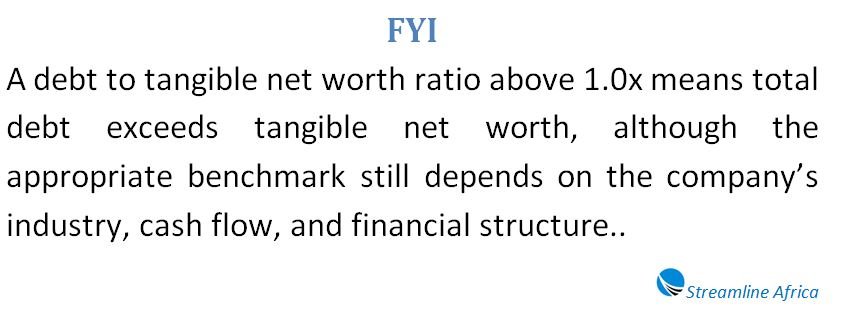
A result above 1.0x indicates that debt exceeds tangible net worth, which may attract greater attention from lenders and credit analysts.
However, the ratio should never be interpreted using a single threshold alone. What is considered acceptable can differ substantially by industry, business model, asset quality, earnings stability, and access to financing.
Why Industry Comparisons Matter
A construction company, transportation operator, software business, and consulting firm may naturally report very different debt to tangible net worth ratios.
Asset-heavy industries often own equipment, property, vehicles, or infrastructure that create a larger tangible asset base. These businesses may also use more debt to finance capital expenditure.
By contrast, technology and professional-services companies may derive much of their economic value from intellectual property, software, people, or customer relationships. Their tangible net worth may therefore appear relatively low even when their commercial prospects are strong.
For this reason, analysts should compare a company’s ratio with relevant industry peers and with its own historical performance rather than relying exclusively on a general benchmark.
Debt to Tangible Net Worth Versus Debt to Equity
Debt to equity compares total debt with shareholders’ equity as reported on the balance sheet.
Debt to tangible net worth goes a step further by excluding intangible assets before determining the remaining net worth.
This makes debt to tangible net worth a more conservative measure when a company has substantial goodwill or other non-physical assets.
Two businesses can therefore report similar debt-to-equity ratios but very different debt to tangible net worth ratios if one carries significantly more goodwill.
The two metrics are best viewed as complementary. Debt to equity offers a broad capital structure perspective, while debt to tangible net worth focuses more specifically on the strength of tangible financial backing.
Debt to Tangible Net Worth Versus Net Debt to EBITDA
Net debt to EBITDA measures debt relative to operating earnings, making it more focused on a company’s ability to generate income that can support repayment.
Debt to tangible net worth, by contrast, concentrates on the balance sheet and the tangible asset cushion behind outstanding debt.
A profitable company may have a relatively high debt to tangible net worth ratio but a manageable net debt to EBITDA ratio if earnings are strong. Conversely, a company with substantial tangible assets may still have difficulty servicing debt if operating cash flow deteriorates.
Using both ratios together can therefore produce a more balanced picture of credit risk.
What Does Negative Tangible Net Worth Mean?
Negative tangible net worth occurs when liabilities exceed the value of tangible assets after intangible assets are removed.
This can be a serious warning sign because it suggests creditors have limited tangible balance-sheet protection behind the company’s obligations.
However, negative tangible net worth does not automatically mean that bankruptcy or default is imminent. Some companies, particularly asset-light businesses, can continue operating successfully because they generate strong cash flow despite having limited tangible assets.
Still, lenders are likely to examine such companies more closely, especially if they also face declining earnings, weak liquidity, refinancing pressure, or unstable cash flows.
How Acquisitions Can Affect the Ratio
Acquisitions can materially change debt to tangible net worth.
When one company buys another for more than the fair value of its identifiable net assets, goodwill is often created on the balance sheet. Because goodwill is excluded from tangible net worth, a heavily debt-financed acquisition can cause the ratio to rise quickly.
For example, a company may borrow substantially to fund an acquisition that creates significant goodwill but relatively few tangible assets. Even if total assets increase, tangible net worth may not rise by the same amount.
This is one reason lenders often monitor leverage carefully following mergers and acquisitions.
Why Trend Analysis Is Important
A single ratio provides only a snapshot. The direction of the ratio over time can reveal more about changing financial risk.
Suppose a company’s debt to tangible net worth increases from 0.42x to 0.58x and then to 0.76x over three years.
The latest ratio may still appear manageable, but the steady upward trend could indicate that borrowing is growing faster than tangible net worth.
The cause may be expansion, acquisitions, asset disposals, declining retained earnings, or weaker asset values.
Tracking the ratio over several reporting periods helps analysts determine whether leverage is stabilizing, improving, or becoming progressively more aggressive.
How Companies Can Improve the Ratio
Businesses can strengthen their debt to tangible net worth position in several ways.
Reducing outstanding debt is one of the most direct approaches. Retaining earnings can also strengthen net worth over time, provided those earnings are not offset by large distributions or asset write-downs.
Raising equity may further reduce reliance on borrowing, while disciplined capital expenditure can improve the tangible asset base where investment creates productive long-term value.
Management should not focus only on lowering the ratio mechanically. Taking on debt can be financially sensible when the funds are invested in projects that generate attractive returns and sustainable cash flow.
The objective should be maintaining an appropriate balance between growth, leverage, liquidity, and financial resilience.
Limitations of Debt to Tangible Net Worth
The ratio has several limitations.
Balance sheet values do not always reflect current market values. Property may be worth significantly more than its recorded cost, while old equipment or slow-moving inventory may be worth less than its stated value.
Receivables may not be fully collectible, and some tangible assets may be difficult to sell quickly.
The ratio also does not directly measure whether a company can generate enough cash to pay interest and principal when due.
For these reasons, analysts commonly combine debt to tangible net worth with interest coverage, current ratio, operating cash flow, net debt to EBITDA, debt to equity, and other solvency measures.
Practical Use in Lending Decisions
Banks and commercial lenders may use debt to tangible net worth when evaluating loan applications, setting financial covenants, or determining borrowing capacity.
Imagine a company seeking a $10 million expansion loan. A lender may calculate the company’s existing ratio and then estimate what the ratio would become after the additional borrowing.
If the proposed loan materially weakens tangible financial support, the lender may require additional collateral, a lower loan amount, stronger covenants, or more equity from the borrower.
The ratio is therefore more than an academic calculation. It can directly influence credit approval, pricing, and lending conditions.
Key Takeaway
Debt to tangible net worth is a useful solvency and leverage metric because it compares borrowing with the portion of a company’s net worth supported by tangible assets.
A lower ratio generally indicates stronger balance-sheet support for lenders, while a high or rapidly increasing ratio can point to greater financial risk.
Even so, the metric should always be assessed in context. Industry norms, asset quality, cash flow, profitability, debt maturity, acquisition activity, and access to capital can all influence what constitutes a reasonable level of leverage.
Used alongside other credit and financial ratios, debt to tangible net worth provides a clearer picture of whether a company’s debt burden is appropriately supported by its underlying financial resources.