
The Democratic Republic of the Congo (DRC) applies personal income tax, commonly known as IPR, primarily to employment earnings. For employees, the tax system follows a progressive structure, so income is divided into different bands and each portion is taxed at the rate assigned to that band.
This approach means moving into a higher tax bracket does not automatically result in the entire salary being taxed at the higher percentage.
Personal Income Tax Rates
The first CDF 1,944,000 of annual taxable income falls within the 3% tax band. Income from CDF 1,944,001 to CDF 21,600,000 is taxed at 15%, while the portion between CDF 21,600,001 and CDF 43,200,000 attracts a 30% rate. Any taxable income above CDF 43,200,000 falls within the 40% bracket.
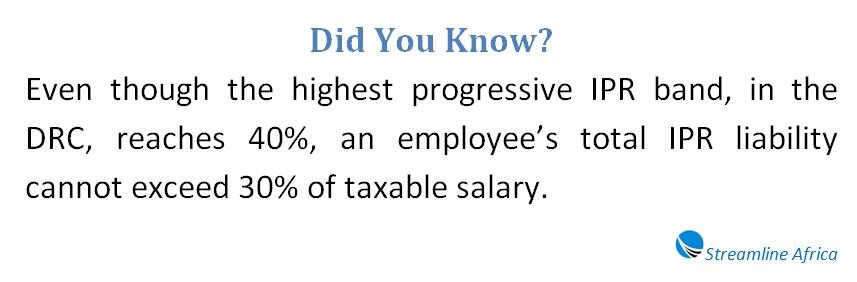
However, there is an important limitation for employees: the total IPR payable cannot exceed 30% of the taxable salary. This cap should therefore be considered when determining an employee’s final personal income tax liability.
Special Treatment of Employment Payments
Some employment-related payments are taxed differently from regular salaries. Indemnities and allowances paid when an employee’s contract is terminated are subject to IPR at a specific rate of 10%.
Casual employees who are hired and paid on a day-to-day basis are also covered by a separate arrangement. Their earnings are generally subject to IPR at a preferential rate of 15%.
In practice, IPR mainly applies to salaries and employment-related earnings. Other forms of individual income are generally outside its practical application. Foreign-source profits are also not subject to personal income tax in the DRC.
Tax on Expatriate Employees
Employers that hire expatriate workers may have an additional tax obligation known as the Impôt Exceptionnel sur la Rémunération des Expatriés (IERE).
Unlike ordinary personal income tax, IERE is not deducted from the expatriate employee’s salary. Instead, it is a cost borne directly by the employer. The tax is calculated using the same general taxable base applied for IPR purposes.
The standard IERE rate is 25%. Mining companies benefit from a reduced rate of 12.5% during their first ten years of activity, after which the standard rate applies.
What Employers Should Know
IERE is generally not deductible for corporate income tax purposes, although specific treatment applies to mining companies and qualifying subcontractors. For mining businesses, the tax may remain deductible for corporate income tax purposes.
Businesses employing local or expatriate staff should maintain accurate payroll records, correctly classify employment payments and monitor applicable tax requirements. This helps ensure that employee deductions and employer-paid taxes are calculated and reported appropriately.
Commonly Asked Questions
How is personal income tax calculated in the DRC?
The DRC uses progressive tax bands. Different portions of an employee’s taxable income are taxed at rates ranging from 3% to 40%.

Is there a maximum amount of IPR an employee can pay?
Yes. The total personal income tax payable cannot exceed 30% of an employee’s taxable salary.
Are termination benefits taxed in the DRC?
Yes. Indemnities and allowances connected with the termination of an employment contract are generally taxed at a specific IPR rate of 10%.
How are casual workers taxed?
Employees hired on a day-to-day basis are generally subject to a preferential personal income tax rate of 15% on their earnings.
Are foreign-source profits taxable in the DRC?
Foreign-source profits are generally not subject to personal income tax in the DRC under the rules discussed in this guide.
What is IERE?
IERE, or Impôt Exceptionnel sur la Rémunération des Expatriés, is a special tax that applies when businesses employ expatriate workers in the DRC.
Who pays the IERE?
The employer is responsible for paying IERE. Unlike ordinary employee income tax, it is not withheld from the expatriate employee’s salary.
What is the standard IERE rate?
The standard IERE rate is 25% of the applicable taxable base. Special rules may apply to qualifying businesses in the mining sector.
Do mining companies receive special IERE treatment?
Yes. Mining companies generally benefit from a reduced IERE rate of 12.5% during their first ten years of activity before the standard rate applies.