
When a small soap maker in Accra produces 500 bars a month, each bar carries a hefty share of rent, labor, packaging, and transport. When that same operation grows into a regional manufacturer shipping 500,000 bars, the cost of each individual bar drops sharply—even if the soap itself hasn’t changed at all. This simple but powerful idea sits at the heart of economies of scale.
In economics, economies of scale describe the cost advantages organizations gain as their level of output increases. As production expands, the average cost per unit often falls, allowing firms to operate more efficiently, price more competitively, or earn higher margins. These advantages can stem from technology, organization, purchasing power, logistics, or learning over time. The opposite phenomenon—where costs rise as production grows—is known as diseconomies of scale.
Economies of scale can appear at many levels: within a single machine, an entire factory, a logistics network, or a multinational enterprise. Understanding where they come from—and where they break down—helps explain why some industries are dominated by giants while others remain fragmented and local.
When Bigger Really Is Cheaper
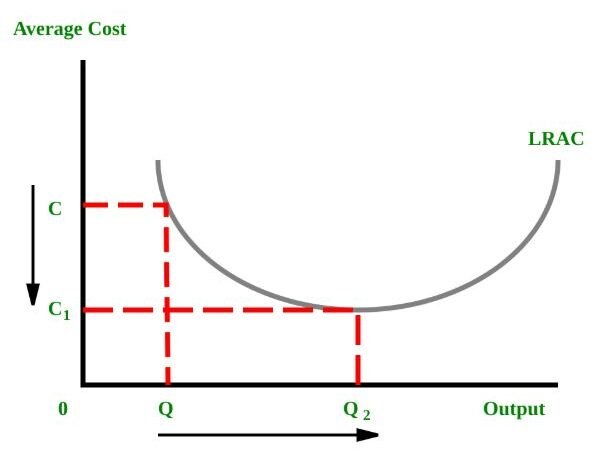
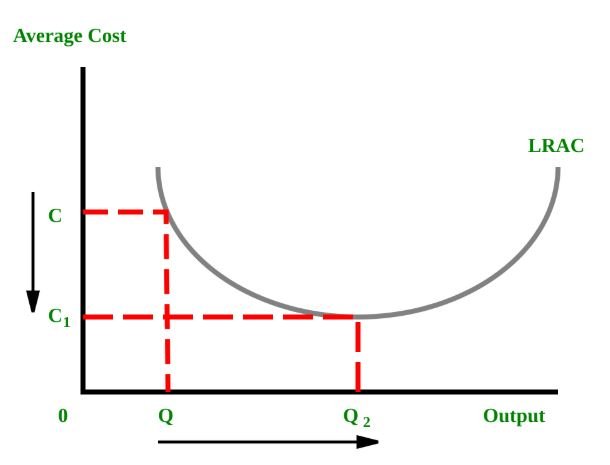
At its most basic level, economies of scale occur when producing more units lowers the average cost of each unit. If a factory’s total cost rises more slowly than its output, the cost per unit declines. This is why manufacturers often aim to keep facilities running near capacity and why underused plants tend to be uncompetitive.
Some cost advantages have clear physical roots. A large cement kiln, for example, uses less energy per ton of output than several small kilns producing the same total amount. Likewise, a high-capacity data center can process vastly more information without needing proportionally more staff or electricity.
The idea itself isn’t new. Early economists observed that dividing work into specialized tasks allowed larger operations to outperform smaller ones. A single worker making an entire product from start to finish simply can’t match the speed or consistency of a coordinated production line.
Still, economies of scale are not infinite. Beyond a certain point, costs may flatten or even rise due to management complexity, supply constraints, or inefficiencies. The challenge for firms is finding the range where size works for them rather than against them.
Different Sources of Scale Advantages
Economies of scale don’t come from a single mechanism. Instead, they arise from a combination of factors that reinforce one another as organizations grow.
Purchasing power is one of the most visible. A regional food processor buying grain by the ton negotiates better prices than a neighborhood bakery purchasing sacks at retail rates. Long-term supply contracts further reduce per-unit costs by spreading administrative and transaction expenses over larger volumes.
Managerial specialization also matters. As firms expand, leadership roles become more focused. Instead of one person juggling operations, finance, marketing, and HR, each function can be handled by specialists who improve efficiency and decision-making.
Financial advantages emerge as well. Larger firms usually borrow at lower interest rates, gain access to more funding instruments, and spread financial risks across diverse product lines and markets.
Marketing economies allow big brands to amortize advertising costs over millions of units. A nationwide billboard campaign costs the same whether it sells ten thousand products or ten million.
Finally, technological economies play a growing role. Advanced machinery, automation, and digital systems often require large upfront investments that only make sense at high production volumes.
Scale, Trade, and Market Structure
Economies of scale help explain why some industries support only a few major players. Producing jet engines, microchips, or commercial aircraft requires massive fixed investments that are only profitable when output is high and markets are global.
This logic also underpins international trade. A country with a relatively small domestic market can still host globally competitive firms if they serve international customers. It would make little economic sense for every small nation to produce its own commercial vehicles or telecommunications equipment solely for local use.
Scale advantages can even lead to natural monopolies, where a single provider can supply the entire market at a lower cost than multiple competing firms. Utilities like water distribution or rail infrastructure often fall into this category.
Economists distinguish between internal economies of scale, which benefit individual firms as they grow, and external economies of scale, which arise when an entire industry expands. For example, when multiple electronics manufacturers cluster in one region, shared suppliers, skilled labor pools, and specialized services reduce costs for all participants—not just the largest firm.
Physical Laws and Engineering Realities
Many scale advantages are rooted in physics and engineering. As structures grow larger, volume often increases faster than surface area. This means that tanks, ships, pipelines, and warehouses can handle far more material without proportionally higher construction or operating costs.
In transportation, a cargo vessel twice the size of another does not require twice the crew or twice the fuel per ton of goods. The result is lower shipping costs per unit. This is why global trade relies on ever-larger container ships and aircraft.
Energy efficiency also improves with scale. Large industrial furnaces lose less heat per unit of output than smaller ones, reducing fuel costs. Similarly, thicker cables or larger pipes transmit electricity or fluids more efficiently than smaller alternatives.
These advantages are not about indivisibility—machines can still be technically separable—but about the geometry of space and flow. Bigger systems simply waste less, proportionally speaking.
Inventory, Risk, and Reserves
Scale also brings statistical advantages. A firm operating hundreds of machines does not need spare parts for every possible failure at once. Risks average out. Inventory buffers, safety stock, and financial reserves can be proportionally smaller in large organizations because fluctuations in demand or breakdowns are less likely to hit all units simultaneously.
A national retailer, for instance, can manage inventory centrally, shifting goods between regions as demand changes. A single-store operation has no such flexibility and must carry higher relative stock levels to avoid shortages.
Coordinating Production Capacity
In complex production processes, different stages must align. If one step is slower or more expensive, it can bottleneck the entire operation. Small-scale producers often face idle time because certain machines or skills are underused.
As output grows, these mismatches shrink. A larger factory can balance capacities across stages, ensuring that equipment runs closer to optimal utilization. This is especially important in capital-intensive industries where machines are expensive and downtime is costly.
Division of Labor and Skill Depth
Larger operations support deeper specialization. Workers can focus on narrow tasks, improving speed and quality. Engineers can refine processes, technicians can maintain equipment, and quality-control teams can catch defects early.
This specialization often changes the nature of both inputs and outputs. Higher-quality components become viable, waste falls, and production techniques improve. Over time, this creates a feedback loop where scale enables skill development, which in turn reinforces scale advantages.
Learning, Growth, and Experience
Some cost reductions don’t come from size alone but from experience. As firms produce more over time, they learn how to do things better. Mistakes decline, processes tighten, and incremental innovations accumulate. This is sometimes called the experience curve.
Growth itself can generate temporary advantages. A logistics company expanding into new cities may unlock underused capabilities, negotiate better land deals, or improve route density. These benefits often fade once expansion slows, but they can be powerful during growth phases.
Capital Costs and the “Six-Tenths Rule”
Engineers have long observed that the cost of building industrial equipment rises less than proportionally with capacity. Rough estimates often suggest that doubling capacity increases capital costs by only about 60 percent. This rule of thumb explains why larger plants usually enjoy lower capital cost per unit of output.
Installing a higher-capacity cable, pipeline, or motor often requires only marginally more labor and materials than a smaller one. At the same time, efficiency frequently improves with size, further reducing operating costs.
Transport, Crews, and Operations
In transportation, operating crews do not scale linearly with capacity. A larger aircraft does not require twice as many pilots, nor does a longer train need proportionally more engineers. This is why “stretched” vehicle designs are common: they increase payload without equivalent increases in operating costs.
Similarly, many automated factories require roughly the same staffing levels regardless of output. Complexity, not volume, drives labor needs.
Byproducts and Waste Reduction
Large-scale production makes it economical to capture and reuse byproducts that would be wasted in smaller operations. Modern chemical plants, food processors, and paper mills often convert residual materials into energy or secondary products, turning waste into revenue.
Scale, Exporting, and Global Reach
Firms that achieve scale often find it easier to export. Fixed costs—such as compliance, logistics setup, and marketing—can be spread across large volumes. More productive firms generate higher revenues abroad and are better positioned to absorb trade costs.
As trade barriers fall, resources tend to shift toward these more efficient producers, raising overall industry productivity. However, scale alone does not guarantee success; product quality, reliability, and adaptability still matter.
Economies of Scale vs. Returns to Scale
Economies of scale focus on costs. Returns to scale describe how output responds to changes in inputs. The two concepts overlap but are not identical. A firm may experience increasing returns in production but still face rising costs if input prices increase with volume. Conversely, bulk discounts can create economies of scale even when technical returns are flat or declining.
Understanding this distinction matters when analyzing real-world markets, where firms often influence input prices or face constraints absent from idealized models.
Why Big Doesn’t Always Mean Monopoly
Despite strong scale advantages, many industries remain populated by firms of vastly different sizes. This apparent contradiction has puzzled economists for generations. The answer lies in factors beyond pure cost efficiency.
Product differentiation, flexibility, customer preferences, learning capabilities, and transaction management all shape market outcomes. A small, specialized producer can thrive alongside mass producers by offering customization, speed, or service that large firms struggle to match.
Economies of scale are powerful, but they are not destiny. They explain why firms grow—but not how large they must become, nor who ultimately succeeds.
In the end, economies of scale are less about size for its own sake and more about how intelligently size is used. Growth can unlock efficiency, but only when organizations manage complexity, learning, and coordination as carefully as they manage output.