
As organizations expand across borders, access to talent is no longer determined solely by where a company maintains a physical office or incorporated entity. Businesses are increasingly recruiting employees in markets where they have no formal legal presence. While this creates significant opportunities for growth, it also introduces complex employment, tax, payroll, and regulatory obligations.
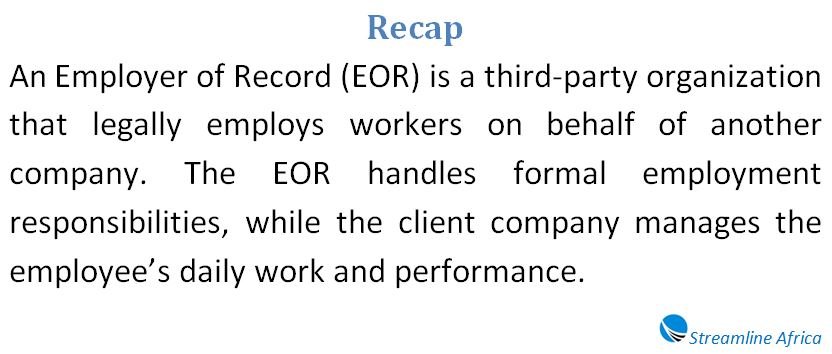
An Employer of Record, commonly referred to as an EOR, provides a structured solution to this challenge. An EOR is a third-party organization that becomes the legal employer of an individual on behalf of another company. The EOR assumes responsibility for formal employment obligations, while the client organization continues to direct the employee’s day-to-day activities, performance, responsibilities, and business objectives.
For example, a European technology company seeking to hire a data specialist in Nairobi may not wish to establish a Kenyan subsidiary solely for one employee. Through an EOR arrangement, the company can engage the employee in compliance with Kenyan employment requirements while maintaining operational control over the individual’s role.
From a strategic perspective, the EOR model allows companies to separate workforce deployment from the more time-consuming process of establishing corporate infrastructure in every jurisdiction where talent is located.
How the Employer of Record Structure Operates
The EOR model creates a clear distinction between legal employment and operational management.
The client organization typically identifies the candidate, determines the job scope, agrees on compensation, establishes performance expectations, and manages the employee’s daily responsibilities. The EOR then assumes the formal employer role by issuing a locally compliant employment contract and managing the administrative requirements associated with employment.
These responsibilities commonly include payroll processing, tax deductions, statutory contributions, benefits administration, employment documentation, and compliance with local labor requirements. This reflects the underlying distinction in the source material between employment as a legal relationship and performance management as an operational relationship.
Consider a renewable energy company headquartered in Copenhagen that needs a project coordinator in Accra. The company may retain responsibility for project deadlines, reporting structures, performance evaluation, and operational supervision. The EOR, however, would manage the Ghanaian employment contract, payroll administration, statutory deductions, leave entitlements, and other local employment obligations.
This division of responsibilities allows companies to focus on business performance while relying on local employment infrastructure provided by the EOR.
Strategic Applications of EOR Services
Employer of Record arrangements are particularly valuable when organizations need to enter new markets quickly or employ individuals in countries where they do not yet have a registered entity.
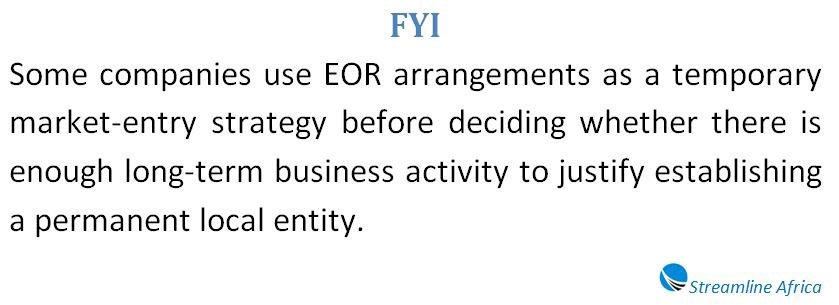
One common application is market entry. A consumer goods company evaluating expansion into Tanzania, for example, may first recruit a country business development manager through an EOR before committing to the cost and complexity of establishing a permanent subsidiary.
EORs are also frequently used for international remote workforces. A software company based in Toronto may employ developers in Poland, customer support specialists in South Africa, and product designers in Portugal without maintaining separate legal entities in each country.
Another application involves time-bound projects. Engineering, infrastructure, consulting, development, and professional services organizations may require specialist employees in a particular jurisdiction for twelve or eighteen months. Where the assignment is temporary, establishing a permanent legal entity may be disproportionate to the commercial requirement.
In each of these situations, the EOR provides an employment platform that allows the organization to deploy people while managing regulatory complexity.
Employer of Record Versus Professional Employer Organization
The Employer of Record model is often compared with the Professional Employer Organization, or PEO, model. Although both involve outsourcing certain employment responsibilities, the legal structures are materially different.
Under an EOR arrangement, the EOR generally becomes the legal employer of the individual. This allows the client company to employ workers in a jurisdiction even where it has no local legal entity.
A PEO, by comparison, normally operates through a co-employment structure. The client organization remains an employer and typically requires an existing legal entity in the jurisdiction. The PEO supports areas such as payroll, benefits administration, HR systems, and compliance.
For example, a multinational group that already owns a subsidiary in Johannesburg may engage a PEO to streamline payroll and HR administration for its South African employees. However, if the same organization wishes to employ a commercial analyst in Kigali without establishing a Rwandan subsidiary, an EOR arrangement would generally be more appropriate.
The practical distinction therefore rests on legal presence and employer responsibility. EOR solutions enable employment where the company lacks an entity, while PEO solutions primarily help organizations administer an existing workforce more efficiently.
Managing Employment Compliance Across Jurisdictions
Employment compliance is one of the most significant considerations in international workforce expansion.
Countries differ considerably in their requirements governing employment contracts, payroll taxes, working hours, probation periods, social security contributions, annual leave, maternity protections, pensions, notice periods, severance obligations, disciplinary processes, and termination procedures.
An EOR provides local employment infrastructure designed to address these requirements. The service may include preparing compliant contracts, registering employees with relevant authorities, calculating statutory deductions, administering mandatory benefits, maintaining employment records, and supporting legally compliant exit processes.
This support can be particularly valuable where an organization lacks in-house knowledge of local labor regulations.
However, companies should avoid interpreting an EOR arrangement as a complete transfer of all employment risk. The client organization continues to make operational decisions affecting the employee. Poor management practices, discriminatory instructions, inappropriate performance management, or unlawful workplace conduct may still expose the organization to legal and reputational consequences.
Accordingly, effective EOR arrangements require clearly defined responsibilities, strong communication between the EOR and client, and disciplined management practices.

Supporting International Workforce Strategy
The expansion of remote and distributed work has significantly increased the strategic relevance of EOR services.
Organizations are increasingly developing workforce strategies around skills availability rather than office location. A financial technology company may recruit compliance professionals across several jurisdictions. A life sciences organization may need regulatory specialists close to priority markets. A consulting firm may assemble regional teams around individual client engagements.
In these circumstances, the EOR model can provide greater flexibility than immediate legal incorporation.
It can also serve as a transitional structure. A company entering Lusaka, for instance, may initially employ a sales lead and two operations professionals through an EOR. If the market develops successfully and headcount increases, management may later determine that establishing a local subsidiary is more economical.
The EOR therefore does not necessarily replace permanent market establishment. In many cases, it provides an interim mechanism that allows companies to validate a market before making longer-term investments.
Industry Adoption of EOR Solutions
Employer of Record services are increasingly relevant across industries with mobile, specialized, or geographically distributed workforces.
Technology businesses frequently use the model when recruiting software engineers, developers, cybersecurity professionals, and data specialists internationally. Professional services firms may use EORs to establish project teams in new client markets.
Renewable energy companies can engage technical and project personnel close to infrastructure developments, while healthcare and life sciences organizations may use EOR arrangements to access regulatory, research, or commercial expertise in unfamiliar jurisdictions.
International development organizations, education companies, creative businesses, and financial services firms can also benefit where local employment is required without immediate incorporation.
The common factor across these industries is the need to balance speed, access to talent, compliance, and cost.
The Evolution of the Employer of Record Market
The fundamental concept behind Employer of Record services predates the modern remote-work economy. Employment intermediaries have existed for decades, initially helping organizations manage workers across different states or jurisdictions.
The model became more strategically important as companies expanded internationally and labor mobility increased. Cross-border employment created increasingly complex requirements involving tax registrations, payroll administration, employee protections, and statutory reporting.
The growth of distributed work accelerated this development further. Organizations became more willing to hire employees without requiring relocation, while professionals gained greater access to international employment opportunities.
Modern EOR providers increasingly combine local employment expertise with centralized technology. Services may include digital onboarding, multi-country payroll coordination, workforce reporting, employment documentation, benefits administration, and compliance monitoring.
The result is a model that has evolved from an administrative solution into an increasingly important component of global workforce strategy.
Evaluating the Business Case for an EOR
The decision to use an Employer of Record should be based on commercial objectives, workforce scale, duration of market presence, regulatory complexity, and total employment cost.
EOR pricing is commonly structured as either a fixed monthly amount per employee or a percentage of payroll. These fees are generally additional to salary, employer taxes, statutory contributions, insurance, and mandatory benefits.
For a small number of initial hires, an EOR may be considerably more efficient than establishing and maintaining a local entity. Incorporation typically introduces legal fees, accounting obligations, corporate filings, tax registrations, payroll systems, governance requirements, and ongoing administrative costs.
As workforce numbers grow, however, management should periodically reassess whether maintaining an EOR arrangement remains commercially efficient or whether creating a permanent local entity would provide greater long-term value.
Employer of Record as a Global Expansion Tool
An Employer of Record should ultimately be viewed as more than an outsourced payroll provider. When properly structured, it can form part of a broader international expansion and workforce strategy.
The model gives organizations the flexibility to recruit talent, enter new markets, support temporary projects, and test commercial opportunities without immediately establishing legal entities in every jurisdiction.
At the same time, companies should recognize that EOR arrangements require sound governance. Clear contractual responsibilities, careful provider selection, transparent pricing, strong compliance capabilities, and appropriate workforce management remain essential.
For organizations pursuing international growth, an EOR can therefore provide a practical bridge between business opportunity and local employment compliance. Used strategically, it can reduce barriers to market entry while enabling companies to build internationally distributed teams in a controlled and scalable manner.
FAQs
Why do companies use an EOR?
Companies mainly use EOR services to hire employees in countries where they do not have a registered legal entity. This allows them to access international talent without immediately establishing a subsidiary or branch.
What responsibilities does an EOR handle?
An EOR typically manages employment contracts, payroll, tax deductions, statutory contributions, benefits, employment records, leave requirements, and other local employment obligations.
Does an EOR manage employee performance?
Usually, no. The client company remains responsible for setting objectives, assigning work, supervising employees, and evaluating performance. The EOR primarily manages the legal and administrative employment relationship.
How can an EOR support international expansion?
An EOR can help a business enter a new market quickly by allowing it to employ local talent before establishing its own legal entity. This can be useful when testing a market or making only a small number of initial hires.
What is the difference between an EOR and a PEO?
An EOR generally becomes the legal employer of the worker, whereas a Professional Employer Organization usually operates through a co-employment arrangement. A PEO also commonly requires the client to already have a registered local entity.
Can an EOR help companies manage remote workers?
Yes. EOR services are particularly useful for distributed teams because they allow companies to employ people in different jurisdictions while meeting local payroll, tax, benefits, and labor requirements.
Does using an EOR remove all employment risk?
No. While an EOR manages many compliance obligations, the client company must still manage employees responsibly. Poor performance management, inappropriate workplace practices, or unlawful instructions can still create legal and reputational risks.
Which industries commonly use EOR services?
Technology, consulting, financial services, renewable energy, life sciences, education, international development, and other sectors with globally distributed or project-based workforces frequently use EOR arrangements.
Is an EOR useful for temporary projects?
Yes. An EOR can be particularly valuable where employees are required in a country for a limited project period and establishing a permanent local entity would not be commercially practical.
How are EOR services normally priced?
EOR providers commonly charge either a fixed monthly fee per employee or a percentage of payroll. Salary, employer taxes, statutory contributions, insurance, and mandatory benefits are normally additional employment costs.
When should a company consider establishing its own entity instead?
As employee numbers and long-term operations in a country increase, establishing a local entity may become more commercially attractive. Businesses should periodically compare EOR costs with the cost and strategic value of maintaining their own legal presence.