

For businesses operating in Ethiopia, tax compliance requires disciplined financial reporting, timely payments, and accessible records. Manufacturers, hospitality operators, and regional groups should build these obligations into their finance calendars to protect cash flow and reduce avoidable administrative pressure.
Align the Tax Year With Operations
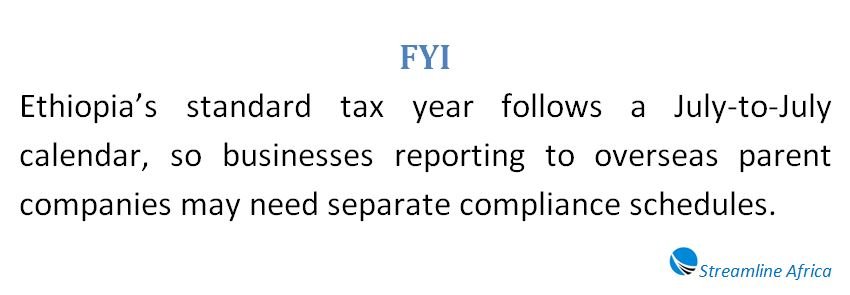
The standard Ethiopian tax year runs from 8 July to 7 July. A company’s taxable period generally covers the twelve months reflected in its annual financial statements. Businesses needing a different reporting cycle must obtain written approval from the Ministry of Revenues (MoR), with corresponding adjustments to the taxable base.
For an Ethiopian subsidiary reporting to a parent company in Nairobi or Johannesburg, aligning group reporting deadlines does not automatically change local tax requirements.
Read More: SAS No. 149 Group Audit Requirements: A Complete Guide to Risk-Based Group Audits
Plan for Filing and Payment
Resident companies and permanent establishments of foreign companies must submit annual self-assessment returns, supported by financial statements, tax computations, and relevant schedules. Returns and corporate income tax payments are due by the last day of the fourth month after year-end.
The ministry reviews submissions before acceptance and may request clarification. Businesses must also budget for quarterly advance payments after the filing deadline, each equivalent to 25% of the preceding tax liability.
Prepare for Audit Scrutiny
Large taxpayers undergo regular audits, commonly covering two tax periods, although reviews can extend further. Most examinations occur onsite. Discrepancies in returns or unusual turnover patterns can also trigger desk audits.
A hotel expanding its conference business, for example, should retain documentation explaining significant revenue movements.
Maintain Records That Support Clearance
Company books and documents must be retained for ten years under Ethiopia’s Commercial Code, exceeding the five-year tax retention period. Businesses may request audits and clearance letters anytime.
Frequently Asked Questions
When Does Ethiopia’s Standard Tax Year Begin?
It runs from 8 July to 7 July of the following year.
Can a Company Use a Different Tax Year?
Yes, but it must obtain written approval from the Ministry of Revenues before changing its reporting period.
Who Must File an Annual Corporate Tax Return?
Resident companies and permanent establishments of foreign companies must file annual self-assessment returns.
What Documents Accompany the Return?
Companies must provide financial statements, a tax computation, and relevant supporting schedules.
When Are Returns and Tax Payments Due?
Both are due by the final day of the fourth month after the company’s tax year ends.
How Much Are Quarterly Advance Payments?
Each quarterly instalment equals 25% of the preceding tax liability, helping businesses anticipate their payment obligations.
What Can Trigger a Tax Audit?
Large taxpayers face regular audits. Inconsistent returns, unusual turnover movements, or other discrepancies can also attract scrutiny.
How Long Should Companies Keep Their Records?
Company books and documents must generally be kept for ten years. Records should remain accessible to support audits and clearance requests.