
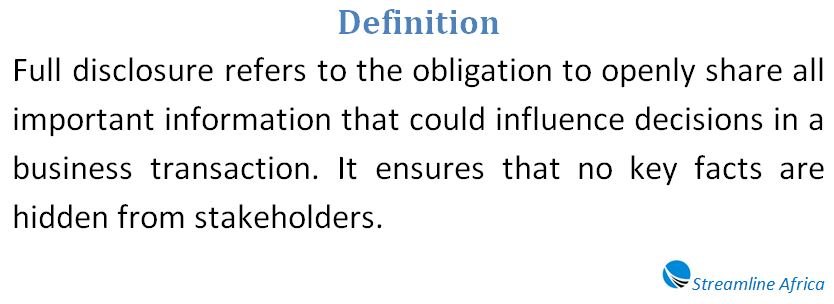
Transparency is no longer just a regulatory obligation; it has become a defining characteristic of credible and sustainable businesses. Full disclosure represents the principle that all relevant and material information tied to a transaction or an organization’s operations should be openly shared with stakeholders. Whether in financial markets or everyday commercial dealings, the expectation is simple: nothing significant should be hidden.
In today’s environment, where information travels quickly and trust can be easily broken, full disclosure acts as both a legal safeguard and a strategic advantage. Companies that embrace openness tend to foster stronger relationships with investors, partners, and customers, while those that conceal critical details risk reputational damage and legal consequences.
The Core Meaning of Full Disclosure
At its essence, full disclosure requires organizations to communicate all material facts that could influence decision-making. In the corporate world, this obligation is closely tied to regulatory frameworks designed to ensure that investors have access to accurate and complete information before committing their resources.
This concept extends beyond financial reporting. It applies to any situation where one party relies on another for truthful information. For instance, when entering into a business contract, both sides are expected to reveal facts that could significantly affect the outcome of the agreement. The goal is to eliminate information asymmetry, where one party holds an unfair advantage due to hidden knowledge.

Regulatory Foundations and Historical Evolution
The roots of full disclosure in the United States can be traced back to the aftermath of the stock market crash of 1929. In response to widespread financial manipulation and misinformation, lawmakers introduced comprehensive regulations to restore confidence in the capital markets.
The Securities Act of 1933 marked a turning point by requiring companies issuing securities to provide detailed and truthful information to the public. This was followed by the Securities Exchange Act of 1934, which expanded oversight and established the U.S. Securities and Exchange Commission to enforce compliance.
Together, these laws laid the groundwork for modern disclosure practices. Rather than restricting companies from raising funds, the intention was to ensure that investors could make informed decisions based on reliable data.
Balancing Transparency and Capital Formation
One of the ongoing challenges in regulatory design is finding the right balance between transparency and business flexibility. Excessive reporting requirements can discourage smaller firms from entering public markets due to the cost and complexity involved.
To address this, regulators have introduced exemptions and thresholds that reduce the burden on smaller offerings. Over time, the limits for these exemptions have increased, allowing emerging businesses to access funding without being overwhelmed by compliance obligations.
This approach reflects an understanding that while transparency is critical, it should not come at the expense of innovation or economic growth. By tailoring requirements based on company size and offering scale, regulators aim to maintain fairness without stifling opportunity.
The Structure of Corporate Disclosure
For publicly listed companies, disclosure is not a one-time event but an ongoing responsibility. Organizations are required to provide periodic updates that reflect their financial health, operational performance, and strategic direction.
One of the most significant components of this process is the annual filing known as the Form 10-K. This document serves as a comprehensive snapshot of a company’s activities over the past year. It includes detailed financial statements, risk assessments, and management discussions that offer insight into both current performance and future prospects.
The preparation of such reports involves collaboration between management teams and independent auditors. While executives provide context and narrative explanations, auditors verify the accuracy of financial data, ensuring that the information presented meets established standards.
What Goes Into an Annual Report
Annual reports are designed to give stakeholders a holistic view of a company’s position. They typically include audited financial statements such as balance sheets, income statements, and cash flow reports. These documents provide a clear picture of revenue generation, profitability, and liquidity.
In addition to financial data, companies often present multi-year summaries that highlight trends in sales, assets, liabilities, and shareholder returns. This historical perspective allows investors to evaluate consistency and growth over time.
Equally important is the narrative section, where management discusses key developments, challenges, and strategic priorities. This qualitative information helps readers understand the context behind the numbers, making the report more than just a collection of figures.
The Broader Impact of Transparency
Full disclosure plays a vital role in maintaining the integrity of financial markets. When companies provide accurate and timely information, investors can allocate resources more efficiently. This leads to better pricing of securities and a more stable economic environment.
Transparency also reduces the likelihood of fraudulent activities. When organizations know they are required to reveal critical details, they are less likely to engage in deceptive practices. In this sense, disclosure acts as both a preventive measure and a mechanism for accountability.
Beyond compliance, openness can enhance a company’s reputation. Businesses that consistently communicate honestly are more likely to gain the trust of stakeholders, which can translate into long-term success.
Applying Full Disclosure Beyond Financial Markets
While regulatory frameworks often focus on publicly traded companies, the principle of full disclosure extends to many other areas of business. Any transaction involving significant risk or uncertainty benefits from clear and honest communication.
In partnerships, for example, parties are expected to disclose potential conflicts of interest, financial obligations, or operational risks. Failure to do so can lead to disputes, legal action, and damaged relationships.
Similarly, in mergers and acquisitions, due diligence processes rely heavily on full disclosure. Buyers need access to complete and accurate information to assess the value and risks associated with a target company.
Transparency in Real Estate Transactions
Real estate provides a practical illustration of how full disclosure operates in everyday transactions. When buying or selling property, both parties depend on accurate information to make informed decisions.
Sellers are typically required to reveal any known defects or issues that could affect the property’s value or usability. This might include structural problems, environmental hazards, or legal encumbrances. Concealing such information can result in serious legal consequences.
Agents and brokers also have responsibilities. They must disclose any personal interests in the transaction, as well as relevant details about pricing, market conditions, and prior offers. This ensures that buyers and sellers can negotiate on a level playing field.
Legal Consequences of Non-Disclosure
Failing to adhere to full disclosure requirements can lead to significant penalties. In financial markets, companies that provide misleading or incomplete information may face fines, sanctions, or legal action from regulators.
In real estate and other private transactions, nondisclosure can result in lawsuits, contract rescission, or even criminal charges in severe cases. The underlying principle is that withholding material information undermines fairness and trust.
These consequences highlight the importance of transparency not just as a moral obligation but as a legal necessity. Businesses that ignore disclosure requirements expose themselves to risks that can far outweigh any short-term gains from concealment.
Building a Culture of Openness
Achieving full disclosure is not solely about meeting regulatory standards; it requires a broader cultural commitment within organizations. Companies must prioritize honesty and accountability at every level, from leadership to frontline employees.
This involves implementing robust internal controls, encouraging ethical behavior, and fostering an environment where concerns can be raised without fear of retaliation. Training programs and clear policies can help ensure that employees understand their responsibilities المتعلقة disclosure.
Technology also plays a role in supporting transparency. Advanced data systems and reporting tools enable companies to track and share information more efficiently, reducing the likelihood of errors or omissions.
Why Full Disclosure Matters More Than Ever
In an era defined by rapid information exchange and heightened scrutiny, the importance of full disclosure continues to grow. Stakeholders today expect more than just compliance; they demand clarity, honesty, and accountability.
Organizations that embrace transparency are better positioned to navigate challenges, attract investment, and build lasting relationships. On the other hand, those that fall short risk losing credibility in a competitive and unforgiving marketplace.
Ultimately, full disclosure is about creating an environment where decisions are made based on truth rather than speculation. It is a principle that supports fairness, strengthens markets, and underpins the trust that drives all successful business interactions.

Frequently Asked Questions
Why is full disclosure important for companies?
It builds trust, supports informed decision-making, and protects companies from legal risks. Transparency also strengthens credibility with investors and customers.
Which laws established full disclosure requirements?
The Securities Act of 1933 and the Securities Exchange Act of 1934 introduced the foundation for disclosure rules in financial markets.
What role does the SEC play in full disclosure?
The U.S. Securities and Exchange Commission enforces disclosure requirements, ensuring that public companies provide accurate and complete information.
What is a Form 10-K and why does it matter?
The Form 10-K is a detailed annual report that includes financial statements, risks, and operational insights, helping investors evaluate a company’s performance.
Does full disclosure apply only to public companies?
No, it applies broadly. While public companies have strict regulatory requirements, private transactions also require honesty about material facts.
How does full disclosure affect real estate transactions?
Sellers and agents must reveal property defects, legal issues, and other relevant details. This helps buyers make informed decisions and prevents disputes.
What happens if a business fails to disclose important information?
Consequences can include lawsuits, fines, damaged reputation, and even criminal charges depending on the severity of the omission.
How does full disclosure reduce fraud?
By requiring transparency, it limits opportunities for deception and ensures that all parties operate with the same critical information.
Can full disclosure benefit a company beyond compliance?
Yes, companies that embrace transparency often gain stronger investor confidence, better partnerships, and long-term business sustainability.