
Inventory accounting sits at the heart of financial reporting for manufacturers, wholesalers, and retailers. The way inventory is valued affects reported profits, taxable income, balance sheet strength, and even investor perception. Two major frameworks dominate this area: U.S. Generally Accepted Accounting Principles (GAAP) and International Financial Reporting Standards (IFRS). While they share the same objective—producing reliable and comparable financial information—their treatment of inventory diverges in meaningful ways.
This article presents a fully reimagined explanation of how GAAP and IFRS approach inventory accounting. Using new examples, new geographic settings, and a fresh narrative angle, it explores valuation rules, cost-flow assumptions, write-down treatments, and the broader push toward global convergence. Understanding these distinctions is essential for organizations operating across borders or comparing financial statements prepared under different standards.

Inventory Valuation Frameworks Under Two Accounting Systems
Consider a mid-sized electronics distributor based in Vancouver that also operates a subsidiary in Singapore. The Canadian parent reports under IFRS, while its U.S. distribution arm follows GAAP. At first glance, inventory accounting seems straightforward: record goods at cost and reduce their value if market conditions deteriorate. In practice, however, the definition of “value” differs depending on the framework applied.
Under GAAP, inventory is generally carried at the lower of cost or net realizable value, particularly for entities using FIFO or average cost. This guidance reflects updates issued by the Financial Accounting Standards Board (FASB), which shifted away from older replacement-cost concepts in favor of a clearer realization-based measure. Net realizable value under GAAP represents the amount a company reasonably expects to collect from selling inventory, after considering completion, disposal, and transportation costs.
IFRS takes a similar but not identical approach. Inventory is measured at the lower of cost or net realizable value as well, but IFRS defines net realizable value more precisely. It is calculated as the estimated selling price in the ordinary course of business, less the estimated costs of completion and the costs necessary to make the sale. While the difference may appear minor, it can lead to different valuation outcomes in practice, especially in volatile markets or industries with thin margins.
Subtle Differences in Net Realizable Value
To illustrate, imagine a textile manufacturer in Morocco producing seasonal apparel. At the end of the reporting period, unsold inventory must be assessed for impairment. Under IFRS, management estimates the expected selling price during upcoming clearance sales and deducts marketing and distribution expenses. If this net amount is lower than cost, the inventory is written down accordingly.
Under GAAP, management performs a similar exercise, but the emphasis is placed on what the inventory is expected to realize overall, rather than strictly adhering to a formula tied to selling price less costs. The outcome may be the same, but the judgment process and documentation requirements can differ. These nuances become particularly important during audits or when financial statements are reviewed by cross-border investors.
Treatment of Inventory Write-Downs
Both GAAP and IFRS require companies to recognize inventory write-downs promptly when the carrying amount exceeds recoverable value. This ensures that assets are not overstated and that losses are recognized in the appropriate period.
Problems arise, however, when conditions improve. Suppose a renewable energy equipment supplier in Chile writes down specialized components due to a sudden drop in demand. Six months later, government incentives revive the market, and the components regain much of their value.
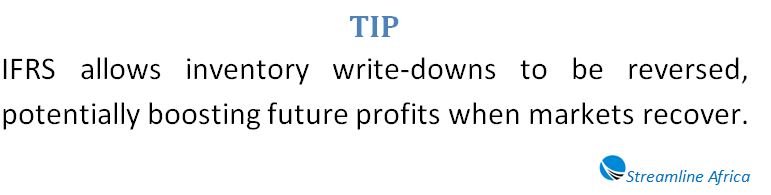
Under IFRS, the company may reverse part or all of the previous write-down, as long as the reversal does not increase the inventory above its original cost. The reversal is recognized in profit or loss during the period in which the recovery occurs. This approach reflects IFRS’s broader emphasis on economic reality and current conditions.
GAAP takes a more conservative stance. Once inventory has been written down, that reduced value becomes the new cost basis. Even if market conditions recover, GAAP prohibits reversing the write-down. Supporters of this rule argue that it prevents earnings manipulation and maintains consistency. Critics counter that it can result in outdated asset values on the balance sheet.
Inventory Costing Methods and Managerial Flexibility
One of the most widely discussed differences between GAAP and IFRS involves permitted inventory costing methods. Under GAAP, companies may choose from several cost-flow assumptions, including First-In, First-Out (FIFO), Last-In, First-Out (LIFO), and weighted-average cost. Management is encouraged to select the method that best reflects periodic income and operational realities.
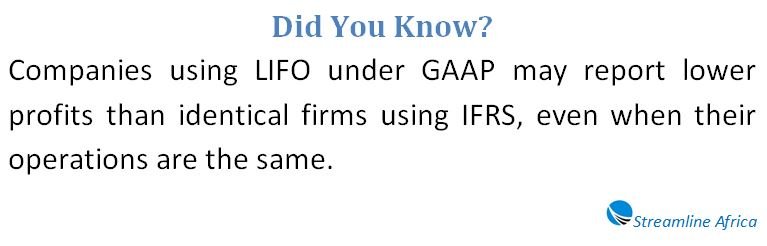
This flexibility allows U.S.-based firms to align inventory accounting with tax planning strategies. For example, a chemical supplier in Texas operating during periods of rising input costs may prefer LIFO because it matches recent, higher costs against current revenues. This typically results in lower reported profits and reduced taxable income, improving short-term cash flow.
IFRS does not allow this level of discretion. LIFO is explicitly prohibited. International standards permit only FIFO or weighted-average cost, except in rare cases involving non-interchangeable items produced for specific projects. Moreover, once a method is chosen, it must be applied consistently to inventories with similar characteristics and use.
This consistency enhances comparability across companies and jurisdictions but limits managerial flexibility. Multinational firms often find themselves maintaining parallel inventory records to satisfy both reporting frameworks.
Consistency Versus Flexibility in Practice
The contrast between these approaches reflects deeper philosophical differences. GAAP emphasizes detailed guidance and accommodates industry-specific practices, even if that results in less uniformity. IFRS prioritizes comparability and principle-based reasoning, sometimes at the expense of tailored solutions.
For a global food distributor with operations in Brazil, Germany, and the United States, these differences are not academic. Inventory valuation affects loan covenants, performance metrics, and internal decision-making. Reconciling GAAP-based and IFRS-based figures can require extensive adjustments and careful communication with stakeholders.
Global Efforts Toward Convergence
For more than two decades, standard setters have explored ways to reduce the gap between GAAP and IFRS. Joint projects between the FASB and the International Accounting Standards Board (IASB) have addressed revenue recognition, leases, and financial instruments, with varying degrees of success.
Inventory accounting remains a sensitive area, largely because of LIFO. Eliminating LIFO in the United States would have significant tax implications for companies that have relied on it for decades. Nevertheless, many observers believe that eventual convergence would require its removal, along with a more harmonized definition of net realizable value.
While full alignment has not yet been achieved, the direction of travel suggests increasing pressure for consistency, particularly as capital markets become more interconnected and investors demand greater transparency.
Why These Differences Still Matter
Even in an era of globalization, GAAP and IFRS remain distinct systems. Inventory accounting differences can materially affect reported earnings, asset values, and tax outcomes. Companies operating internationally must understand these distinctions to manage compliance risk and present financial information accurately.
Auditors, analysts, and investors also need this knowledge to interpret financial statements correctly. A higher profit margin under one framework does not necessarily indicate better performance; it may simply reflect a different accounting treatment.
Final Takeaway
GAAP and IFRS approach inventory accounting from different perspectives. GAAP allows a broader range of costing methods, including LIFO, and prohibits reversals of inventory write-downs. IFRS restricts cost-flow assumptions to FIFO and weighted-average cost, but permits reversals when inventory values recover. These differences influence financial reporting, tax planning, and comparability across borders.
Although convergence efforts continue, inventory accounting remains an area where the distinctions between GAAP and IFRS have real-world consequences. For businesses engaged in global operations, understanding these rules is not optional—it is a prerequisite for informed decision-making and credible financial reporting.
Frequently Asked Questions
Why does inventory accounting differ between GAAP and IFRS?
GAAP and IFRS were developed in different regulatory and economic environments. GAAP prioritizes flexibility and detailed guidance, while IFRS emphasizes consistency and comparability across countries, leading to different rules for valuing and reporting inventory.
Which inventory costing methods are allowed under each standard?
GAAP permits FIFO, LIFO, and weighted-average cost methods. IFRS allows only FIFO and weighted-average cost, prohibiting LIFO entirely to improve comparability across financial statements.
How does the treatment of LIFO affect reported profits?
Under GAAP, LIFO can lower reported profits during periods of rising prices because newer, higher costs are matched against revenue. IFRS does not allow this approach, which often results in higher reported profits compared to LIFO-based reporting.
What is net realizable value, and why does it matter?
Net realizable value represents the amount a company expects to recover from selling inventory after deducting relevant costs. Although both standards use the term, IFRS applies a more formula-driven definition, which can change when and how inventory is written down.
Are inventory write-downs handled the same way under both standards?
No. Both GAAP and IFRS require inventory to be written down when its value falls below cost, but only IFRS allows those write-downs to be reversed if market conditions improve.
Why does GAAP prohibit reversals of inventory write-downs?
GAAP takes a conservative approach to prevent earnings manipulation and maintain consistency. Once inventory is written down, the reduced value becomes the new cost basis permanently.
How do these differences affect multinational companies?
Companies operating in multiple countries may need to maintain separate inventory records or make reconciliation adjustments, increasing reporting complexity and compliance costs.
What role does consistency play under IFRS inventory rules?
IFRS requires companies to apply the same costing method to similar inventories over time, which enhances comparability for investors and analysts reviewing international financial statements.
Is there a chance GAAP and IFRS will fully align on inventory accounting?
While convergence efforts continue, inventory accounting—especially the treatment of LIFO—remains a major obstacle. Full alignment is possible but would likely require significant regulatory and tax changes in the U.S.