
Every business eventually encounters a period in which established assumptions no longer hold. Customer demand may weaken, operating costs may rise, financing conditions may tighten, regulations may shift, and competitors may introduce new technologies or commercial models. These developments rarely arrive as a single, clearly defined event. More often, they emerge gradually through slower payments, declining margins, reduced order volumes, or increased pressure from suppliers and customers.
For Amara Ndlovu, founder of a regional logistics company in Gaborone, the first signs of disruption appeared through longer payment cycles, higher fuel costs, and growing requests from clients to revise commercial terms. Initially, the company responded by increasing sales activity and placing greater pressure on operational teams. However, it soon became clear that additional effort alone would not resolve the underlying challenges.
The business required a structured reassessment of its financial position, operating model, customer proposition, and performance management approach. This reflects a broader principle: organizations cannot always control external conditions, but they can significantly influence how effectively they respond.
Companies that navigate disruption successfully are not necessarily those that predict every change. They are those that identify emerging risks early, assess their position objectively, and implement timely adjustments before short-term pressure develops into long-term decline.
Establish Clear Financial Visibility
The first priority during periods of uncertainty is to understand the company’s financial position with precision. Revenue growth or profitability reported in financial statements may conceal underlying cash-flow pressure caused by delayed customer payments, slow-moving inventory, rising overheads, or deteriorating margins.
Amara initiated a detailed review of the company’s cash inflows, operating expenses, supplier commitments, and receivables. The analysis revealed several areas where costs had increased without corresponding improvements in performance. The company was maintaining duplicate software subscriptions, underutilized warehouse capacity, and service agreements negotiated during an earlier period of rapid expansion.
Although no single expense represented a major financial threat, the combined impact was reducing the company’s flexibility. Management therefore classified expenditure according to strategic importance and eliminated or renegotiated costs that no longer supported operational priorities.
The company consolidated technology subscriptions, revised fleet maintenance agreements, and introduced stronger approval controls for nonessential spending. It also engaged major customers to improve payment timelines and offered limited incentives for earlier settlement where commercially appropriate.
This approach illustrates the importance of targeted cost management. Broad, indiscriminate reductions may protect cash temporarily, but they can also weaken service quality, employee capability, and future growth. A more effective strategy is to preserve expenditure that supports revenue generation, customer retention, operational resilience, and regulatory compliance.
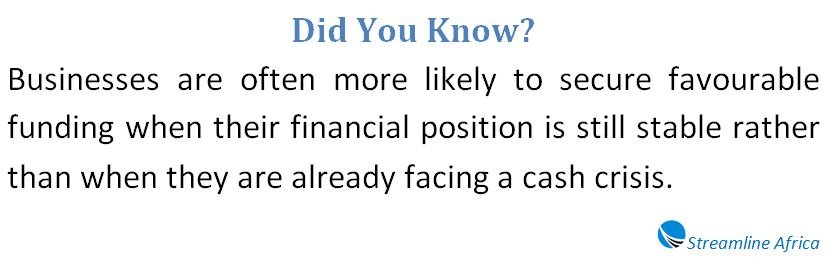
Businesses should also assess access to external funding before liquidity becomes urgent. Credit facilities, supplier financing, or working-capital arrangements are generally easier to secure when the organization remains financially stable. Establishing such options early can provide an important buffer during periods of volatility.

Reconfigure Operations For Greater Efficiency
Improved financial discipline creates stability, but it does not automatically create growth. Organizations should therefore examine whether their operating models remain appropriate for current market conditions.
The central question is not simply what costs can be removed, but how the business can operate more effectively.
A specialty food manufacturer in Kumasi, led by Daniel Owusu, faced a significant decline in orders from hotels and hospitality businesses. Rather than reduce production and wait for demand to recover, the company redesigned its commercial approach. It repackaged selected products for household consumers and smaller retailers, introduced lower minimum order quantities, and created recurring delivery packages for repeat customers.
This allowed the business to apply existing production capabilities to a broader customer base. The initiative did not require a complete transformation of the company’s core operations. It required a more flexible use of assets, distribution channels, and market knowledge.
Technology can also play an important role in improving efficiency. Automated invoicing, customer relationship management systems, inventory alerts, digital self-service tools, and real-time reporting can reduce manual processes and improve decision-making.
However, technology investments should be linked to clearly defined operational outcomes. The objective should not be digital adoption for its own sake. The priority should be to reduce inefficiency, improve customer responsiveness, strengthen management visibility, and allow employees to focus on higher-value activities.
Organizations should also review workflows, approval structures, supplier arrangements, and service delivery models. Processes that were effective during periods of rapid growth may become unnecessarily expensive or complex when conditions change.
Refine The Customer Value Proposition
Economic uncertainty typically makes customers more selective. Purchasing decisions may take longer, price sensitivity may increase, and clients may demand stronger evidence of value before committing resources.
Under these conditions, organizations must communicate clearly why customers should choose them over competing alternatives.
This requires a disciplined review of the company’s value proposition. Management should be able to define the priority customer segment, the most important problem being addressed, and the specific capabilities that differentiate the organization.
Leila Mansour, managing partner of a business advisory firm in Alexandria, faced increasing competition from larger consulting providers and lower-cost independent advisers. Her firm had traditionally presented itself as a general provider of business consulting services. While technically accurate, the positioning was too broad to create meaningful market distinction.
Leila repositioned the firm around supporting family-owned manufacturing companies with cash-flow management, governance improvement, and succession planning. This narrower proposition made the firm’s expertise more visible and enabled prospective clients to understand its relevance more quickly.
A strong value proposition should be reflected consistently across proposals, websites, marketing materials, and sales discussions. It should also respond to current customer concerns rather than relying on assumptions developed under previous market conditions.
During periods of uncertainty, targeted communication is often more effective than high-cost, broad-based promotion. Referral programmes, strategic partnerships, focused digital campaigns, sector-specific content, and client education initiatives can improve market visibility without placing excessive pressure on budgets.
Align Employees With The Strategic Response
Operational and financial plans will not produce the intended results unless employees understand the strategy and their role in delivering it.
Amara introduced regular management briefings and monthly company-wide updates as part of the logistics firm’s response plan. These sessions explained the challenges facing the business, the actions being implemented, and the areas where decisions were still under review.
Management avoided both excessive optimism and unnecessary alarm. The communication approach was factual, transparent, and forward-looking.
Employees were also invited to identify opportunities to reduce waste, improve service, and address recurring customer concerns. A dispatch coordinator recommended grouping deliveries by commercial zones rather than by customer category. This reduced travel distances, fuel use, and late deliveries. A customer service officer proposed automated delivery notifications, which reduced the volume of follow-up calls and improved customer confidence.
These examples demonstrate the value of involving employees in problem-solving. Frontline teams frequently have direct insight into process inefficiencies, service gaps, and customer frustration.
Leaders should therefore create structured channels for employee input, encourage controlled experimentation, and recognize practical improvements. Clear communication, visible leadership, and consistent recognition can strengthen confidence during uncertain periods.
Employee morale should also be monitored carefully. Extended uncertainty can increase anxiety, reduce engagement, and affect productivity. Leaders should communicate expectations clearly, acknowledge pressure where it exists, and explain how decisions support the organization’s long-term stability.
Strengthen Performance Monitoring And Forecasting
When market conditions are unpredictable, management requires more frequent and reliable performance information. Organizations should identify the indicators that provide the clearest view of financial health, operational performance, and customer behaviour.
Relevant measures may include cash conversion, gross margin, order volume, customer retention, sales pipeline quality, inventory turnover, overdue receivables, service delivery time, employee productivity, and customer acquisition cost.
The most appropriate indicators will vary by industry and business model. However, each measure should be linked to a specific strategic objective.
Daniel’s food manufacturing company introduced weekly monitoring of retail orders, repeat purchases, returns, distribution costs, and product margins. One newly introduced product appeared successful because sales volumes were increasing. A more detailed review, however, showed that packaging and delivery costs were absorbing most of the margin.
Management responded by adjusting bundle sizes and introducing minimum order values. The issue was corrected before the product created a significant financial burden.
This reinforces an important management principle: headline growth does not always indicate improved performance. Leaders must examine the economics behind revenue and assess whether growth is creating sustainable value.
Budgets and forecasts should also be treated as dynamic management tools. Assumptions should be reviewed regularly, and projections should be updated when new information becomes available.
Organizations that maintain rigid plans despite changing evidence are likely to respond too slowly. The ability to revise a decision when conditions change is not a sign of inconsistency. It is a core component of effective management.
Advance With Disciplined Confidence
Uncertainty does not require reckless action, but it does require timely decision-making. Organizations that delay action while waiting for complete clarity may lose customers, weaken cash flow, and surrender competitive ground.
A more effective approach is to implement measured interventions, test assumptions, and scale initiatives that produce credible results.
Business resilience depends on several connected capabilities: financial control, operational flexibility, customer relevance, employee alignment, and performance visibility. Each capability contributes to stability, but their combined effect is significantly greater.
Amara’s logistics company did not return to its previous operating model. Instead, it became more disciplined, more data-driven, and more responsive to customer needs. The period of pressure exposed structural weaknesses, but it also accelerated improvements that had previously been postponed.
Changing conditions will continue to challenge business leaders. The organizations most likely to succeed are not always the largest or most established. They are those that evaluate their assumptions honestly, protect critical resources, and adjust their strategies before external pressure forces more disruptive change.
For business leaders, the objective should not simply be to survive a difficult period. It should be to use uncertainty as an opportunity to strengthen decision-making, improve execution, and build a more resilient organization for the future.
Important Questions And Answers
Why Should Businesses Review Their Finances During Uncertainty?
A detailed financial review helps leaders understand where cash is coming from, where it is being spent, and which expenses may no longer support business priorities.
Is Cutting Costs Enough To Protect A Business?
No. Cost reduction may provide temporary relief, but long-term resilience also requires better operations, stronger customer value, and new revenue opportunities.
How Can A Company Improve Cash Flow?
Businesses can improve cash flow by collecting payments faster, renegotiating supplier terms, reducing unnecessary expenses, and maintaining access to working-capital funding.
Why Is Financial Visibility Important?
Clear financial information enables leaders to identify risks early and make decisions based on evidence rather than assumptions or incomplete reports.
How Can Businesses Adapt Their Operations?
Companies can redesign workflows, simplify approval processes, use existing assets differently, and introduce technology that improves efficiency and customer service.
What Role Does Innovation Play During Difficult Periods?
Innovation allows businesses to respond creatively to changing demand, reach new customer groups, and develop more flexible products, services, or delivery models.
Why Should A Business Refine Its Value Proposition?
A clear value proposition helps customers understand why the company is relevant, what problem it solves, and why it offers greater value than competing alternatives.
How Can Businesses Attract Customers With Limited Marketing Budgets?
Targeted digital campaigns, referral programmes, useful content, strategic partnerships, and sector-specific communication can deliver strong results at a lower cost.
Why Should Employees Be Involved In Business Transformation?
Employees often understand operational problems and customer frustrations better than senior leaders. Their insights can lead to practical and affordable improvements.
How Can Leaders Maintain Employee Confidence?
Leaders should communicate honestly, explain decisions clearly, acknowledge challenges, and demonstrate a realistic but positive plan for moving forward.
Which Performance Indicators Should Businesses Monitor?
Important indicators may include cash flow, gross margin, customer retention, sales pipeline quality, inventory turnover, overdue payments, productivity, and service delivery time.
What Is The Main Lesson For Business Leaders?
The central lesson is that businesses cannot control every market condition, but they can control how quickly, intelligently, and confidently they respond.