
In investing, some industries look straightforward from the outside but reveal far more complexity once you look under the hood. Supermarket businesses fall squarely into that category. Food is a basic human need, which makes grocery retailers appear safe and predictable. People buy food during economic booms, recessions, pandemics, and everything in between.
Yet that apparent stability can be deceptive.
Behind every supermarket chain lies a delicate balancing act involving razor-thin margins, intense competition, consumer loyalty, supply chain precision, and operational discipline. One company may look successful because of rising sales, while another may quietly outperform by managing costs better and generating stronger cash flow.
For investors, the challenge is not deciding whether food retail matters. It clearly does. The challenge is identifying which supermarket businesses are built to endure and grow.
This guide walks through a structured approach to analyzing grocery and supermarket stocks—from understanding how these companies earn money to evaluating financial performance, spotting competitive advantages, recognizing industry trends, and identifying hidden risks.
Step One: Understand How a Supermarket Makes Money
Before reviewing financial statements, it helps to understand the economic engine of a grocery business.
Unlike luxury brands or software firms, supermarkets do not depend on high margins per sale. Their business model revolves around volume. They sell thousands of everyday products with relatively small markups, relying on consistent customer traffic to generate profits.
Imagine a large grocery chain in Toronto or Johannesburg. It might sell milk, bread, vegetables, cleaning products, and household goods all day long. Each individual item generates only a small profit, but the total volume creates substantial revenue.
Typical revenue sources include:
- Fresh food such as fruits, meat, and dairy
- Packaged consumer goods
- Store-owned private-label brands
- Membership fees for warehouse retailers
- Add-on services like pharmacies, cafés, and petrol stations
A company’s revenue mix matters because not all income streams produce equal profit. A retailer heavily dependent on low-margin packaged foods may struggle compared with one earning additional revenue from pharmacy services or premium store brands.
Understanding this foundation gives context to every financial metric that follows.
Step Two: Focus on the Financial Numbers That Actually Matter
Many investors drown in data. Smart investors focus on the numbers that truly reveal operational health.
Gross Margin
Gross margin tells you how much money remains after paying for inventory.
In food retail, this number is naturally low—often somewhere between 18% and 30%.
A chain in Singapore with a 28% gross margin may appear stronger than one in Chile operating at 20%, but context matters. Is the first company selling more premium goods? Does it rely heavily on private-label products?
Margins alone never tell the full story—but they reveal efficiency.
Operating Margin
Operating margin goes deeper.
It accounts for wages, rent, electricity, logistics, and store operations.
This is often where supermarket businesses separate winners from laggards. A one-percentage-point improvement may sound small, but in a billion-dollar business, it can translate into enormous profits.

Comparable Store Sales
Also called same-store sales, this metric measures growth from existing locations rather than new store openings.
Why does that matter?
A retailer can inflate revenue by opening fifty new outlets. But if older stores are declining, that expansion may hide weakness.
Healthy same-store growth suggests genuine customer demand.
Inventory Turnover
Supermarkets deal with perishables.
If bananas sit too long, they spoil. If dairy products remain unsold, losses rise.
Inventory turnover measures how fast goods move from shelf to customer.
Higher turnover generally signals stronger demand and better operational discipline.
Debt and Cash Flow
Because grocery profits are thin, excessive debt can be dangerous.
Look carefully at:
- Debt-to-equity ratios
- Interest coverage
- Free cash flow
A retailer with strong cash flow can modernize stores, pay dividends, reduce debt, and survive economic shocks.
Cash is often the clearest sign of resilience.
Step Three: Identify Competitive Advantages
Not all grocery businesses compete equally.
Some operate with durable advantages that protect profitability over time.
Scale and Buying Power
Large chains usually negotiate better prices from suppliers.
Consider a giant retailer in Germany buying milk for 2,000 stores versus a regional chain buying for only 50.
The larger buyer gets better pricing.
That cost advantage can be passed to consumers, attracting even more customers and reinforcing market dominance.
This creates a powerful loop.
Private-Label Products
Store-owned brands often produce better margins than national brands.
A supermarket in Spain selling its own pasta sauce earns more per unit than when selling a global label.
Retailers that build customer trust in private-label goods often enjoy higher profitability and stronger loyalty.
This has become one of the most powerful strategies in modern food retail.
Convenience and Location
Location has always mattered.
A store near a busy train station in Tokyo naturally benefits from foot traffic.
But convenience has evolved.
Today, location also includes:
- Fast delivery
- Mobile ordering
- Click-and-collect services
- Digital payment experiences
Retailers that blend physical and digital convenience are increasingly ahead.
Step Four: Watch the Industry Trends Reshaping Grocery Retail
Strong analysis looks forward, not backward.
Several trends are transforming the supermarket business globally.
Digital Grocery Shopping
Online food ordering has permanently changed consumer behavior.
Customers increasingly expect:
- Same-day delivery
- Subscription ordering
- Personalized promotions
- App-based shopping
Retailers investing in digital infrastructure may enjoy stronger future growth.
Those ignoring it risk irrelevance.
Inflation and Consumer Shifts
When prices rise, shoppers change behavior.
They may:
- Switch to discount stores
- Buy cheaper alternatives
- Choose private-label brands
- Reduce impulse purchases
Inflation can hurt some retailers—but help others.
Discount-focused chains often thrive during these periods.
Supply Chain Strength
Recent global disruptions exposed supply chain vulnerabilities.
Companies with diversified suppliers, strong warehousing, and efficient logistics recovered faster.
Supply chain resilience is now a competitive moat.
Investors should treat it as such.
Step Five: Decide Whether the Stock Is Fairly Valued
Even a fantastic business can become a poor investment if purchased at the wrong price.
Valuation matters.
Price-to-Earnings Ratio
The P/E ratio shows how much investors pay for each dollar of earnings.
Supermarket stocks often trade at lower multiples than fast-growing technology companies because their growth tends to be slower.
That does not make them unattractive.
It simply changes how they should be evaluated.
Price-to-Sales Ratio
Since grocery margins are small, price-to-sales can offer valuable perspective.
A low ratio may indicate opportunity—but only if the underlying business is healthy.
Cheap stocks can also be traps.
Dividend Yield
Many grocery companies pay dependable dividends because food demand remains stable.
Income-focused investors often like this sector for that reason.
But always ask:
Is the dividend supported by free cash flow?
If not, it may not last.
Step Six: Understand the Risks
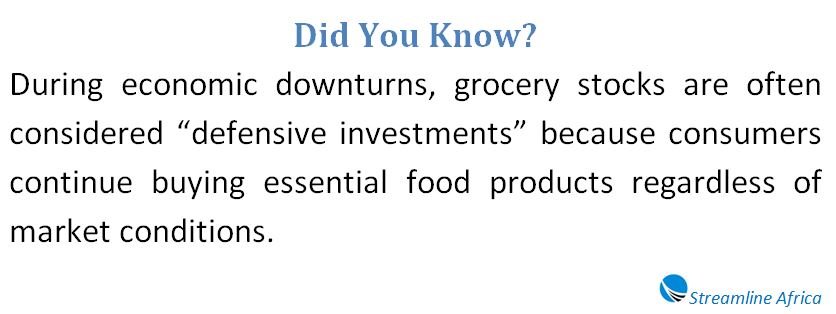
Supermarket stocks are often labeled “defensive,” but defensive does not mean risk-free.
Margin Pressure
A rise in transportation costs, employee wages, or refrigeration expenses can quickly erode profits.
With already-thin margins, small cost increases matter enormously.
Competitive Price Wars
Retail competition is brutal.
Discount chains, organic specialists, warehouse clubs, and convenience stores all compete for the same consumer wallet.
Price wars can destroy profitability.
Consumer Preferences Change
Shoppers today care more about:
- Organic foods
- Sustainability
- Ethical sourcing
- Health-conscious products
Retailers slow to adapt may lose relevance.
Consumer loyalty is not guaranteed.
A Practical Framework for Analyzing Any Grocery Stock
To simplify your analysis, follow this six-part checklist:
- Start with revenue growth and same-store sales.
- Study gross and operating margins.
- Check inventory turnover and efficiency.
- Evaluate debt levels and free cash flow.
- Identify competitive advantages like scale or private labels.
- Compare valuation against peers.
Think of it like inspecting a machine.
Every part must function well.
A beautiful exterior means nothing if the engine is failing.
Example: Comparing Two Fictional Grocery Chains
Imagine two supermarket companies:
Northern Basket operates 900 stores across Canada. It has moderate growth, strong private-label sales, and healthy cash flow.
Urban Fresh operates 300 stores across major cities in Australia. Revenue is rising quickly, but debt is increasing and margins are shrinking.
Which is better?
At first glance, Urban Fresh looks exciting.
But Northern Basket may be the superior investment because it combines resilience, efficiency, and predictable returns.
That is the lesson.
Growth alone is not enough.
Quality matters.
Frequently Asked Questions About Grocery Stocks
Are grocery stocks good long-term investments?
They can be excellent long-term holdings because food demand is steady and predictable. However, they usually deliver moderate rather than explosive growth.
What metric matters most?
Comparable store sales is highly important because it reveals genuine organic performance.
Why are margins so small?
Food retail is intensely competitive, and customers are highly price-sensitive. That forces retailers to keep prices low.
Do grocery stocks perform well during recessions?
Generally, yes. Food remains essential, so revenue tends to be more stable than in cyclical industries.
How does inflation affect supermarkets?
It depends on pricing power. Strong retailers can pass higher costs to customers. Weak ones cannot.
Why do private-label products matter?
They typically offer better margins and help differentiate the retailer from competitors.
Final Thoughts
Analyzing supermarket stocks is not about chasing dramatic growth stories.
It is about identifying businesses built on discipline.
The strongest food retailers tend to share similar traits:
- Operational efficiency
- Reliable cash flow
- Strong supply chains
- Customer loyalty
- Thoughtful expansion
- Adaptability
These companies often behave less like flashy growth stories and more like precision-engineered systems.
Every shelf stocked correctly, every truck delivered on time, and every percentage point of margin improvement contributes to shareholder value.
The next time you walk through a supermarket, notice what is happening around you.
You are not just seeing shelves and shopping carts.
You are seeing a complex economic machine—one that, when run well, can become a surprisingly powerful investment opportunity.