

It is important that entrepreneurs realize that company registration is not simply an administrative requirement. It is one of the first strategic decisions a business owner makes because it influences ownership, taxation, liability, governance, financing, and future expansion.
In South Africa, registering a company creates a formal legal identity for the business and provides a structure through which commercial activities can be conducted more effectively. For entrepreneurs planning to attract investors, apply for financing, compete for contracts, employ staff, or build a scalable enterprise, formal registration can provide an important foundation.
However, our experience shows that many founders focus primarily on obtaining a registration certificate and give insufficient attention to what the chosen structure means for the business over the longer term. A successful registration process should therefore combine legal compliance with careful commercial planning.
Understanding South Africa’s Company Registration Framework
South African companies are primarily governed by the Companies Act 71 of 2008. The legislation provides the framework for company formation, corporate governance, directors’ responsibilities, shareholder rights, company records, and other regulatory matters.
The Companies and Intellectual Property Commission, commonly referred to as the CIPC, administers company registrations and maintains official corporate records. Much of the process can now be completed through digital channels, including BizPortal.
From an advisory perspective, digitisation has made registration considerably more accessible, but an easier application process does not remove the need to make sound structural decisions.
A private company must have at least one director. Directors are responsible for managing and overseeing the affairs of the company and must exercise their responsibilities in accordance with applicable legal and governance requirements.
The company’s shareholders, on the other hand, are its owners. In smaller businesses, directors and shareholders are often the same individuals, but their legal roles remain different. This distinction becomes increasingly important when investors join the business, ownership changes, or disagreements arise.
Selecting a Business Structure That Supports Your Strategy
One of the first issues we encourage clients to consider is whether their legal structure supports their commercial objectives.
For most profit-oriented businesses, a private company, identified by “(Pty) Ltd,” is a practical option. It can accommodate businesses ranging from small owner-managed enterprises to substantial private organizations.
One of its principal advantages is that the company exists as a separate legal entity. This generally creates a degree of separation between the company’s liabilities and the personal assets of its shareholders, subject to the law and circumstances involved.
Other structures may be more appropriate in particular situations. Public companies are generally suited to businesses operating under broader ownership and capital-raising arrangements, while non-profit companies are established primarily for public-benefit, social, charitable, or community-related purposes.
A sole proprietor operates differently because there is no separate legal personality between the owner and the business. The individual receives the business income but also assumes personal responsibility for its obligations.
We therefore recommend considering liability exposure, anticipated investment, tax implications, financing requirements, ownership arrangements, succession plans, and growth ambitions before selecting a structure.
Choosing and Protecting the Company Name
A company name is both a legal identifier and a commercial asset.
During registration, applicants may submit proposed names to the CIPC for consideration. It is sensible to prepare several alternatives because a preferred name may be unavailable or too similar to an existing registered name.
Businesses can also be incorporated using their registration number as the company name and introduce a formal name later.
From a branding perspective, however, we advise entrepreneurs to look beyond basic name registration. Registering a company name with the CIPC should not automatically be regarded as complete intellectual-property protection.
Where a business intends to invest significantly in its brand, products, reputation, or marketing, trademark considerations should form part of the broader business-protection strategy.
Preparing Accurate Incorporation Information
Registration can often be completed relatively quickly when the required information is prepared correctly.
Applicants generally need to provide identification and other information relating to directors and incorporators. Foreign applicants may need suitable passport documentation and additional supporting information depending on the circumstances.
An important document within the incorporation framework is the Memorandum of Incorporation, or MOI. We view the MOI as more than a filing document because it provides important rules governing the company’s internal structure.
It may address matters involving directors, shareholders, voting, decision-making, and shares. For businesses with straightforward ownership, standard arrangements may be sufficient. For businesses involving several founders, external investors, family ownership, or complex voting rights, greater attention may be necessary.
Where another person or professional adviser handles the incorporation process, appropriate authority may also be required.
Inaccurate documents can result in delays, but the larger risk is creating corporate records that do not accurately represent the intended ownership and governance structure.
Clarifying the Roles of Directors and Shareholders
A recurring source of confusion among entrepreneurs is the difference between management and ownership.
Directors are responsible for directing and managing the company’s affairs. Shareholders own shares in the company and exercise the rights attached to those shares.
A founder can hold both roles, but the rights and responsibilities associated with each position are different.
This distinction becomes particularly important when a business accepts outside investment. An investor may receive shares without participating in everyday management, while a director may manage the company without owning a substantial percentage of its shares.
We recommend that founders define these relationships clearly from the beginning.
Where several shareholders are involved, a shareholder agreement can provide additional clarity regarding decision-making, share transfers, investor exits, disputes, funding commitments, and other matters that may not be sufficiently addressed through informal understandings.
Structuring Company Shares Properly
Shares determine ownership and can become an important mechanism for raising capital.
A company’s constitutional arrangements may authorize a particular number or class of shares. However, authorized shares and issued shares should not be treated as the same thing.
Shares must be properly issued to shareholders, and the company’s records should accurately reflect who owns them.
For early-stage businesses, this may initially appear straightforward. Problems often arise later when founders introduce investors, reward key employees with equity, reorganize ownership, or sell part of the business.
Our advice is to establish a clear ownership record from the outset. Shareholders should have appropriate documentary evidence of their interests, and the company’s securities records should be properly maintained.
Informal promises regarding ownership can create significant commercial disputes once the business becomes more valuable.
Addressing Corporate Tax Responsibilities
Registration with the CIPC is only one part of formalising a business.
A private company is generally treated as a taxpayer in its own right and therefore has responsibilities involving the South African Revenue Service.
Business owners should confirm that the company’s tax registration details are correct and maintain the relevant documentation carefully.
As the company develops, additional obligations may arise depending on turnover, payroll, employees, transactions, and the nature of its activities.
From an advisory standpoint, we strongly recommend establishing appropriate bookkeeping and accounting systems early. Waiting until the company has grown before separating revenue, expenses, assets, liabilities, and tax records often creates avoidable difficulties.
Good financial discipline from the beginning also improves management reporting and provides better information for strategic decision-making.
Meeting Employment and Industry-Specific Requirements
A company registration certificate does not necessarily give a business permission to undertake every intended activity.
Organizations employing workers may have obligations involving employment-related registrations, including requirements connected with the Unemployment Insurance Fund and compensation for occupational injuries and diseases.
Some industries also require specific licenses, authorisations, permits, or professional registrations.
A business dealing in regulated products, financial services, transportation, healthcare, food, liquor, construction, or other controlled activities should establish its sector-specific requirements before commencing operations.
We recommend developing a compliance checklist based on the company’s industry, workforce, products, operating locations, and regulatory exposure.
This prevents the common mistake of assuming that incorporation alone means the business is fully compliant.
Establishing a Dedicated Business Bank Account
Once a company has been formally established, separating company finances from personal finances becomes an important governance practice.
A corporate bank account allows business income and expenditure to be recorded independently. Supplier payments, employee costs, taxes, customer receipts, and operating expenses become easier to track.
From our experience, mixing company and personal transactions creates unnecessary accounting complexity and can make it difficult to understand the true financial condition of the business.
Clear financial separation also assists during tax preparation, audits, financing applications, investment discussions, and financial due diligence.
Entrepreneurs seeking to build businesses that are attractive to investors or lenders should regard reliable financial records as part of their corporate infrastructure rather than merely an accounting requirement.
Understanding the Strategic Benefits of Formal Registration
The value of company registration extends beyond legal recognition.
Formal businesses often enjoy greater credibility when dealing with large customers, corporate suppliers, government agencies, banks, investors, and tendering organizations.
A registered company can also create a more suitable platform for investment because ownership can be structured through shares.
Limited liability can provide an additional layer of commercial protection by distinguishing company obligations from shareholders’ personal affairs, although business owners should understand that this protection is not absolute in every situation.
Formal registration can also assist with business continuity. Contracts, employees, intellectual property, equipment, and other business assets can be organized around the company rather than around an individual entrepreneur.
This becomes increasingly valuable as the business grows beyond its founder.
Avoiding Common Registration and Governance Mistakes
We frequently see entrepreneurs concentrate on speed and cost while underestimating the consequences of registration decisions.
Choosing the wrong structure may create tax, liability, investment, or governance complications. Poor ownership records can generate disputes among founders. Inadequate agreements may leave important questions unanswered when shareholders disagree.
Another recurring problem is neglecting compliance after registration.
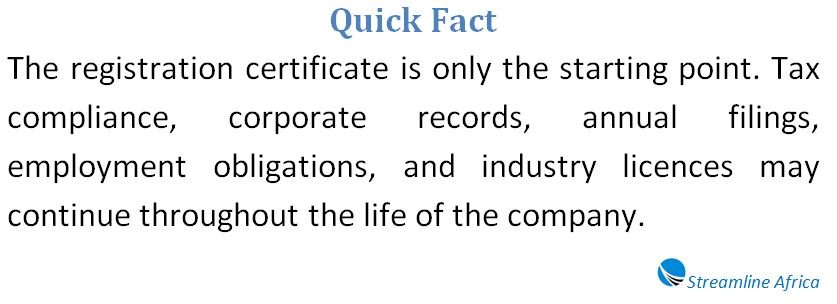
Companies may have continuing filing, recordkeeping, tax, regulatory, and governance responsibilities. Failure to comply with annual filing requirements can eventually affect the company’s standing and create unnecessary operational complications.
Entrepreneurs should therefore treat company registration as the beginning of a compliance cycle rather than a once-off administrative task.
Deciding Whether to Register Independently or Seek Professional Support
South Africa’s digital registration systems make it possible for many entrepreneurs to register their own companies.
For a straightforward private company with simple ownership arrangements, this may be entirely appropriate.
Professional advice becomes more valuable when the business involves foreign investors, multiple shareholders, customized share rights, complex governance arrangements, intellectual property, significant external financing, or anticipated future investment.
Different professionals may assist with different aspects of the process. Legal advisers can support governance and shareholder arrangements, accountants can advise on tax and financial structures, while company secretarial specialists can assist with statutory administration.
Our preferred approach is to determine the complexity and future direction of the business first and then decide what level of professional assistance is justified.
Building for Compliance, Investment, and Long-Term Growth
From a business advisory perspective, company registration should be viewed as an early strategic exercise rather than simply a government filing.
The strongest foundations combine the correct legal structure with clearly documented ownership, sound governance, accurate records, appropriate tax arrangements, regulatory compliance, financial discipline, and protection of important business assets.
Entrepreneurs who establish these systems early are generally better positioned to approach investors, secure financing, enter major contracts, manage risk, and scale operations.
The registration certificate may officially establish the company, but it is the quality of the structure built around that company that ultimately supports sustainable growth. Our advice to entrepreneurs is therefore simple: register with the future of the business in mind, not merely with the objective of completing today’s paperwork.
Frequently Asked Questions about Business Registration in South Africa
What Is the First Step When Registering a Company in South Africa?
The first step is choosing the right business structure. For most profit-driven businesses, a private company or (Pty) Ltd is a popular choice because it creates a separate legal entity and can support future investment and expansion.
Who Regulates Company Registration in South Africa?
The Companies and Intellectual Property Commission (CIPC) is responsible for company registration and maintaining official corporate records in South Africa. Much of the process can be completed online through its digital platforms.
What Is the Difference Between a Director and a Shareholder?
A director manages and oversees the affairs of the company, while a shareholder owns part of the company through shares. In smaller businesses, the same person may be both a director and a shareholder.
Does a Private Company Need More Than One Director?
No. A South African private company can generally be established with at least one director, making the structure accessible to individual entrepreneurs as well as businesses with larger management teams.
Why Is the Memorandum of Incorporation Important?
The Memorandum of Incorporation, or MOI, sets out important rules governing the company. It can address matters such as directors, shareholder rights, voting arrangements, decision-making, and the company’s share structure.
Does Registering a Company Name Automatically Protect the Brand?
Not necessarily. Registering a company name with the CIPC establishes the business’s corporate identity, but trademark registration may be necessary if the business wants stronger legal protection for a valuable brand name or logo.
Why Should Business Owners Separate Personal and Company Finances?
Keeping business and personal money separate creates clearer financial records and makes accounting, tax reporting, audits, financing applications, and investment discussions easier. It also reinforces the company’s status as a separate business entity.
Does Company Registration Automatically Cover Tax Registration?
A registered company has its own tax obligations and should ensure its corporate tax information with the South African Revenue Service is properly established. Additional tax responsibilities may also arise as the company grows.
What Additional Registrations May Be Required When Hiring Employees?
Employers may need to comply with employment-related requirements involving areas such as the Unemployment Insurance Fund and compensation for occupational injuries and diseases. The precise obligations depend on the business and workforce.
Why Does the Company’s Share Structure Matter?
Shares determine ownership and can also provide a mechanism for bringing investors into the business. Clear share records become especially important when there are several founders, new investors, ownership transfers, or future fundraising plans.
Can Entrepreneurs Register a Company Without Professional Help?
Yes. Straightforward companies can often be registered directly through CIPC systems. However, legal, accounting, or company secretarial advice may be valuable where there are foreign investors, several shareholders, complex ownership arrangements, or customized governance requirements.
What Happens After a Company Is Registered?
Registration is only the beginning. Businesses must continue maintaining accurate corporate and financial records, meeting tax and regulatory obligations, submitting required filings, and complying with any industry-specific licensing requirements.