
Growth is often celebrated as proof that a business is gaining market acceptance. More customers, stronger sales and wider visibility can make expansion feel like the obvious next move. Yet growth without structure can create financial stress, weaker service and operational confusion. Scaling requires more than ambition. It requires a model that allows the business to handle greater demand while protecting quality, profitability and control.
From a consulting perspective, scaling should be managed as a coordinated transformation. A company does not become scalable simply by hiring more people, opening more branches or increasing advertising spend. It becomes scalable when its finances, people, processes, suppliers, technology and customer experience can support expansion together. The objective is to become bigger without becoming fragile.
Test Whether the Business Is Ready
A responsible scaling decision begins with a readiness assessment. The first test is demand. Leaders should determine whether customer interest is consistent, profitable and repeatable. Sales patterns, customer retention, market size, competitive strength and pricing power should all be reviewed before committing resources to expansion.
Financial readiness is equally important. A business preparing to scale must understand its cash flow, margins, working capital needs, debt obligations and investment requirements. Expansion usually requires spending before returns are realised. New employees, larger inventory, upgraded systems, additional facilities and stronger marketing can all create pressure. Without disciplined financial management, growth can weaken liquidity and expose the company to avoidable risk.
Culture must also be considered. A company with rigid teams, poor communication or resistance to change may struggle to absorb new people and processes. Scalable organisations usually have cultures built on accountability, learning and collaboration. If the business depends heavily on a few individuals or informal decision-making, leaders should strengthen the operating culture before pursuing aggressive expansion.

Convert Ambition Into a Practical Growth Plan
A growth plan should translate opportunity into a sequence of practical decisions. It must define the target market, growth objectives, required resources, key milestones, investment needs and operational implications. If a retail company wants to expand into another region, the plan should explain which customers it will serve, how supply will be managed, what staff will be needed and when the new operation should become profitable.
The budget behind the plan should be realistic and conservative. Many businesses underestimate scaling costs because they focus only on visible expenses. In practice, expansion may involve recruitment delays, training costs, compliance requirements, supplier adjustments, technology implementation and increased customer support. A strong budget should include a contingency allowance so unexpected costs do not disrupt the strategy.
Protect Core Operations With Dedicated Funding
Scaling requires capital that is clearly separated from the cash needed for daily operations. One common mistake is funding expansion from the same pool used for salaries, rent, supplier payments, inventory and utilities. When growth spending competes with operating obligations, the core business becomes vulnerable.
Leaders should ring-fence funds specifically for growth initiatives. This creates transparency and protects the existing operation from disruption. The amount required will depend on the size and pace of the expansion. A modest product launch may need limited funding, while entry into a new region, equipment purchase or new location may require substantial investment.
Funding may come from retained earnings, bank finance, investor capital, strategic partnerships or a combination of sources. The best option depends on ownership preferences, repayment capacity and risk appetite. The key principle is simple: capital should support sustainable growth, not force the business into unrealistic targets.
Strengthen Capacity Before Increasing Demand
No company can scale beyond the strength of its supply chain. Before launching a major growth initiative, leaders should engage suppliers, logistics partners and service providers to confirm whether they can support increased volumes, consistent quality and reliable timelines. This is also the right moment to negotiate better payment terms, volume discounts or service-level expectations.
Where existing suppliers cannot support expansion, alternatives should be identified early. Supplier diversification reduces dependency risk and protects the company from delays or quality failures. Internal processes should also be reviewed. Procedures that work in a small business may become inefficient as transactions multiply. Approvals, inventory checks, billing cycles, customer onboarding and complaint resolution should be simplified before they become bottlenecks.
Growth also places pressure on people. Leaders should prepare a workforce plan that identifies which roles are needed immediately, which can wait and which functions can be outsourced temporarily. Hiring should be driven by strategic need rather than panic. Clear sequencing helps the business avoid both understaffing and unnecessary payroll expansion.
Use Technology to Improve Control
Technology should be introduced to solve real operating problems, not to create the appearance of modernity. The purpose of digital tools is to improve visibility, reduce manual workload and strengthen decision-making. Businesses that rely on scattered spreadsheets or informal messaging often struggle when volumes increase.
Appropriate systems can support accounting, inventory control, customer relationship management, workflow automation, communication and performance reporting. A distribution company may need real-time stock tracking. A service company may need a platform to manage leads, proposals and client follow-ups. A finance team may need accounting software that provides timely information on receivables and margins.
Automation is valuable for repetitive tasks such as invoice processing, email follow-ups, lead tracking and customer service requests. However, technology delivers value only when people are trained to use it properly and leaders insist on consistent adoption. Software cannot compensate for unclear processes or weak discipline.
Protect Customers and Manage Change
Existing customers are often the strongest foundation for future growth. They provide repeat business, credibility and referrals. However, they can quickly become dissatisfied if expansion leads to slower response times, inconsistent quality or weaker communication. Scaling should never make loyal customers feel forgotten.
Every growth decision should be tested against the customer experience. Will delivery timelines remain reliable? Will product quality remain consistent? Will support still be easy to access? Customer data should also guide expansion. Buying patterns, complaints, location-based demand and product preferences can reveal where growth is most likely to succeed.
Scaling is not only operational; it is also human. Employees may worry about new expectations, revised reporting lines, new technology or changes in culture. Leaders must communicate the purpose of growth clearly and explain how roles will evolve. Employee feedback should be encouraged because frontline teams often understand risks that senior leaders may not see.
As the company grows, founders and senior executives cannot approve every decision personally. Authority must be distributed to capable managers with clear accountability. This does not mean losing control. It means building a business that can perform without depending excessively on one person.
Avoid Unsustainable Growth Traps
Unsustainable scaling often begins with poor assumptions. Some companies hire too quickly, enter markets they do not understand or rely heavily on optimistic projections. Others prioritise short-term sales while neglecting quality, customer service or financial discipline.
Weak accounting is particularly dangerous. As businesses grow, financial complexity increases. Leaders need accurate information on margins, tax obligations, receivables, liabilities and profitability by product, branch or service line. Without reliable reporting, management may continue expanding while hidden losses accumulate.
Cultural misalignment is another risk. Hiring people who do not share the organisation’s values can weaken performance, especially in leadership roles. Ignoring early warning signs, such as customer complaints, staff resistance or process failures, can also turn small problems into structural weaknesses.
Create Growth That Can Endure
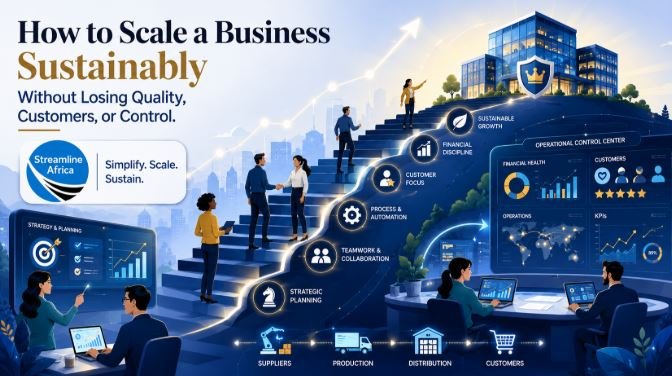
Sustainable scaling is a long-term capability, not a one-time project. A business that scales well develops stronger systems, better managers, clearer financial controls and deeper customer understanding. It grows in a way that protects its reputation while increasing its reach.
The most resilient companies do not expand at any cost. They move when evidence supports the decision, capital is available, suppliers are ready, teams are prepared and leadership can manage greater complexity. They understand that speed without control can be expensive, while disciplined growth can create lasting value.
Ultimately, scaling is about balance. The business must remain ambitious without becoming reckless, efficient without becoming rigid and customer-focused while building capacity for the future. When growth is managed with discipline, the organisation does not simply become larger. It becomes more competitive, resilient and better positioned to serve its market over time.
Important Takeaways
Scaling Is Not Just Growth
A business is not truly scaling simply because it is selling more. Real scaling means the company can handle more demand without losing efficiency, quality, or profitability.
Readiness Comes Before Expansion
Before expanding, leaders must confirm that demand is strong, finances are stable, and the team is prepared for operational change.
A Growth Plan Reduces Risk
A clear plan helps businesses know where they are going, what resources they need, and how to measure progress without making emotional decisions.
Cash Flow Must Be Protected
Expansion should not drain the money needed for daily operations. Growth funds should be separated from regular business expenses.
Suppliers Must Be Prepared
A company cannot serve more customers if suppliers cannot deliver more products, materials, or services on time and at the right quality.
Technology Should Support Control
Digital tools, automation, CRM systems, and accounting software can help growing businesses stay organised and reduce manual pressure.
Customers Should Not Feel Forgotten
Loyal customers are the foundation of sustainable growth. Expansion should never weaken service quality or customer relationships.
Managers Become More Important
As a business grows, founders cannot make every decision alone. Dependable managers are needed to lead teams, solve problems, and maintain standards.
Fast Growth Can Be Dangerous
Growing too quickly can damage product quality, cash flow, culture, and customer trust. Sustainable growth is better than temporary excitement.