Every business needs enough resources to function smoothly from day to day. One key measure that helps determine this short-term financial stability is working capital. Working capital reflects how much funding a company has available after setting aside the money needed to cover its upcoming bills and short-term obligations. When viewed correctly, it provides insight into liquidity, operational efficiency, and a company’s ability to respond to challenges or opportunities in the near term.
Working capital is also known as net working capital, and it focuses on items expected to be converted into cash or owed within one year. It helps leaders, creditors, and investors understand how flexible and prepared the business is to handle regular operations without running into cash shortages.
What Working Capital Represents
Working capital is calculated by taking the value of a company’s current assets and subtracting its current liabilities. Current assets include items that can reasonably be converted into cash within twelve months—such as bank balances, inventory, and money owed by customers. Current liabilities are short-term financial commitments that must be settled within the same period, including supplier payments, wages, taxes, and the upcoming portion of longer-term loans.
If a business has more current assets than current liabilities, it has positive working capital, indicating it has financial breathing room. If the opposite is true and current liabilities exceed current assets, the company has negative working capital, signaling possible liquidity pressure and the need for careful financial planning.

Why Working Capital Matters
Working capital is more than just a balance sheet figure—it’s an indicator of a company’s operational rhythm. When working capital is healthy, a business can pay its suppliers, compensate its employees, purchase materials, fund short-term projects, and reinvest in growth. A lack of working capital can lead to delayed payments, production interruptions, missed opportunities, and in severe cases, insolvency.
A common misconception is that higher working capital is always better. While strong liquidity is positive, an excessively high balance may suggest the company is holding too much idle cash, carrying slow-moving inventory, or not using credit efficiently.
Key Takeaways
• Working capital evaluates a company’s short-term financial strength.
• Positive working capital indicates adequate liquidity to fund operations.
• Negative working capital may signal financial strain if it persists.
• Very high working capital may reflect inefficient use of cash or inventory.
• Working capital must be interpreted based on industry characteristics and business lifecycle.
Calculating Working Capital
The formula for working capital is straightforward:
Working Capital = Current Assets – Current Liabilities
Working capital is expressed in currency rather than as a ratio or percentage. For example, if a business has $120,000 in current assets and $70,000 in current liabilities, its working capital is:
$120,000 – $70,000 = $50,000
This means the company has $50,000 available to use for operational or strategic needs.
Positive Working Capital
A positive result indicates that the company has enough liquidity to meet its short-term obligations comfortably. It may be able to invest in expansion, purchase equipment, or increase production without needing new financing.
Negative Working Capital
A negative result means current liabilities exceed current assets. This may be temporary for fast-moving industries such as supermarkets, which receive cash from customers immediately but pay suppliers later. However, in most cases, persistent negative working capital suggests risk.

Components of Working Capital
Working capital includes various short-term assets and liabilities that appear on the balance sheet. These accounts differ based on business type, scale, and industry, but the core elements are widely recognized.
Current Assets
Current assets are resources expected to be turned into cash within one year. They represent the funds a business can draw on quickly to finance operations.
Common current assets include:
• Cash and cash equivalents: Bank balances, petty cash, and short-term interest-earning instruments.
• Accounts receivable: Payments owed from customers who purchased on credit.
• Inventory: Goods being produced, finished goods available for sale, and raw materials.
• Short-term notes receivable: Loans or receivables expected to be collected soon.
• Prepaid expenses: Items such as prepaid rent or insurance, which reduce future cash obligations.
Although prepaid expenses are not easily converted to cash, they reduce near-term expenses, so they still contribute to working capital.
Current Liabilities
Current liabilities represent obligations due within the next year. These are debts that must be honored to keep the business running smoothly.
Common current liabilities include:
• Accounts payable: Supplier invoices waiting to be paid.
• Wages payable: Salaries and compensation owed but not yet paid.
• Current portion of long-term debt: The amount of loan principal due in the next 12 months.
• Taxes payable: Income or business taxes expected to be remitted soon.
• Dividends payable: Approved but unpaid shareholder distributions.
• Unearned revenue: Advance payments received for products or services not yet delivered.
Working capital shows whether the business can meet these obligations using short-term resources rather than taking on additional financing.
Factors Influencing Working Capital Needs
Not all businesses need the same level of working capital. Industry structure, business strategy, and operational model play major roles.
• Manufacturers require more inventory and often wait longer to receive payment.
• Retailers rotate inventory faster and may operate on lower working capital margins.
• Service firms may need minimal inventory but carry higher payroll expenses.
Companies with predictable sales patterns may need less working capital than those with seasonal or uneven cash flows.
Limitations of Working Capital as a Measure
While working capital is useful, it does not tell the entire story. There are limitations to consider:
- Snapshot timing
Working capital changes daily. Financial statements offer only periodic views, which may not reflect real-time conditions. - Asset quality concerns
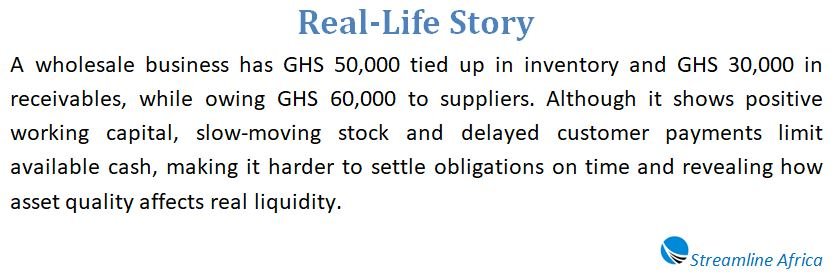
A company may appear to have strong working capital, but if most assets are tied up in slow-moving inventory or overdue receivables, liquidity may still be tight. - Risk of asset devaluation
Inventory can become obsolete and receivables can become uncollectible, reducing actual liquidity. - Incomplete liability capture
Rapidly evolving environments may involve debt obligations not yet recorded or invoices still in transit.
Working capital should therefore be reviewed alongside cash flow statements, aging schedules for receivables, and inventory turnover metrics.
Strategic Uses of Working Capital
Businesses use working capital planning to ensure they can support operations, avoid shortages, and invest effectively. Common strategies include:
• Negotiating longer payment terms with suppliers.
• Encouraging customers to pay faster through discounts or credit policy changes.
• Reducing unnecessary inventory stockpiles.
• Optimizing how much cash is kept available versus invested.
Companies with efficient working capital management are often more stable and more responsive to new opportunities.
Example of Working Capital in Practice
Suppose Company X reports:
- Current assets: $450 million
- Current liabilities: $300 million
Working Capital = $450 million – $300 million = $150 million
This means Company X retains a substantial cushion to manage its operations and short-term financial needs, invest in marketing or production expansion, and handle unexpected expenses without requiring immediate borrowing.
Final Thoughts
Working capital is a vital indicator of a company’s short-term operational health and liquidity. It reveals whether the business has enough readily available resources to pay its bills, sustain operations, and pursue growth. Positive working capital usually signals financial stability, while negative working capital suggests potential challenges. However, interpretation requires context—industry norms, business cycles, and asset quality all matter.
When analyzed thoughtfully, working capital provides a meaningful window into how effectively a company manages its cash, obligations, and day-to-day operational rhythm.