Inflation is a normal part of economic life, but in extreme cases, it can spiral out of control. When price increases accelerate to the point where money rapidly loses its value, a society faces what economists call hyperinflation. This rare but devastating phenomenon has historically pushed nations into deep crises, leaving people unable to afford basic necessities and governments struggling to maintain stability. To understand hyperinflation is to grasp both its destructive force and the strategies individuals can use to shield themselves financially when inflationary pressures grow.
Defining Hyperinflation
Ordinary inflation describes a gradual rise in prices, often seen as manageable or even healthy if kept around 2–3% annually. Hyperinflation, by contrast, is far more extreme: prices climb by more than 50% in a single month. At that pace, what you could buy for $100 at the start of the month might cost $150 just a few weeks later.
Though modern developed economies rarely face such circumstances, history provides sobering examples. Post-war Hungary, late-2000s Zimbabwe, and the former Yugoslavia all endured hyperinflationary collapses. These cases highlight how flawed monetary policies, political instability, and supply shortages can set off uncontrollable price surges.
Tracking Inflation and Hyperinflation
Economists use tools like the Consumer Price Index (CPI) to measure inflation. The CPI tracks the cost of thousands of goods and services ranging from rent to healthcare. When this index shows monthly increases above 50%, a nation is experiencing hyperinflation.
For perspective, in the United States, inflation has generally hovered near 2–3% per year for decades, with occasional spikes such as 13% in 1980. Hyperinflation is thus an entirely different scale, where prices sometimes double within days. Imagine a grocery bill that rises from $500 to $675 in one week, and then to $900 the next—that is the reality in economies engulfed by hyperinflation.
Why Hyperinflation Happens
Several factors can trigger hyperinflation, but two stand out: uncontrolled money supply growth and demand-pull pressures.
Unrestrained Money Printing
Central banks often expand the money supply during recessions to encourage lending and spending. When done carefully, this can stimulate growth. Problems arise when money creation far exceeds economic output. If factories, farms, and businesses are not producing enough goods to match the cash in circulation, prices soar.
This imbalance can spiral: higher prices prompt governments to print even more money to cover costs, which drives prices further upward. The cycle repeats until the currency loses nearly all value.
Demand-Pull Pressures
The second driver is when demand outpaces supply. If households and businesses scramble to purchase goods that are in short supply, sellers raise prices sharply. In situations where supply cannot expand—because of war, sanctions, or resource shortages—this demand-pull effect fuels rapid inflation.
Often, hyperinflation arises from a combination of these forces, compounded by poor policy decisions or corruption.
Daily Consequences of Hyperinflation
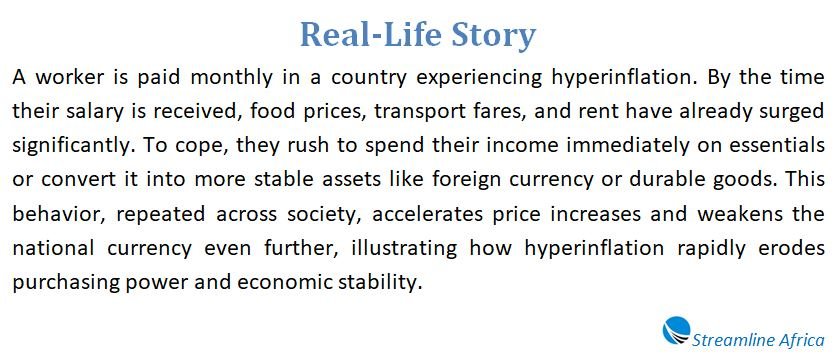
Hyperinflation devastates economies at every level. For households, the immediate impact is the collapse of purchasing power. Salaries fail to keep up with soaring prices, leaving families unable to afford groceries, rent, or healthcare. People may hoard essentials out of fear that prices will rise again tomorrow, which only worsens shortages.
Banks suffer too. As citizens lose confidence in the currency, they may stop depositing money, leading to financial system breakdowns. Governments collect less tax revenue because businesses falter and citizens cannot pay, undermining public services.
Over time, barter systems may re-emerge, with people trading goods directly when currency becomes meaningless. Such conditions destabilize societies, often leading to political unrest and mass migration.
Lessons from History
Several historical episodes demonstrate just how destructive hyperinflation can be.
Hungary after World War II
Between 1945 and 1946, Hungary experienced the worst hyperinflation in recorded history. Prices doubled every 15 hours at its peak. Wages became meaningless, and people carried wheelbarrows of currency just to buy bread. Stability only returned once the government abandoned its collapsing currency and introduced a new one.
Yugoslavia in the 1990s
In the early 1990s, Yugoslavia faced one of the most notorious cases of hyperinflation. Political turmoil, war, and poor monetary policy combined to destroy the economy. Inflation rates reached hundreds of millions of percent per month, forcing people to rely on bartering and foreign currencies to survive. Eventually, the adoption of the German mark helped stabilize the situation.
Zimbabwe in the 2000s
Zimbabwe’s crisis began in the late 1990s when government mismanagement, drought, and costly political programs weakened production. By 2007, the inflation rate reached nearly 100% per day. Citizens fled the country, businesses collapsed, and the Zimbabwean dollar became worthless. Only after abandoning its currency and adopting foreign ones did the economy regain some measure of stability.
These cases underscore that hyperinflation is not just an economic failure but also a social and political catastrophe.
Can Hyperinflation Happen in the U.S.?
Although hyperinflation is possible in theory, it is highly unlikely in the United States or other advanced economies. Central banks like the Federal Reserve have tools to control inflation, including raising interest rates or reducing the money supply. For example, in the early 1980s, Fed chair Paul Volcker dramatically increased interest rates to curb double-digit inflation. The move triggered short-term recessions but successfully stabilized prices.
While the U.S. may face higher-than-normal inflation at times, the safeguards built into its financial and political systems make a Zimbabwe-style collapse improbable.
Protecting Personal Finances During Inflationary Times
Even if hyperinflation is unlikely in most developed economies, ordinary inflation can still erode savings and purchasing power. Individuals can take steps to cushion themselves:
- Diversification: Spreading investments across different asset classes—such as stocks, real estate, and commodities—reduces risk.
- Tangible assets: Hard assets like gold, silver, or real estate often hold or gain value when currencies weaken.
- Treasury Inflation-Protected Securities (TIPS): These government bonds adjust their principal value with inflation, offering a safeguard against rising prices.
- Inflation-focused funds: Mutual funds and ETFs tied to commodities or inflation swaps can also help protect wealth.
Building a financial plan that accounts for inflationary risks can help households remain resilient even when prices rise quickly.
Broader Impacts on Economies and Societies
Hyperinflation reshapes economies in ways that go beyond individual hardship. Businesses face planning nightmares, as costs and revenues become unpredictable. International investors lose confidence, leading to capital flight. Governments may struggle to pay debts or maintain public order.
On a societal level, hyperinflation often widens inequality. Wealthier citizens may protect themselves by moving assets abroad or investing in durable goods, while poorer families suffer disproportionately. Over time, trust in institutions collapses, and political unrest becomes more likely.
Warning Signs and Prevention
While hyperinflation rarely appears overnight, warning signs can accumulate. Persistent high inflation, unsustainable government borrowing, uncontrolled money printing, and political instability can all point toward rising risks.
Prevention relies on credible monetary policy and fiscal responsibility. Central banks must maintain independence, avoid financing deficits through excessive money creation, and ensure that supply and demand remain balanced. Strong governance, transparent institutions, and diversified economies provide further resilience.
The Worst Case in History
Of all the examples, Hungary’s post-war hyperinflation remains the most extreme. At its height, prices rose 207% per day. People were forced to abandon currency altogether, relying instead on direct exchange of goods. This episode remains a stark reminder of the destructive power of uncontrolled inflationary spirals.
Final Take-Home
Hyperinflation is one of the most damaging economic events a nation can endure. It destroys trust in money, paralyzes financial systems, and leaves citizens struggling to survive. Although rare, it is often the result of reckless monetary policy, weak governance, and external shocks.
For individuals, understanding hyperinflation is not merely an academic exercise. While the likelihood may be low in developed nations, preparing for inflationary pressures by diversifying assets and safeguarding purchasing power is wise. For governments, the lesson is clear: maintaining discipline in fiscal and monetary policy is essential to avoid the chaos that unchecked inflation can bring.
Commonly Asked Questions about Hyperinflation
How is it different from normal inflation?
Normal inflation is gradual and often targeted at 2–3% annually, while hyperinflation can make prices double within weeks or even days.
What usually causes hyperinflation?
It often comes from excessive money printing without matching economic growth, combined with demand for goods outstripping supply.
How does hyperinflation affect people’s daily lives?
Salaries lose meaning, groceries and rent become unaffordable, savings vanish, and people may resort to hoarding or even bartering.
Can banks and governments function during hyperinflation?
Banks struggle because people stop depositing money, while governments collect less tax, leading to public service failures.
What are some historical examples?
Hungary after World War II, Yugoslavia in the 1990s, and Zimbabwe in the 2000s all faced hyperinflationary collapse.
Could hyperinflation happen in the U.S.?
It’s highly unlikely because the Federal Reserve has strong tools to control inflation, though the country can still face periods of high inflation.
How can individuals protect their finances?
Diversifying investments, holding tangible assets like real estate or gold, and using inflation-protected securities can help preserve value.
What are early warning signs of hyperinflation?
Persistent high inflation, uncontrolled government borrowing, excessive money printing, and political instability are red flags.
Why is hyperinflation so dangerous for societies?
It destroys trust in money, widens inequality, causes social unrest, and can destabilize entire governments and economies.