
Accounting for income taxes plays a crucial role in presenting an accurate picture of a company’s financial health. The international standard that governs this area is IAS 12 — Income Taxes, which explains how organizations should recognize and measure both current and future tax obligations. While taxes may seem like a straightforward cost of doing business, the accounting behind them often involves timing differences, tax planning strategies, and adjustments that affect financial reporting over multiple periods.
Consider the example of Riverside Engineering Ltd, a manufacturing firm based in Brisbane, Australia. At the end of its financial year, the company calculates the tax it owes on its profits. That immediate obligation represents current tax. However, Riverside may also face future tax consequences because certain expenses or revenues are treated differently in accounting records compared to tax regulations. These differences give rise to deferred tax, which IAS 12 requires companies to recognize and measure properly.
The main objective of IAS 12 is to ensure that financial statements reflect both the current tax payable and the future tax effects of transactions already recorded. This approach allows investors, regulators, and other stakeholders to understand not only what a company owes now but also what it may owe—or recover—in the future.

Current and Deferred Taxes
IAS 12 separates income tax accounting into two key components: current tax and deferred tax.
Current tax represents the amount of income tax payable or recoverable for the present and previous reporting periods. For example, HarborTech Solutions, a software company operating in Vancouver, Canada, may calculate a tax liability based on profits earned during the year. The amount recognized in the financial statements is measured using tax rates that have already been enacted or effectively approved by government authorities by the end of the reporting period.
Deferred tax, on the other hand, arises because accounting standards and tax regulations do not always treat transactions the same way. Imagine that HarborTech purchases specialized servers for $200,000. In its accounting records, the servers may be depreciated evenly over five years. However, the tax authority might allow a larger portion of the deduction in the first year. This difference in timing creates what IAS 12 calls a temporary difference between the asset’s carrying amount in the financial statements and its tax value.
These temporary differences eventually reverse in future periods, and IAS 12 requires companies to recognize their tax consequences today through deferred tax assets or liabilities.
Deferred Tax Liabilities
Deferred tax liabilities represent taxes that a company will likely have to pay in the future because of taxable temporary differences. These differences arise when the carrying value of an asset or liability in financial statements exceeds its value for tax purposes.
For instance, BlueWave Logistics, a shipping company in Singapore, may recognize revenue earlier in its accounting records than for tax reporting. Since the tax authority will eventually tax that income later, the company records a deferred tax liability to reflect the future obligation.
However, IAS 12 identifies three situations where a deferred tax liability is not recognized.
The first occurs when the temporary difference arises from the initial recognition of goodwill in a business acquisition. Goodwill itself does not usually generate tax deductions, so recognizing deferred tax for it could distort financial results.
The second exception involves situations where an asset or liability is initially recognized in a transaction that affects neither accounting profit nor taxable profit at the time of the transaction, provided the transaction is not part of a business combination.
The third exception relates to investments in subsidiaries, branches, associates, or joint arrangements. If a company can control when the temporary difference reverses—for example, by deciding when to distribute profits—and it is unlikely that the difference will reverse in the foreseeable future, the deferred tax liability does not need to be recorded.
These exceptions help ensure that companies do not recognize obligations that may never materialize.
Deferred Tax Assets
Deferred tax assets represent future tax benefits. They arise when a company has deductible temporary differences, unused tax losses, or unused tax credits that can reduce taxes in future periods.
Take the example of Northern Fields Agriculture, a grain exporter in Argentina. During a challenging year marked by drought, the company reports a financial loss. Tax laws allow that loss to be carried forward and offset against profits in future years. Because those losses can reduce future tax payments, the company may recognize a deferred tax asset.
However, IAS 12 requires caution. A deferred tax asset can only be recognized if it is probable that the company will have sufficient taxable profit in the future to use the benefit. Without expected profits, the tax deduction would never be realized.
Two notable exceptions apply here as well. Deferred tax assets are not recognized for certain temporary differences that arise during the initial recognition of assets or liabilities when the transaction affects neither accounting profit nor taxable profit. In addition, deferred tax assets related to investments in subsidiaries or associates are recognized only when the reversal of the temporary difference is expected in the foreseeable future and taxable profit will be available.
Organizations must also reassess unrecognized deferred tax assets at the end of each reporting period. If business conditions improve and profitability becomes likely, those assets may then be recorded.
Measurement of Deferred Tax
Deferred tax assets and liabilities are measured using the tax rates expected to apply when the temporary differences reverse. These rates must be based on laws that have already been enacted or substantially enacted by the reporting date.
For example, if the government of New Zealand passes legislation reducing the corporate tax rate effective next year, companies preparing financial statements today would use the new rate when calculating deferred tax amounts expected to reverse after the change takes effect.
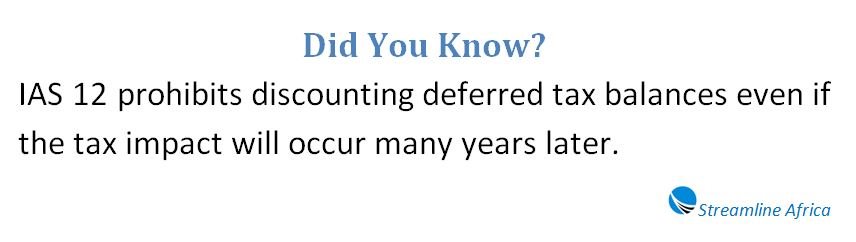
Another important principle is that deferred tax balances are not discounted. Even if the reversal occurs many years later, the value is not adjusted for the time value of money.
The measurement must also reflect how the company expects to recover or settle the carrying amount of its assets and liabilities. For example, if a real estate company such as Everstone Property Group holds an investment building measured at fair value, the standard presumes that the asset will be recovered through sale rather than use. This assumption affects how the tax consequences are calculated.
Read Also: Tax Planning vs. Tax Fraud: Understanding the Legal Line
Presentation of Current and Deferred Tax
IAS 12 also explains how income tax should appear in financial statements. In most cases, both current tax and deferred tax are recognized as part of profit or loss for the period.
However, if the tax arises from a transaction recorded outside profit or loss—such as an item recognized directly in equity or in other comprehensive income—the related tax effect must also be recorded in that same area.
For instance, if Lakeshore Energy Plc revalues land and recognizes the gain in other comprehensive income, the associated tax effect must also appear there rather than in profit or loss.
Another presentation rule is that deferred tax assets and liabilities are classified as non-current items in the statement of financial position. This classification reflects their long-term nature, since they relate to differences that reverse in future periods.
History of IAS 12
The development of IAS 12 reflects decades of refinement in international accounting practice. The earliest step occurred in April 1978, when an exposure draft on accounting for income taxes was released for public comment.
In July 1979, the first version of IAS 12 was officially issued, establishing guidance on how companies should report tax obligations. Over time, the standard underwent several revisions as global accounting practices evolved.
During the late 1980s and early 1990s, new exposure drafts and structural updates were introduced to improve clarity and consistency. A major milestone occurred in October 1996, when a revised version of IAS 12 was issued, becoming effective for financial statements covering periods beginning on or after 1 January 1998.
Subsequent updates addressed specific issues such as the tax consequences of dividend payments, the treatment of deferred tax related to underlying assets, and the recognition of deferred tax assets for unrealized losses.
In 2017, an important interpretation called IFRIC 23 was introduced to clarify how companies should account for uncertainty in income tax treatments. More recently, amendments in 2021 addressed deferred tax related to assets and liabilities arising from a single transaction.
A significant development occurred in May 2023, when IAS 12 was amended to incorporate aspects of the global OECD Pillar Two tax reforms. These rules aim to ensure that multinational corporations pay a minimum level of tax across jurisdictions. The amendment introduced an exception allowing companies not to recognize or disclose certain deferred tax effects related to these new global tax rules, while requiring disclosure that the exception has been applied.
Related Interpretations
Several interpretations complement IAS 12 and provide additional guidance in specialized circumstances.
One such interpretation explains how tax accounting interacts with financial reporting in hyperinflationary economies, while another addresses the complexities of uncertain tax positions where the outcome of a tax treatment may be disputed by authorities.
Additionally, guidance exists for situations where a company’s tax status changes—for example, when an enterprise transitions from a taxable entity to a tax-exempt structure or when shareholders’ tax treatment changes.
Amendments Under Consideration
At present, there are no active amendments under consideration by the International Accounting Standards Board (IASB) related specifically to IAS 12. However, the standard continues to evolve as global tax systems change and multinational business structures grow more complex.
Related Items and Projects
IAS 12 is connected to a variety of broader accounting initiatives and improvement cycles within international financial reporting. These projects have explored issues such as deferred tax recognition for unrealized losses, tax implications of asset recovery, and accounting for tax uncertainties.
Together, these ongoing efforts ensure that IAS 12 remains relevant in a world where tax laws, cross-border transactions, and corporate structures are constantly evolving.
Ultimately, the standard serves a critical purpose: helping organizations present transparent and reliable information about the taxes they owe today and the tax consequences that may arise tomorrow.
Frequently Asked Questions about IAS 12
What Is IAS 12 and Why Does It Matter in Financial Reporting?
IAS 12 is an international accounting standard that explains how organizations should account for income taxes in their financial statements. It ensures companies report both the taxes they currently owe and the future tax consequences of their transactions. By doing so, it helps investors, regulators, and stakeholders understand a company’s true financial position.
What Is the Difference Between Current Tax and Deferred Tax?
Current tax refers to the amount of tax a company must pay or recover based on its taxable profits for the present or previous financial period. Deferred tax, however, arises when there are timing differences between accounting rules and tax regulations, creating tax effects that will occur in future periods.
What Are Temporary Differences in IAS 12?
Temporary differences occur when the value of an asset or liability in the financial statements differs from its value for tax purposes. These differences eventually reverse over time and create deferred tax assets or deferred tax liabilities.
What Is a Deferred Tax Liability?
A deferred tax liability represents taxes a company is expected to pay in the future because of taxable temporary differences. These usually arise when income is recognized earlier in accounting records than in tax calculations, meaning taxes will be paid later.
Are There Situations Where Deferred Tax Liabilities Are Not Recognized?
Yes. IAS 12 outlines certain exceptions. Deferred tax liabilities are not recognized when they arise from the initial recognition of goodwill, when the initial recognition of an asset or liability does not affect accounting or taxable profit, and in some cases involving investments in subsidiaries or associates where the timing of reversal can be controlled.
What Is a Deferred Tax Asset?
A deferred tax asset represents a future tax benefit. It occurs when a company can use deductible temporary differences, unused tax losses, or tax credits to reduce taxes in future periods.
When Can a Company Recognize Deferred Tax Assets?
Deferred tax assets are only recognized when it is probable that the company will generate enough taxable profit in the future to use those benefits. If future profits are uncertain, the asset may not be recorded.
Why Must Deferred Tax Assets Be Reassessed Each Year?
Business conditions can change over time. IAS 12 requires companies to review unrecognized deferred tax assets at the end of each reporting period to determine whether they have become usable due to improved profitability.
How Are Deferred Tax Assets and Liabilities Measured?
They are measured using the tax rates expected to apply when the asset is realized or the liability is settled. These rates must be based on tax laws that have already been enacted or substantially enacted by the end of the reporting period.
Are Deferred Taxes Discounted Like Other Long-Term Liabilities?
No. IAS 12 specifically states that deferred tax assets and liabilities should not be discounted, even if they will reverse many years in the future.
How Are Income Taxes Presented in Financial Statements?
In most cases, current and deferred taxes are recorded as an expense or income in profit or loss. However, if the related transaction is recorded outside profit or loss, such as in equity or other comprehensive income, the tax effect is reported in the same place.
Why Is IAS 12 Important for Investors and Businesses?
IAS 12 improves transparency by showing both present and future tax effects in financial reports. This allows stakeholders to better evaluate a company’s financial performance, sustainability, and potential tax obligations.